|
|
|
|
Music Reviews from the Staff of the Poison Pie Publishing House
|
|
 April 23, 2026
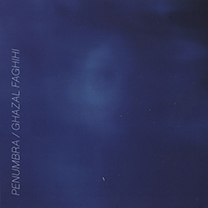
Penumbra - Ghazal Faghihi
Label: Relative Pitch Records
Catalog #: RPRSS051
Location: New York, United States
Release Date: May 22, 2026
Media: compact disc or digital download
bandcamp.com entry
discogs.com entry
The latest entry in the Relative Pitch Records Solo Series (RPRSS) features clarinetist and improviser, Ghazal Faghihi. The musician is new to our ears, a recurring theme of RPRSS and one of its appeals. It takes some effort for listeners, dedicated to the pursuit of hearing new voices from the cultural margin, to find reliable avenues in which such encounters occur. This series is one of them.
As we listened, we searched for some background on the musician. We found a curriculum vitae online and learned that Ghazal Faghihi is an Iranian woman who, though classically trained, regards herself as an improviser. She has earned (at least?) three Master's degrees in Music, the first from Boston University (2020) and the latter two from the Royal Academy of Fine Arts (KASK) in Ghent, Belgium in clarinet performance (2023) and contemporary music (2025). Her music explores the electro-acoustic intersection of historical clarinets and modern electronics. Penumbra is her debut release.
The term penumbra describes the partially shaded space between full shadow and light. We look to the title to guide our interpretation of the music. Is it intended to suggest a blending of two elements—shadow and light—as in acoustic and electronic instruments? We don't feel very confident about this hypothesis. Alternatively, the penumbra can be thought of as a transitional space. The implication of the title depends upon the direction of movement. If one moves from the light into the penumbra, it is a kind of withdrawal into hiding. On the other hand, if one moves from darkness into the penumbra, it is a guarded emergence or partial revealing of oneself. Maybe all these things at once, or none of them. The ambiguous multiplicity of interpretations is amenable to the music on the album.
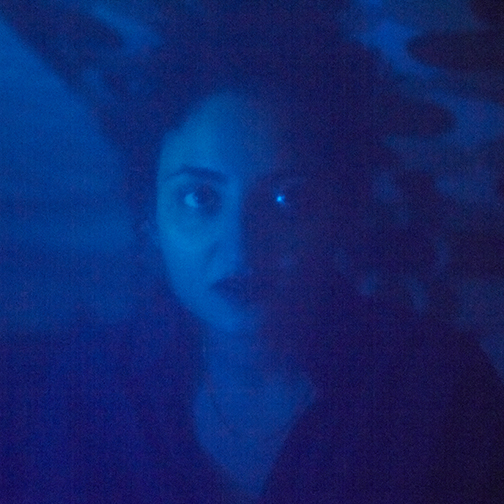
photo credit: Sarah Jacques
We don't know anything about the historical clarinet. Her CV introduces us to a new word chalumeau, a single reed pipe regarded as a predecessor to the modern clarinet. The album credits Faghihi with multiple instruments: Bb (B-flat) clarinet, historical clarinet, objects, shruti box, electro-acoustic and interactive electronics. On some tracks, e.g. In Remembrance of the Memory or Ismail, we hear drums too. Presumably, she plays everything, as no other artists are listed. In these reviews, the staff of the Poison Pie Publishing House have no compunction against revealing the full extent of our music ignorance. So, we won't start now. Our ears cannot tell which of the 13 tracks feature the Bb clarinet and which the historical clarinet. Surely, there are better educated musicians for whom the difference is immediately apparent.
Despite these uncertainties, we yet have something to say. Unlike most of the RPRSS releases, these tracks appear to be multi-tracked with separate recordings of the clarinet and the accompanying percussive objects, shruti box or electronics. In the improvisations, the clarinet is played to generate a characteristic sound of the instrument, as opposed to an extended technique where it may be hard to recognize the instrument based on the recorded sounds. The notes are languid, the pace unhurried. The titles of the tracks, Siesta or Drifting reinforce this notion. A hallmark of non-idiomatic improvisation is the balance of consonance and dissonance. On Penumbra, we hear the clarinets as the champions of consonance and the accompanying instruments as the source of dissonance. The other instruments play the supporting role, though at times their volume rises to equal that of the clarinet.
By nature, we try to attune ourselves to be receptive to the message that the musician is communicating through instrumental music. We acknowledge that some musicians are adamant that "the music is the message", a sentiment which we wholly accept, while at the same time allowing for additional content, be it musical or philosophical, inserted by musician or listener, buried within music or floating outside it. In any case, the message is part of the music for us and we went looking for it on Penumbra.
The album opens with a track titled After Nothing, which means to us that the music starts with a movement from darkness into light, a music predicated on a history that is not part of this document and remains unknown to the listener. The album closes with Nothing After, a perhaps humorous announcement that the album is over. We hear in the music between beginning and end an opaque thoughtfulness. Should we demand greater clarity on the matter? Upon reflection, we appreciate the discreet restraint of Ghazal Faghihi for it isn't as if we would have preferred a soul-bearing confession. The subtlety of the delivery is an intrinsic element of the aesthetics of the music.
personnel:
- Ghazal Faghihi (Bb clarinet, historical clarinet, objects, shruti box, electro-acoustic and interactive electronics) (social media)
|
|
|
Related Reviews from the Poison Pie Publishing House
- Relative Pitch Records Solo Releases
- Taking Place - Adia Vanheerentals (December 5, 2025)
- Plank 9 - Berlinde Deman (December 5, 2025)
- Monophonic - Maria Bertel (May 17, 2024)
- silver dawn - Zosha Warpeha (March 11, 2024)
- Una Ofrenda A La Ausencia - Camila Nebbia (August 22, 2023)
- Goodbye Ground - Sakina Abdou (December 22, 2022)
- MUTABLE - Don Malfon (December 22, 2022)
- Look Like - Kelsey Mines (October 15, 2022)
- Trasluz - Amidea Clotet (August 18, 2022)
- Fukiya - Masayo Koketsu (June 3, 2022)
- a grain of Earth - Marta Warelis (May 27, 2022)
- refuge - Alexandra Grimal (May 13, 2022)
- Prismatist - Robbie Lee (December 14, 2021)
- Hi Hello I'm Signe - Signe Emmeluth (November 1, 2021)
- Tremble - Hermione Johnson (November 23, 2020)
More music reviews from the Poison Pie Publishing House
|
|
|
|
