February 13, 2026
We Are. Profoundly. Predisposed. To Drowning. - Anne Efternøler with Maria Laurette Friis and Johanna Borchert
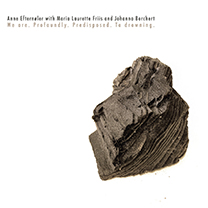 Label: Relative Pitch Records
Catalog #: RPR1246
Location: United States
Release Date: February 20, 2026
Media: compact disc or digital download
bandcamp.com entry
discogs.com entry
We Are. Profoundly. Predisposed. To Drowning. is the new album by a trio composed of Anne Efternøler on trumpet and Johanna Borchert on piano with the voice of Maria Laurette Friis.
Instrumental music is certainly capable of conveying messages—kinetic, emotional and some suggest intellectual—without resorting to words, absent lyrics, absent even a title. However, the presence of a title can provide an influential guide to the interpretation of the music. Two historical examples come to mind. When Pauline Oliveros created her bog music with titles Alien Bog, Big Slow Bog and Mind Bog to name but a few, the electronic blurps, crackling and undulations placed the listener decidedly in the middle of a bog. It's unknown whether the music without the prompt of the title would have had the same effect. Another example is the instrumental, religious music of Ákos Rózmann, who gave pieces titles such as Helvetets Övergivande (The Abandonment Of Hell) and Det Svarta Hålets Innehåll Och Liv (The Contents And Life Of The Black Pit). These titles put the listener in a frame of mind where it is hard to find peace or joy in the music.
In the album under review, We Are. Profoundly. Predisposed. To Drowning., the title focuses the attention of the active listener in a particular direction. The most obvious feature of the title is the contradiction in the juxtaposition of predisposition and drowning. In the vast majority of cases, drowning is an unintentional tragedy. Yet, the musicians insist on this contradiction in two ways. First, they add the adverb profoundly to remove any doubt. Second, they punctuate with not one but four periods to emphasize the finality of the statement. A listener struggles to find any ambiguity or flexibility in the interpretation of the title.
So, as we listened to the music, we began to think of cases of intentional drowning. A couple different situations came to mind. The first is of mothers who suffer such depression and disillusionment with the world that they drown their children. From time to time, newspapers report stories of mothers living near coasts who drown their children in the tides of the ocean, while mothers who live in rural parts drown their children in farm ponds. Sometimes, but not always, the mother drowns herself as well. Another example of intentional drowning involves animals. When rodents and other vermin infesting basements or attics are captured live by exterminators, they are removed from the premises. Often the standard practice is then to drown the creatures. This solution offers two advantages: there is no cost associated with it and it is a relatively quick, humane death compared to alternatives.
These two examples are more or less the extent of our knowledge regarding intentional drowning. A sense of morbidity cannot be dismissed. Those of us with a predilection toward gloom have learned to hide it in polite company, for we do not want to be the cause of darkening another's doorstep. However, it is the rightful duty of the artist to state truth without pretense or dissembling. Consquently, we sought to listen to the music of Efternøler, Borchert and Friis in this light.
As a point of clarification, we think of the music as instrumental because the voice of Friis is not used to utter words but is rather itself a non-verbal instrument. To our ears, the music takes the form of a freely improvised trio participating in a non-idiomatic collaboration. This is a favorite musical vehicle of the PPPH staff, appreciated for the breadth of its possible expressions. As is not unusual for music of this kind, the performers explicitly rely on neither melody nor rhythm to carry the music. We fall back to characteristic measures of non-idiomatic improvisation—density, chaos, ferocity, the balance between harmony and dissonance. The music is not especially dense. Often only one or two musicians are heard at a time. There are gaps of measured silence essential to the setting the mood. As to whether, one might describe the music as chaotic, it doesn't immediately demand to be described in that way. The piano is contemplative. For much of the album, the voice is a hum, though at other times it is emerges in a shout or grating yowl. Likewise, the trumpet sometimes emits long, clear notes from a measured breath while at other times is played to generate undeniably non-traditional trumpeting sounds. The music is not a brash display of three musicians demonstrating the independence of their respective techniques. On the contrary, the musicians play together, supportively responding to each other.
We feel fairly certain that were we to listen to this music without knowledge of the title, we would not think of a profound predisposition to drowning. The music is clever and creative. It fluidly changes in style. We do not hear the exhaustion to failure of a mother who finds no better refuge for her children from the world than the watery oblivion of death. Nor do we hear the resolute drowning of the exterminator who is obligated to prevent the beasts from returning to their nest and has developed a mechanical mindset that protects himself from the mental toll of repeated drownings.
That, we suppose, is the puzzle in this music. Unlike the titles of Oliveros or Rózmann, we were not able to hear this music in the light that the creators intended. Almost certainly, there is more to the mystery than we were able to decipher. Nevertheless, we harbor a perverse fondness for impenetrable music, so our failure to understand it endears the music to us. We like to remind ourselves that we could not understand or really appreciate the music of Derek Bailey for ten years after our introduction but we kept coming back to it until something clicked. There is at least one proverbial slow learner among the staff of the Poison Pie Publishing House.
We suppose (it is almost a certainty) that there exist listeners, possessed of less literal imaginations, who have different expectations of what a predisposition to drowning should sound like and will find it in the music. What can we say except to resort to the cliché, "It takes all kinds to make the world go 'round." So, we encourage like-minded listeners to check the album out and see where they fall.
personnel:
