|
|
|
|
The Poison Pie Publishing House presents:
|
|
|
|
 |
|
|
|
|
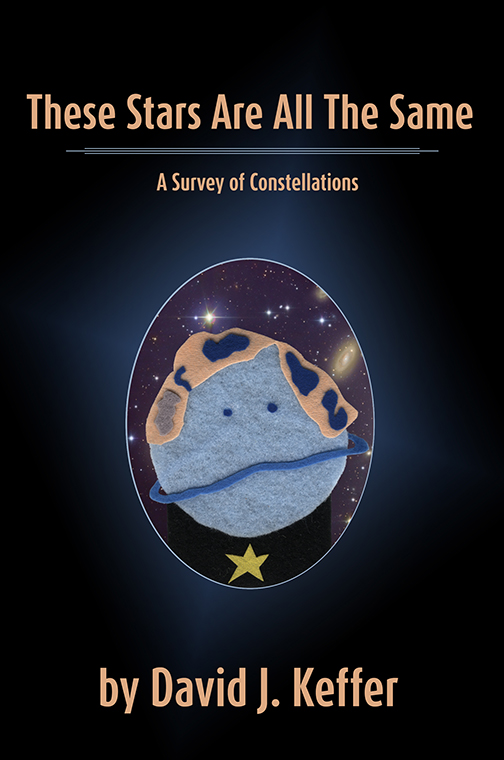
These Stars Are All The Same
A Survey of Constellations
David J. Keffer
|
|
|
|
|
written April-May, 1993
Minneapolis, Minnesota
modestly tinkered with in 2012
Knoxville, Tennessee
Copyright © 2012 David J. Keffer
All rights reserved.
|
|
|
|
|
And still they're all the same to me
These stars all look the same
—Stina Nordenstam
“Alone at Night” from the album “Memories of a Color”, 1992.
|
|
|
|
|
Table of Contents
Boötes link
Canes Venatici, the Hunting Dogs link
Ursa Major, the Great Bear link
Lyra, the Lyre link
Aries, the Ram link
Capricornus, the Sea Goat link
Draco, The Dragon link
Delphinus, the Dolphin link
Hercules, the Laborer link
Hydra, the Water Snake link
Ophiuchus, the Serpent Bearer link
Gemini, the Twins link
Serpens, the Serpent link
Cetus, the Whale link
Orion, the Giant Hunter link
Lepus, the Hare link
Sagittarius, the Archer link
Corvus, the Crow link
Virgo, the Virgin link
Andromeda, the Chained Lady link
Scorpio, the Scorpion link
Perseus, the Champion link
Eridanus, the River link
Cassiopeia, the Lady in the Chair link
Cygnus, the Swan link
Cancer, the Crab link
|
|
|
|
|
Boötes
'Boötes!' was what I was shouting, having found myself in the arctic heavens, amongst the constellations with no clear picture of how to proceed. 'Boötes!' I hollered again. In response, I heard his hunting dogs, Asterion and Chara, barking in the distance. I thought I heard the great bear snarling back at them but that could have been purely the product of my imagination.
'And a fine product it is!' replied Boötes, jumping out from behind a nearby boulder. It is not well known that Boötes was a telepath. He had been persecuted mercilessly in primary school because of this aberration, deemed invasive and uncouth by teachers and peers alike, and thus he had always attempted there-after to keep it secret and to use it as infrequently as possible. The only reason I knew about it was because I went to grade-school with Boötes, a constellation.
Back then Boötes had been an entirely different person, possessed of a certain earthiness of which he was now bereft; he was a happier person then, despite the taunts and jeers of his classmates. He had had his heart set on becoming a farmer, as a kid. It wasn't until much later on that Boötes settled for bear-hunting and he was never fully able to reconcile himself to it.
On that afternoon of my first day in the heavens, Boötes wasn't looking well; his full beard had become unruly, circles sagged beneath the eyes whose pupils were dull and lifeless. The club he ordinarily swung with vigor was instead serving as a walking staff as he hobbled over. It had been more than a few years since I had last spoken to Boötes but I had seen him every night, starry-eyed and glowing, nothing like this animated cadaver approaching me.
'You let your dogs loose!' I knew Boötes, the great bear hunter, always followed his dogs on the hunt.
'I know,' he sighed, settling on the stump of a tree trunk and folding his arms across his lap. 'I have lost my fervor for the hunt.' He made the admission with gravity and grace.
I wasn't altogether surprised by what I was hearing, knowing the Boötes of old, knowing how much he had cherished the chores of tending the earth. Besides, I could imagine that the endless hunting of bears, in fact of any variety of creatures at all might wear on one's nerves as the eons passed.
'It's only too true,' Boötes admitted, reading my thoughts. 'I never wanted to be a hunter. In fact, I never wanted to be a constellation. It's all my mother's fault. She couldn't leave well enough alone.'
I opened my heart to my suffering friend. It had been my role for so long; it was as natural now as shining up here in space. Even back in school, Boötes had hid behind my broad back from the ridicule of our peers who called him, 'Boots' much to his shame. In a moment of weakness, when Boötes could take no more of the childish torment, his brother had robbed him of all his goods and evicted him from the family home.
Betrayed by even his own blood, Boötes had decided to drop out of school and I followed him. We wandered about down on earth, pleasure-seeking, hardship-enduring, traveling from village to village and lurking between the villages as well. As often as not, the excitement we discovered was to be found between the villages. We slept beneath the stars in whatever field or forest we grew weary. Our favorite refuges, though, were swamps. Countless miles we poled in our pirogue past breathing cypress knees, beneath dangling Spanish moss, over stagnant glades reeking of methane, and through clouds of mosquitoes. Those were the sorts of days into which our youth extended itself. The damp rot of marshes prolonged our inevitable fall into maturity. Those were the kind of days when you could find solace in a swamp, in any place really, so long as it was devoid of inhabitants. Of course, we weren't in strict seclusion considering we were there together, but then again, as they say, you always have to make exceptions for your friends and compromises for your family.
If it was destined for Boötes to become a constellation then he should have been placed in the heavens then, I think, when he still was capable of amazement and wonder when encountering the world. For Jupiter to place him up here only after his heart had grown embittered and his vision jaded, when he longer could relish the myriad of glories which swept beneath his gaze from this celestial vantage point, was no less than a dirty trick and one for which Boötes suffered immensely and continuously, that is until last night.
I can't say that I don't blame his mother either. Callisto thought herself so clever. She thought to lure him back home once his brother had abandoned her. And right she was. Clothed only in a scanty bathrobe, leaning onto the window sill, she wept into the wind. It worked; Boötes, paragon of filial piety, foolishly sped to her beckoning. He spent those years being ground into salt by his sniveling, whimpering mother, though he never betrayed by word or sign any hint of unhappiness. When I would visit him I would find him out in the fields or in the pastures, tending to their farm. The sun had changed the color of his face. I pleaded with him to resume his idyllic voyages with me. I swear his face would pale then, the years of labor tanning his flesh would drain from his cheeks, he'd tilt his hat back, and relive, in a breath, our youthful excursions through the swamps. With a single exhalation, the color would return and he would once again be Boötes, loyal son and farmer. Indeed, Boötes' first love was farming and his mother's poor treatment did not deprive him of the joy he found in working the fields.
I wasn't there for the plow episode. I'm glad I wasn't too; I heard it was nasty and some regrettable things were said. I do miss, however, the fact that I never got to say goodbye. That's what I'm here for now.
'How'd you get up here?' Boötes asked, 'What infernal miracle did you perform? What contraption did you create? Who did you have to sleep with to get placed in the heavens as a constellation?' (These reasons were the usual grounds for being granted immortality among the stars.)
'Oh, come on,' I replied, 'It can't be all that bad.' I seated myself on the ground near the stump. Boötes pulled a pouch from his belt and withdrew a pinch of tobacco which he stuffed in his pipe. From a distance, we listened to the yelping and crooning of his dogs immersed in the frenzy of the hunt.
'It's that bad,' Boötes admitted, 'Do you know what I have been doing up here in space ever single night without fail, regardless of whether you folk down on earth can see through the haze of clouds or not?'
Of course I knew; Boötes occupied a prominent position in the heavens. How could I have had eyes and not known? How could I have drunkenly stumbled home from this bar or that bar night after night and not accidentally looked up and come face to face with my old friend, stuck in the stars, chasing that damn great bear, driving it around the north pole with his club, ceaselessly? I had often wondered why Boötes never advanced for the killing stroke.
'Can't kill the stupid bear. That's the one thing Jupiter said to me was, 'Boötes, don't you kill that stupid bear.' So there I was on display with a great bear for the entire world to watch pointlessly revolving. Our pathetic routine, the bear and mine, was like a galactic carousel, never gaining or losing ground, the dogs never cornering it, the bear never turning and confronting us, just spinning around the pole to the insidious merry-go-round music of time. I told Jupiter it was demeaning and I would prefer to abstain. He told me it was an astrological parable explaining the futility of existence to the creatures on earth. He told me it was like I was telling them, 'See, even in heaven, you get the run-around, even where the gods dwell, you waste a lot of time, and don't get recognized for your efforts.' I told Jupiter I wanted to convey no such message. I told him that was a depressing parable and why couldn't I rather tell the one about all the demons getting funneled into a herd of pigs and then all of them running into a lake to drown? Jupiter claimed ignorance of that parable and wouldn't budge.'
'I could only put up with it so long. I could only continue the mockery of myself and the betrayal of my principles for so long. I won't do it anymore. Now I'm hiding.'
This was the Boötes with whom I was educated. Now as then, he held the unerring belief that he could escape his troubles by hiding. Then the swamps had been our sanctuary, later the fields, now the corners of heaven. Hide! I hoped this was an indication that he had not been permanently scathed by the eons of bear-driving.
Boötes paused and lit his pipe. 'I mean I had no idea at the time that something as simple as a plow was going to get me into all this trouble. When I first showed my mother the plow, she was so impressed she insisted on running up Mount Olympus and announcing to Jupiter my accomplishment. I just shrugged. It was only a plow. Just a piece of metal you hooked up to a couple oxen and dragged through the dirt. No fancy deal. Other mortals had created devices and not gotten placed in the stars for it. Take the shovel for example. Somebody had to make the shovel and there's no shovel constellation. Take the scythe, the hammer, the deck of cards. You don't find any of those in the heavens. How was I supposed to know?' Boötes glared at me.
'Well, you can read minds, I mean, maybe you could have figured it out,' I conjectured much to Boötes' dismay.
He straightened his back as he sat on the stump and shouted, 'A plow! Jupiter came down to the farm and asked to see the plow. I showed it to him. How could I not, he was king of the gods? He wanted to see it and I showed it to him, the first plow ever, made by me. Callisto really thought it was something else, she told Jupiter, right there in front of me that I had always suffered at the hands of my classmates in school and then at the thieving hands of my brother and now, I should be placed in the stars for inventing the plow. I thought the whole idea preposterous and was embarrassed that my mother had even brought it up. Jupiter, however, had entirely different plans in mind. He took me aside and said, 'Boötes, you remember when Prometheus took the fire and gave it to man? You remember how I had him chained to a mountain and loosed a pair of buzzards to tear out his liver everyday and then heal it over night? I was not happy about that, the loosing of fire. If I had wanted man to have fire I would have given it to him myself. I would've burned the whole goddamn world down if I had wanted man to have fire. What that whole incident amounted to was a lot of pain and suffering and one less distinction to be drawn between mortals and gods. We gods had only a few things left which man could not claim: cold fusion, faster than light travel, immortality, and the plow, come to mind at the top of the list. And now, I have to go home, back to my palace, back to my screaming, hysterical wife and cross plow off the list. Rather than shame you for all eternity and upset your mother who has been a good neighbor to me all these years, I'm going to put you in the stars, as a bear hunter, a vocation in which you have no natural ability and will therefore be doubly unlikely to make any further 'inventions'. You should consider yourself lucky there are no buzzards in space.''
I had never heard this version of the story and was shocked as you can well imagine.
'I was shocked too!' Boötes exclaimed. 'Over a plow. Right then and there I got zapped. Next morning I woke up with this bear growling over me and I started chasing it with a club I found nearby. I didn't realize until later that I was a constellation, that I was doomed.'
'But you weren't there last night. It caused quite a ruckus down on earth.'
'Like I said, I could only put up with it for so long. I'm through.' Boötes gazed contemplatively toward the pole. 'Is that why you came up here? To see if I was alright?'
'Sure, man. We didn't make blood pacts in those mosquito ridden wastes for nothing.'
Boötes grinned at me. 'How'd you get up here?'
'Well, since there was no chance of a god getting me placed up here, I had to sneak up, risking no less than life and limb.'
'And now that you're up here, what do you think?' Boötes jumped to his feet and leapt atop the stump. He swung his arms about the great expanse of space. 'What do you think?'
'It's got a nice view, man.'
'No kidding. The best,' Boötes agreed. We took a silent moment to appreciate the highly praised view. Looking down on the Aurora Borealis, looking across at the other constellations, but averting our gaze from the hounds still chasing the great bear. 'One day I'm going to kill those dogs. I'm sick of the hunt. I'm sick of those dogs and I want to work the fields again.'
But of course, how could he? How could anyone hide from the gaze of Jupiter, king of the gods? Even for a telepath, it would take constant vigilance.
'I want to deliver the killing stroke to that stupid bear.' Boötes had worked himself up and was lunging about on the stump, grabbing the neck of an imaginary bear, and squeezing the life out of it.
Now my interest was piqued. 'Okay. How do you want to do it? Will there be gunplay? Will there be analogous wordplay to describe the slaughter?' I traveled to the heavens only because my friend Boötes refused to shine last night. But now I was here to witness the butchery of Ursa Major. Hurray and hurrah for adventure!
|
|
|
|
|
Canes Venatici, the Hunting Dogs
'Kill! Kill! Kill! Kill! Kill! Kill! Kill! Kill! Kill! Kill! Kill! All I want to do is kill him, clamp my jaws onto his neck, rend his jugular vein with my teeth, and splash his blood across the horizon.' Asterion sat back on his haunches and sniffed at the air and then at the side of his belly, as dogs are wont to do.
'Who? Boötes?' asked Chara, likewise sitting back, but chewing a clump of poppy leaves. Her mouth had gone numb and saliva crept out of her cheek and dribbled down her face, then fell, swinging on thin viscous tendrils of spit toward the ground.
'No, not Boötes, Hevelius.' Asterion growled out the hated name. 'Although I do have a bone or two to pick with Boötes for stranding us in such a sour pickle.'
'Hevelius was a peon. He was a nomenclaturist, a taxonomist at most, no more. Hevelius was a fool. What could you expect from a seventeenth century astronomer?' Chara barked over at the moon. 'He's dead anyway...certainly, by now.' She checked over her shoulder to make sure they had not roused the great bear who was asleep nearby, enjoying its first rest since Boötes had begun the chase lifetimes ago. 'Forget Hevelius.'
'It doesn't matter. The damage has been done,' Asterion retorted, 'Death is no immunity to this sort of thing. Life is not necessary to participate and death is not sufficient to be excused. Consider us. We weren't even born at the time when Hevelius gathered the ungrouped stars together and first called our names. We were formless masses of enormous quantities of space, defined only by the great bear on one side and Boötes on the other. We were happy embryos without perception, distinction, personality traits. We were unmapped tracts of space, and mysterious in our unchartedness. And what, dear Chara, are we now?'
'Canes Venatici. I'm a bitch and you're a mongrel,' Chara replied as she ran her nose over the ground, feeling for poppy leaves, without opening her eyes, nibbling on one if she found it.
'Christ, Chara,' Asterion wailed, 'Am I to be held accountable for the unenviable situation in which I find myself? I did not call it into being; I didn't summon myself from some far-away perpendicular universe, where I had possibly attained a happiness so perfect that it is unfathomable to me now. I derive no pleasure from this. I have a lot to do today, I have to kill my memory, I have to turn my heart to stone, I have to learn to live again.* All this is merely filling the space between the exciting events which must form the skeletal structure of my life, but which do not exist. I am passing this idle time which is my life. And what am I doing here? Pondering daydreams of the destruction of my creator.'
'Don't get all caught up in the sophistry and rhetoric, Asterion. It's past tense.' Chara rolled over and scratched her back against the sparse patches of grass that populated the principally barren expanse of space.
'How can you shrug off your history so passively?' Asterion howled, emphasizing that he, at least, could not so shrug. 'Can you forgive Hevelius his impertinent assumption that we wanted existence?' The hair on his back bristled up again, showing he at least could not forgive. 'Can you forget so nonchalantly? Do you no longer harbor a grievance against him? Are your thoughts absolutely free of nonplus?' Asterion turned to his partner, who had shifted on her back so that now her belly was directed toward the greatest light, still meager, sunning herself as well as she could. He continued, 'I mean, look at us. We're dogs. Hevelius could have at least had some consideration for the fact that we would spend the rest of eternity up here, until the sweet universe snaps back into a dimensionless spot. He could have made us the constellation of Lovers, for instance. That would be preferable to this. Are you over the initial indignation of being born in the freezing void of space as a dog? Do you deny there might have been a superior incarnation as lovers?'
'Dignity has nothing to do with it. Like any other abstraction you can find it anywhere if you look thoroughly and creatively, under the bed, under the porch, under the shade of a weeping willow, under the guise of submissive disinterest. You can smother dignity for eons and it will still pop back up when you least expect, albeit subdued. I sometimes consider the possibility of a physical relationship between us, but then I consider your hairy muzzled face pressing against my own and I am disgusted. Aside from that, I am ashamed of the inadequacies of my body.'
'What sort of inadequacies?' Asterion asked, mildly interested.
'How can you ask such a question, Mr. Indignation? Inadequacies. Think about it. Think about our lives housed in these shells. In how many ways are our lives inadequate, disappointing, unresponsive to our desires, incapable of providing us satisfactory relief or escape? In every way, my body is inadequate, has failed me. What I want is a body that not only takes this life from me but also gives me more of something else, intangible, like an off-switch, like instant dreamless sleep. I want a body that travels from one universe to another universe to inside a conch shell to on top of a snow cloud to the center of the earth to the center of my heart to a warm, waiting womb to Hevelius. I want a body that would let me climb inside Hevelius' mind and assure myself once and for all that there was no malicious intent in his creation of us, not that it's really a soluble issue, anymore. Mostly just for academic interest.'
'I want one like you said too,' Asterion agreed, impressed, relishing the thoughts of such a carapace.
Chara had already drifted off on a tangent though and she interrupted her companion's thoughts. 'When I think of Hevelius, Asterion, I think of the mortal sitting much as we are sitting, on his haunches, except he's down on the earth. And he's thinking the same thing you are thinking, except he has never been to space. He can't comprehend to him what appears to be endlessly vast. He has no premonition that life in outer space is as vapid and banal as life on earth. He doesn't understand in his quest to organize and label the heavens with his arbitrary collections of stars and projections of animal-like shapes onto them that with each thought he is creating another organism to suffer his same fate, with each outline he draws connecting the dots, he is painting another soul to perish in the fires of hell. He might have drawn us first as geese caught in between the battle of Boötes and Ursa Major. He might have scratched that out and said to himself, 'No geese.' Then he scribbled in cows, sows, butter churns, wrenches, eight cylinder engines, cauldrons of boiling aromatic fats and aborted them all before settling on, think of it!, hunting dogs. That's what we are, Asterion. We were born to suffer so that others would know, not pleasure, but distraction.' At this point, Chara stopped and began chewing on her foreleg.
Asterion watched as she broke through the skin and began to rub the flesh off the bone. 'I'm not distracted, Chara.'
'Don't bother me. I'm releasing natural anesthetics.'
*Borrowed from “The Sentence” by Anna Akhmatova.
|
|
|
|
|
Ursa Major, the Great Bear
Boötes and I waited until it was night on Mount Olympus. We figured Jupiter would either be asleep or out chasing petulant, mortal females. Cautiously, we headed in the direction of the great bear. I wondered if we might be too late as the howling of the dogs and the growling of the bear had ceased some time ago and none of them were shining in the sky. Jupiter was going to be infuriated at Boötes who had instigated the sidereal blackout.
Anyway, we eventually rounded the corner and came upon the snoring bulk of the great bear. Not twenty paces from it, the hunting dogs slept as well, both of their forearms gnawed to the bone.
'Boötes, your dogs are kind of gaunt,' insinuating, I supposed, that it was his fault.
'They're fabled existentialists, you know, and drug addicts to boot. It's difficult to keep them in good health. I do what I can, but really, it's none of my business. As the saying goes, I'm just passing through.'
How I agreed with that. We were just passing through heaven and along the way we were going to stop and slaughter the great bear. Let the sacrifice begin! 'Are you going to kill it in its sleep?'
'No. I've got to ask it a question first,' Boötes replied. He approached the bear with his head hung low.
'Are you sure you want to ask it a question first? I mean, as the saying goes, bludgeon first and ask questions later.' It seemed to me, we'd be looking a gift horse in the mouth to find the bear sleeping and then wake it so we could kill it.
Boötes was weeping now. He knelt beside the bear and buried his face in the crook of his elbow, in a manly way.
'What's the matter, Boötes? What question do you have to ask the bear?'
'It's just that I've been chasing this bear for so long, I've become sentimentally attached to it. It's like I have to cut off a finger or something.' Boötes collapsed against the bear, waking it.
The bear jumped to its feet growling. Spotting the disturbance, it said, 'Oh, you're back. Are we going to continue tonight?'
'No.'
'Then why are you disturbing me?' the bears growled as it settled back down to its nap.
'I'm disturbing you because I have to ask you a question before I kill you,' Boötes replied.
Although I admired Boötes honesty, I doubted whether this was the ideal manner in which to proceed in the killing of bears, but as I was a swift runner and had a twenty pace head-start on him, I stifled my doubts.
'What's the question?' the bear asked.
'Why did Jupiter order me not to kill you?'
'Does my answer have any influence on whether you carry through with your proposed threat?'
'Not in the least,' Boötes insisted.
'You'll upset Jupiter,' the bear pointed out, quite correctly.
'I'm already on his bad side.'
'Very well. The main reason for Jupiter leveling that prohibition was his aversion to matricide.' The bear waited for the significance of its statement to sink in. As an afterthought it added, 'Although apparently he has no qualms about patricide. Or adultery for that matter.'
'The implication of which, I am to assume, is that you are my mother?' Boötes responded.
'No other implication. I am Callisto, your wretched mother.'
Boötes slaps his forehead in disbelief.
'Just as you were a farmer and are now a hunter, but still remain Boötes, I was your mother and now am a bear, a great one at that, but still remain Callisto.'
'She's putting you on, Boötes. Don't you fall for that old 'I am your mother' trick. Darth Vader used a similar ploy on Luke Skywalker and then he cut off his arm. I saw the movie. Don't fall for it,' I advised Boötes but he foolishly ignored me. It didn't really bother me though. Having traveled through the swamp with Boötes, I was used to that sort of treatment, his stubborn hardheadedness, his over-valuing of his own advice. I admired him for his self-confidence, as misplaced as it might be. In the swamps, our destinations had depended on the whims of who held the pole and was propelling our craft forward at the moment. When Boötes poled, we went where he wanted.
The bear growled at me, menacingly. I was taken aback by the threat and took a step back.
The bear continued, 'After Jupiter took you off for that private talk from which you were never to return, I had a premonition something was seriously amiss. It was motherly intuition. I fled to the surrounding forests. I had failed to realize, however, in my impetuous race to Mount Olympus, that summoning Jupiter and running off with him at my heels, that I might incur the wrath of Juno. Needless to say, my rash actions and the immediate response they provoked on her husband's part, not only irked Juno but incensed her.
'In fear for my continued well-being, I fled. I had become quite lost in the forest when I heard the dainty footsteps of the queen of the gods approaching. I hid behind the trunk of a black poplar and hoped to elude her. 'She could sense me though. I think she was still mad that I had borne her husband a son, your older brother, Arcas, more than a few years back. Don't grimace, Boötes, at the sound of your brother's name; he treated you most cruelly but like the rest of us, he was a plaything of the immortals.
'Anyway, Juno was scouring the forest high and low. There was no doubt she would find me. And I knew I was the object of her ardent search because she kept calling idiotically, 'Nymph, nymph, Callisto, come out, come out!' I was peering out from behind the trunk when her gaze shifted my way. I spun about and pressed by back against the bark, sure that she had spotted me, only to find Jupiter crouched over facing me. He touched me on the forehead with his finger and disappeared. I was transformed into a bear, not so great at the time, but good enough so that when Juno looked on the other side of the tree, she was satisfied that I was not there. She even scratched my head affectionately. That Juno, lover of animals.
'How wondrous it was to be a bear! After the initial shock, I became quite fond of my transformed state. I developed a craving for honey and would spend my days rambling through the woods, disrupting hives, and sating my pointed sugar teeth. But the world can't leave well enough alone, son.
'One day, a hunter, exiled from his home, no less than your brother, Arcas, found me wading in a crisp, chilly stream. I was enjoying my bath, absorbed in removing the congealed honey off my fur and did not notice him until he was right above me with his spear uplifted, posed for the fatal blow. I called out to Jupiter in desperation.
'Zap and I woke up and I was a great bear, a constellation. I found you lying unconscious on the ground out here. I was surprised that you were still alive, having heard no word from you since the unfortunate plow episode. Despite my completely benevolent intentions, when my efforts at rousing you succeeded, you were most distraught at finding a bear lurching over you. You picked up that club and started chasing me. I could never catch my breath long enough to explain to you that I was your mother.'
'That's pretty far-fetched,' I exclaimed, 'Don't you fall for it, Boötes.'
Boötes lifted the club and bashed in the bear's skull, killing it in one swift, sure stroke. 'I'm not a moron. I can tell fabrication by its texture when it runs through my fingers.'
So we skinned Boötes' mother, cured the pelt, and he made an excellent bearskin cape such as had never been crafted from an earth-bound bear. It twinkled when it hung over his back with the luster of the stars which had once filled it. It shimmered in the darkness of space giving Boötes an elegant, incorporeal address.
This is what I thought as we left the site, the hunting dogs still sleeping, 'How fortunate I am to have been educated with a constellation who is garbed in his mother's skin.' That was Boötes, after he killed Ursa Major.
|
|
|
|
|
Lyra, the Lyre
Boötes and I hadn't been wandering very long when we heard singing coming from the direction we were headed, which, because of my immodest devotion to truth, I must admit was nowhere in particular. The singing had been going on a long time, we could tell. It was that old kind of music, older even than ragtime. It wasn't as if it caught our attention when it started up, rather, it had been growing continuously and had only recently broken the barrier where it became audible to our consciousness. In fact, I commented to Boötes, 'Can you remember a time when the music was not playing in the background?'
'What?' Boötes had been absorbed in unknown daydreams, he didn't look particularly annoyed that I had disturbed him, nor did he look relieved that I had rescued him from some imaginary torment inside himself.
'The music.'
'I thought you were humming,' Boötes replied.
The music was a lot like humming. I thought that Boötes and I complemented each other well because I would hear 'music', he would tell me something like, 'humming', and I would draw comparisons to previous examples of both humming and music. I would predict using a variety of divinational techniques what sort of humming or music to expect in the future. We were separated components of the same body, Boötes and I. I was the senses and he, the reflexes; I, the intellect, and, he, the soul; he, the helium, and I, the hydrogen; I, deterministic, and, he, probabilistic; he, dexterous, and, I, sinister; he, prone, and I, supine; he, the fluke, and I, the freak; I, the Eridanus, and he, the Lethe; I, the hymen, and he, the prepuce, the club, the spade, the shovel, the hammer, the moon, the sun, the boulder that rolls back down the hill on Sisyphus, the wheel Ixion in his torment is strapped to, the pool of Tantalus. Our relationship is simpler than I make it sound when I look at it outside the bounds of these definitions. If I look at walking beside Boötes in outer space, free, able to stretch our arms and legs about us, able to see the sun, to hear this music wrapping us up, then it is simpler.
The music, as we approached the source, took on the weight of the music of death: dirges, laments, unrestrained wailing. It brought to mind the time we had emerged from the swamps in New Orleans. Here we were again, just like old times, accompanied by brass! Taking a little jaunt to some funeral music for the anonymous deceased. Were we happy in the state of ignorance, unknowing whose passing we stepped through unperturbed? I felt happy, but I was confronted with the fact that we tuned our ear to make out the particular tale that was being related, the particular grief being unburdened, and I must admit then, that there is the possibility we were not happy.
The tale which unfolded from a source as of yet undisclosed began with an overture introducing a lyre, named Lyra, played by a musician named Orpheus, son and pupil of Apollo and Calliope. This lyre was exquisitely fondled in the hands of this famed musician and it was no small pleasure for the lyre to be plucked for hours on end beneath the shade of a fig tree on languid afternoons.
Boötes and I had heard this sort of tale, one variation or another way back. What was new to Boötes and I was how the song told of the seething jealously that had filled the lyre when Eurydice, sensible to the charm of his music, seduced the musician and tainted him. No longer was Orpheus able to devote himself to the lyre with his whole essence. Much to the lyre's chagrin, the purity of his playing had been diluted with love for a mortal woman.
At this point, Boötes and I were ready to take our leave. This sort of a story leads nowhere. Dilution. What else could happen but further dilutions upon dilutions? But this was no ordinary instrument, or so the tune informed us, before we could make our departure. Lyra hid its swollen feelings and did its best to compensate for its player's deficiencies. If one of Orpheus's fingers did not reach out far enough to pluck the proper string, so wrapped up in the thoughts of caressing Eurydice's shadowed neck, the lyre would bend that string toward the finger and resonate as best it could. Should one of Orpheus's fingers overextend a string, so absorbed in thoughts of probing Eurydice's secret contours, the lyre would, even then, push the string back underneath his calloused fingertips.
What we had mistaken for a song of death was a song of the inanimate, of the strength of the unthinking world constantly reinforcing our concepts of the reality around us. I thought it peculiar that such a song should be placed in space where no such situation existed, where the terrain, as well as the firmament and the seas, were at our beck and call to create or dispose of as suited our whim. That's one thing that heaven does have over earth, that flexibility of reality.
As the song progressed, the lyre related the lovely wedding feast, the sensuous nuptial evening, the marital bliss of newlyweds, and the shepherd Aristæus who made unsolicited advances upon Eurydices, who, upon fleeing, stepped on a snake and died. The lyre related in most solemn terms the grief following this episode of Orpheus, but it was not the lyre's grief, it was not genuine, sincere, first-hand grief and Boötes and I were not duped by it. On the other hand, there was no malice in Lyra's rendition of the tragic juxtaposition of delicate foot and serpent, which pleased us, passive audience, with its ambivalence.
When we thought the devotion of the lyre could be shown to no greater extent, the lyre continued and related how it had been faced with a grief-stricken player who refused to perform. Lyra convinced Orpheus to take both of them to hell, apparently with intentions of attempting to resurrect Eurydice. But its motives were impure. Already in the tritones of each note we could tell that each word had a second and a third meaning, perhaps more, perhaps infinite shades of suggestion, and not the foremost of which was convincing Hades to release the cause of all its dismay, that being Eurydice, and getting her almost back to the world of the living, only to have Orpheus screw it up right at the end. It wasn't until that point that Lyra realized Orpheus had second and third motives all along as well. He didn't want a Eurydice; he could have had her right back from the dead, but a glance and whoosh! vapor. What Orpheus wanted, Lyra humbly related to us, was to play the lyre as well as, no, better than, his father Apollo. Aspiring to godhood was and always had been a capital offense (we recalled Marsyas challenging Apollo to a fluting contest with Minerva's flute and being flayed alive, after losing the contest) so he had to be very careful through-out the whole ordeal, convincing the lyre to play more beautifully than it ever had, to in fact, play without him. For Orpheus knew in order to become god-like he had to manipulate reality, he had to fold the space between the tendrilled ribs of the lyre around his flesh. He had to suture his fingers together with that thread. What Orpheus wanted was to become the lyre, after all that, a little purity, nothing unreasonable. For that, the Thracian maidens tore him from limb to limb, decapitated him and threw him in the river Hebrus. The lyre, fortunately, was constructed of tortoise shell, and floated out to sea.
Once there, it was picked up and restringed with strands of kelp and played by dolphins. Here, the quality of the music relating the story seemed to changed pace, as if the sound waves were travelling through water instead of vacuum to reach us. The space around us seemed to take on a definite fluid aspect and we were certain, the soles of our feet, if not our ankles, were immersed in water. I glanced down to confirm my suspicion and not only discovered water up to my thighs but the bottom halves of my legs had mutated into fins.
Boötes gave me an appraising look. 'You're getting carried away.' He slapped my face sharply. I winced. I could feel the print of his hand rising on my cheek, I could feel my legs solidifying, but it wasn't enough to keep my mind off the music.
Lyra continued her autobiographical saga. Yes, by now we had both realized that the instrument, Lyra, was playing itself, was, as Orpheus had aspired, manipulating the environment, sculpting the fragment of reality in the space surrounding it. And as Lyra told us how the dolphins complimented the notes angelically with their high-pitched dolphin songs, it filled the space around us with their flirting images and diving shadows. The dolphins accepted other sea going mammals into the ranks of their growing choir as well, including most notably the humpbacks.
When Arion, musician of Corinth, was cast from the ship whose mutinous crew desired his wealth, it is said he summoned the dolphins to his rescue with his harp, but as Lyra recounted, he actually disturbed the maritime chorus and was brought to safely to shore by the benevolent creatures, who wished only to continue their music-making uninterrupted. For this, they got tuna nets later on.
And Lyra did not stop there. Following the demise of the dolphins, it had been passed to Hercules who practiced upon it and killed his instructor, Linus, with it. From there it had fallen into the hands of Mercury who bestowed it to Amphion, who, as king of Thebes, could move the stones of the city walls with his playing. Lyra was that harp and many more, or so it claimed.
I was completely enraptured by each segment of the tale but Boötes forcibly grabbed me by the shoulders and shook me violently, jogging me back to my senses. 'Friend,' Boötes addressed me, after he had led me out of earshot of Lyra, 'You are new to space and thus are unaware of and unprepared for the myriad of dangers which wait to lure an innocence such as yours into their stellar grasp and then smudge said innocence as if you were a toothbrush, suitable only for scrubbing the plaque from their souls.'
Time in outer space, particularly if spent as a constellation, cannot but broaden the mind. Of this, Boötes convinced me.
Just to firmly situate this in the surrounding historical context, it was the 19th of April that we first encountered Lyra and the 20th when we escaped. The shower of the Lyrids peaked and decayed, then waited another year to reveal themselves.
|
|
|
|
|
Aries, the Ram
'You lost the outline. That was our brief plot synopsis, the goal of our endeavors,' Boötes accused me, 'We have no direction now.' He kicked up a cloud of space dust in dismay.
'I agree that the outline is lost, but as for who contributed to the losing of said document, I am not ready to offer myself. Besides it never really existed as you imagine it to have existed, Boötes. It was flimsy and scratched on the corner of a sheet filled with partial differential equations. It wouldn't have gotten us more than the next three or five segments. I remember that much anyway, or so I suppose, not having any evidence to prove or disprove whether my memory of the outline is faithful to the original, which (Have I mentioned?) is lost.'
'That doesn't matter. All that matters is that it's gone.' Boötes was unreasonably inconsolable.
I lost the outline. It was no big deal. As I recalled, we had some tribulations ahead of us for which we required steeds and thus, we searched for suitable mounts.
We travelled along a gravel road, flanked by ditches running parallel on either side. Beyond the ditches lay vast expanses of plains. The grass grew thick on these plains to about knee height. We would not have known that they hid, not solid land, but water beneath them had Boötes not heard something shifting, hidden from sight and ventured off the path. He thought it might be a rabbit and he had his club posed to bash it, but when he climbed down into the ditch and tried to climb up the other side, he sank in the muck. 'With muck like this, I doubt I can catch the rabbit,' he informed me, over his shoulder. As it turned out, the rustling came from an alligator and not a rabbit. Boötes proved quite able to quickly remove himself from the mud and join me back up on the safety of the road.
Abruptly the plains gave way to well-tended orchards, filled with regularly spaced rows of cherry, crab apple, peach, and pear trees. Having had no rabbit or alligator earlier, we were both feeling hungry, but recalled the myriad of fables about taking fruit from orchards uninvited. It almost always turned out poorly for the trespassers, take Adam in Eden, Dorothy in Oz, or Hercules in Hesperides. Besides, up ahead, we saw a T in the road, one branch leading up to the House of Mars, where we thought we might avail upon some condoned hospitality.
The House of Mars was more aptly described as a castle or a fortification. A moat surrounded the entire structure, separating it from the orchards that extended for light years around it. Across the drawbridge, between the outer and inner walls, was an annular courtyard. Boötes and I stood there, in the dirty corridor, as the great door in the inner wall was sealed, and listened to the creaking of wooden wheels and trotting of iron horseshoes on the cobblestone approach. A haywain rounded the corner and was driven by no less a man than St. Jerome. A pair of horses pulled the wagon, which wobbled on uneven wheels in a state of grievous disrepair, tilting and jolting bundles of hay off the wagon. The horses, upon closer inspection, turned out to be a piebald mare and a skewbald gelding.
'What are their names?' I asked St. Jerome, pointing to the horses.
Boötes looked at the scrawny, malnourished horses and turned to me, 'Friend, these are not suitable steeds. They lack the regal stature we command.'
I nodded to hush him up, as St. Jerome replied in a voice, calm in the knowledge of its promise of a paradise to come, 'The mare is named Ouranos and the gelding, Femto. And their tale is both heart-warming and tragic.' The saint motioned us out of the way with a sweep of his arm. We stepped aside and he drove the haywain past us, circling out of sight.'
'If,' Boötes proposed, 'the courtyard is indeed annular as we initially assumed, then he must return, must he not?'
And so Saint Jerome did return. Again, the wagon's coming was heralded by the clatter of hooves and grinding of wheels; the spokes seemed even more feeble now, the nails rustier, the horses ribs more pronounced.
'Dear Saint,' I called out to him, and he stopped, apparently not recognizing us from the last encounter. 'What are your fine, albeit underfed, horses called?'
Again Boötes nudged me, 'They are getting worse all the time, friend, these are not the steeds we seek. They lack the forthright composure and the single-mindedness and single-heartedness which seems to me must figure most prominently among the selection criteria for our mounts.'
I kicked Boötes in the shin to shut him up, when the Saint looked away to bite at his fingernails. Upon completing his manicure, St. Jerome replied, 'The gelding is named Scape and the mare, Rho. And their tale is both horrifying and tedious.' Again he waved us off to the side and continued on his way.
Once the holy man was gone, Boötes rubbed his shin and whispered fiercely to me, 'We don't want those horses!'
'Boötes, he lied. St. Jerome lied to us. He can't get his story straight.'
Boötes cast a disdainful look in my direction. 'How dare you accuse a Saint of lying, of violating Moses' cherished fourth or fifth commandment. This is space, friend. The horses probably change their names every picosecond. You can't assume everything in space is like it is on earth. But one thing that remains true, perhaps even truer in space, is that, the Saints don't lie.'
Whoa, I was chastised! 'Didn't know.'
As if to prove his point, we waited around for the wagon to return again and this time Boötes asked, 'St. Jerome, even though we are not interested in acquiring your horses, we are curious what their names are.'
The Saint, whose hair was thinning, scratched at his pate and replied, 'The mare's named Andromeda and the gelding, Boötes. Their story is both perplexing and incomplete.' I think St. Jerome might have reconsidered his words, perhaps waited another picosecond for the names to change before responding, if he had known the furious rage into which his response would throw Boötes.
Boötes leapt onto the wagon's seat, grabbed the saint by the collar of his tunic and tossed him into the haystack. The saint disappeared and Boötes dove in after him. I waited outside with the horses, wishing now I had dared to steal a couple apples from the orchard to feed them.
Sometime later, without explanation, Boötes emerged by himself from the haystack. He slapped the rump of the mare and got them going, towing the silent wagon behind them. I brushed the straws of hay which had stuck to the bearskin cape off his back.
The door to the inner courtyard was opened, the portcullis raised, and we entered with Boötes still mumbling to himself, 'Perplexing and incomplete?' I wanted to offer my interpretation of the adjectives but tactfully refrained.
We passed through the inner courtyard and saw various craftsmen at work, including but not limited to cobblers, tailors, blacksmiths, silversmiths, weavers, millers, mechanics, draughtsmen, tanners, armorers, fletchers, and apothecaries. The air was heavy and hot with their activities. Not engaged in any useful occupations ourselves, we quickly continued into the castle proper and strode purposefully into the throne room where Mars sat upon the throne.
I saw a little of St. Jerome's blood on the cuff of Boötes sleeve and I pointed it out to him so he could hide it, lest his rashness get us into trouble with a god, although I doubted Mars had any particular affinity for Saint Jerome. But this was space, land of preposterous coincidences. Mars took no notice of us though. We were ants on the floor of his throne room, nothing worthy of addressing. Surely I was a black drone and Boötes, a red soldier. We danced the squirrelly ant dance on the throne room tile but still could not muster enough energy to catch Mars' attention. We released pheromones which had no effect on Mars' chemical sensors. We carried crumbs of bread, which had fallen from Mars' moustache and which weighed 800 times our weight, on our backs. We built ant hills out of the dirt from his boots and ran into and out of them at least a thousand times, but to no avail. We were insignificant. We did succeed, however, in attracting the attention of Aries, the Ram, with our antics.
'Aries,' Boötes called out as if addressing an old travelling companion, of which I was the only one I knew of, 'I didn't know you lived in the House of Mars.'
Aries sauntered over to us. 'I been here and there, as of late.' He shrugged. 'Maintaining a low profile.'
I eyed Aries' golden fleece speculatively. 'That would rival the bearskin cape,' I mentioned to Boötes who had caught my eye wandering.
Boötes shook his head as he examined the fleece with a connoisseur's eye. 'I see what you mean.'
Aries, disinclined to allow this particular train of thought to continue along the run-away track where it was speeding toward a collapsed bridge, asked, 'I hear you guys are looking for a trusty steed. My fleece isn't silver, but I think I might be able to work that sort of a job into my schedule for the next couple months or so. I mean, after all, the sun just left.'
The sun leaves Aries on April 19th, so we had just missed him, having been delayed by Lyra. I was sharply disappointed but Boötes assured me that there were things to be more disappointed about missing than the sun, like the sight of the goose-pimpled flesh of the Nereids, emerging from the cold surf into the wind scouring the beach. That was really something to be upset about missing.
Returning to the discussion at hand, Boötes replied to the ram, 'That's a tempting proposition, but if I recall properly, the last passengers you carried didn't fare so well.'
'Yeah, that was the pits,' Aries agrees. 'I was just doing a favor for Nephele by transporting her children east to safety. I mean Mercury asked me to do it, and who am I to say 'no' to a god. My life had been pretty easy up to that point and I didn't want it to take an acute turn for the worse if I crossed Mercury. It wasn't my fault that the little girl, Helle, fell off my back into the sea we were over. It's just like history though, to call that sea Hellespont from then on out, just to remind everyone of my mistake. Quite honestly I think I should have dropped both the kids in that sea, the boy, as well and let history doubly smear my name. After all, that little wretch, Phryxus, had me sacrificed and stripped of my pride and joy, my fleece. It wasn't until long after Jason took the fleece from the sleepless dragon that I was able to bargain with his uncle Pelias for it, for which I had to give up bushels of bloodstones, virtual hordes of violet bouquets, and countless varieties of iron ores. Shortly thereafter, I was transformed into a constellation. I thank my lucky stars that I wasn't transformed before I got my fleece back. That would have proved quite a celestial eyesore: Aries, skinned, dominant in the house of Mars.'
Personally, I felt a little ill at ease about travelling upon the back of a steed who possessed such a poor record of ferrying. Boötes, however, had no such reservations. He accepted Aries' offer and they trotted off to get better acquainted before we continued our journey.
|
|
|
|
|
Capricornus, the Sea Goat
We didn't stay in the House of Mars very long, although I hasten to assure you that we were not in a rush to be somewhere else; we were simply uncomfortable in the presence of the gods, this one no more and no less than any other, and the hospitality left a great deal to be desired. When we walked out of the castle, we did not stop at the shops and markets of the inner courtyard, although I saw candles with swirls of colored wax that intrigued me; we hurried past and continued through the outer courtyard, where we heard the haywain again approaching on its circuit but did not wait to see who, if anyone, was at the reins.
There were three of us now, and the sense of solidarity that Boötes and I had shared on our treks through the swamps was not to be recaptured. That damned sheep got in between us and fouled everything up, crossing our signals and interrupting our attempts to break the silence. I decided then and there, as Aries showed us a shortcut through the orchard to the lands beyond, that I needed my own steed.
Since we had no destination yet, I suggested we head to the sea. I have to admit I was still feeling the lure of the Lyra's aquatic song and that probably influenced my decision more than anything else. Besides, who could I turn to but Capricorn? As the nymphs who raised Jupiter had fed him the milk of the goat Amalthea, so I too needed a goat to nourish me in this time of the dying of my friendship with Boötes.
Perhaps, composed reader, you say, 'Don't lose hope, friend. Boötes hasn't forsaken you. It's too abrupt. A friendship with as much history and understanding as yours and Boötes cannot be severed so easily by the intercession of one sheep. If it truly was meant to be then it can be redeemed.' Perhaps you say that to me. I must remind you, I wasn't on earth then. I was in space and, in space, the things that are meant to be are the things that most often disintegrate. The urgency in the call for help fades leaving a remote, repeating distress beacon, which spectators pass by and gawk at stupidly. The howl and the moisture in the breath of life evaporates leaving a dry wind behind. The thing between Boötes and I fell apart just like that. Who could I turn to but Capricorn?
I remember back, oh, it must have been 2449 B.C., when I was staying in China and we witnessed a conjunction of five planets in Capricorn. Somebody, Zhu or Tsu, I forget who really, augured that when all the planets met in Capricorn, the world would be destroyed by great conflagration which caused quite a ruckus among the astronomers of the age. The point of contest was whether conflagration or devastation by carnivorous beetles of the family Carabidae was more likely. The astronomers were split into two factions and could not reach a consensus despite the numerous treatises addressing the viability of both hypotheses in the years that followed. I must admit I favored the Carabids' (as they were known) theory, if for no other reason than I found the image of meat-eaters devouring me more terrifying than being licked by tongues of flame. Such a planetary meeting within Capricorn has yet to occur, though, and the debate is opened ended. I still favor the beetles, but I am less willing to go to war over it than I was in the years following 2449 B.C. Who can say whether my present reservations are due to wisdom or apathy?
I was still in Boötes' company and I did not bring these issues up with him, the old conflagrationist, the old fiery temper himself. No indeed.
When we came onto the beach, I stood, barefoot in the sand and watched Boötes riding Aries up and down the shoreline, his cloven hooves barely touching the surf. I walked into the water, debating whether to swim or to continue walking as the space thickened around me. In the end, I compromised, sort of moving my arms about in a swimming motion, but remaining upright. Astride Aries, Boötes followed me out and quickly caught up with me. They began swimming circles about me, and despite my feelings of abandonment, I grabbed hold of Aries tail and was tugged merrily out to sea.
We ventured farther and farther out, Aries never tiring, and I lost track of how near to, or how deep beneath, the surface we were. Space water breathed much the same as space air. I had not yet informed my companions of my decision to seek out Capricorn, when we were caught in a vortex and rapidly spun into the darkness below. I was separated from Boötes and I closed my eyes in an attempt to keep from getting dizzy. The suspense was too great and I opened them to find Boötes still riding the sheep on the other side of the whirlpool. I laughed at him precariously perched there, caught again in the stellar carousel he so despised. I laughed, and having opened my eyes, vomited.
Capricorn greeted us as we fell from the ceiling into his parlor. 'Hey Aries! I'm going to grind some beans and prepare some coffee. Would you and your friends care to join me?'
'Would we ever!' Boötes exclaimed, who hadn't had coffee since his stint as a constellation had begun, who had forgotten that simple earthly pleasure, and who, I guessed, was still a little riled by the utter lack of recognition at the House of Mars. 'Coffee!' Boötes sang a cappella, 'Coffee and an Irish Creme liqueur! A little of the bean and a lot of the bottle! Coffee and Irish Creme and a Sherman's MCD, if you've got one. A little bean, a lot of liqueur, and a mild tobacco!' Boötes was really getting excited about this. Embarrassed about what impression my party was making on Capricorn, whom I wanted favorably to impress, I motioned for Boötes to behave himself, but he interpreted my hand signals as an orchestra might the wand of a conductor and he sang capriccioso, 'Coffee, Irish Creme, a Nat Sherman's, and a pinch of opium, if you have any on hand! Beans, liquor, smokes, and snuff! Hurray Hurrah, meet me in the parlor, love!'
Fortunately, Capricorn, being as old as the stars, took it all in good humor. We reclined on large pillows embroidered with lilacs and tulips. Lamps of scented oil burned mysteriously from alcoves lining the room and filled the watery atmosphere of the den with a pastel gray smoke and the scent of myrrh. He served us a gourmet coffee in little cups without handles or saucers. He also brought in a bottle of Irish Creme and a box of Sherman's, and a snuffbox with miniature details of a Persian nature painted upon it by a delicate hand, all of this on a silver tray polished to a mirror. It seemed as if he had everything. I mentioned in passing that my shoulder ached, having twisted it at some point during my journey through the vortex and, sure enough, Capricorn had needles on hand, was adept at the healing art of acupuncture, and eased my discomfort. Aries asked if musicians were to be had, and no sooner had he completed the question, than minstrels entered the rooms with dulcimers, flutes, whistles, hurdy-gurdies, and a small harpsichord. They began to play sweetly and dancers, garbed in swathes of gauzy robes, entered and delighted us with their carefully choreographed routines. Boötes asked if any of the dancers were to be had and of course, was quickly chosen by one with whom to disappear into another room.
In just such a relaxed mood, it grew late, the dancers and musicians retired, leaving me with Aries and Capricorn.
'Never would I have guessed I would spend an evening in the company of hircine or ovine creatures as distinguished as yourselves.'
Capricorn, the epitome of humility, replied, 'And never would I have guessed that I would pass such pleasant hours in your company.'
'But that's because you didn't know me before today,' I protested.
'That sort of completely, situational argument, based as it is on temporal cause and effect, doesn't hold any water in space,' Capricorn pointed out, rippling the water about him with his finned tail for emphasis.
Abashed at my naïveté, I tried to change the topic and added, 'I really dig your pad.'
Capricorn blushed with genuine pleasure, 'One does the best one can, here at the bottom of the ocean of deep space. I wanted my home to be a miniature replica of the architect Shin Takamatsu's Kirin Plaza of the Kirin Brewing Company, but he was not available for the scale-down necessary to accommodate my petite proportions.'
I nodded. Never had I met such a benign creature; already I was quite taken with him, enthralled, enraptured, prostrate in adoration. Rather than clumsily confess my love for the sea goat, I sought his advice on the matter of the fissure forming between Boötes and I. Even in the presence of my rival for Boötes attention, Aries, I felt at ease addressing Capricorn on this issue. Aries, much to his commendation, was not bothered by the delicate question.
Capricorn responded by taking a small pamphlet that had been sitting on an end table, unnoticed up to this point. He flipped through the pages and began to read from a chapter entitled, 'A Catalogue of Lovers'.
A CATALOGUE OF LOVERS
VOLUME I
LINEAR COMBINATIONS
OF MOTHERS
PERSONAL,
HISTORICAL,
FICTIONAL,
PAST,
PRESENT,
FUTURE,
ADEPT,
INEPT,
CORRUPT,
CHASTE,
CELESTIAL,
EARTHLY,
DESIRED,
AND DESTROYED.
● ● ●
The object being to compose a lover out of elemental and essential components of mothers presented here-in. A recipe book of lovers. Say, take three teaspoons of the blessed virgin Mary, a tablespoon of well-sifted Cleopatra, a pinch of Medea, a touch of Lot's wife, a sprig of this mother, a stick of that mother, pop it in the oven for the afternoon at a moderate temperature and voila! Lover.
● ● ●
Mothers in threes, mothers as stars, asterisks, grammatical afterthoughts.
● ● ●
Mothers who say:
'If you don't have anything nice to say, don't say anything at all.'
'I can hear you talking but I can't tell what you're saying.'
'Any object you put in your mouth is foreign.'
'The fountain of my youth was a penis.'
'For I'm the boy whose only joy is loving you.'*
'Poor is the man whose pleasures depend on the permission of another.'**
'I have never gloried in the misfortune of others, although, perhaps, I have laughed at my own.'
Mothers who say:
'We are each in our cells, ordered like kernels of corn along the cob. We hide behind the wooden slots in our iron doors like kernels of corn beneath their husk. Thick tufts of yellow silk sprout from our scalps, our bodies thin and brittle as stalks. Green, we are as green as the corn in early summer. As I see it, this is to be the undoing of our world. As I have seen it in the days marked with hatches and cross-hatches on the iron walls, in the cracks of the porcelain sink, in the rust of the tin bucket, along the boards of the wooden cot, in the stitches of the burlap blankets; we are unprepared.'
Mothers who say:
'We are each in our cells, ordered like pips inside an orange. We hide behind the face-sized plexiglass windows in the white doors like seeds beneath a tough rind. Our hair is frayed and split like the web of white strands beneath the peel, clinging to the fruit and, in our inactivity, have rounded out like swollen fruit. Our navels are for puncturing only. As I see it, this is to be the rupture of the world. As I have often sworn, I have never gloried in the misfortune of others. But as I have seldom admitted, I have doubts.'
● ● ●
Mothers who:
say more than they mean, say less than they mean, say exactly what they mean, say what they mean and say it mean, say it in stutters and shrieks, say it with sobs and pules, say it in gasps and rasps, say no more than they should, say nothing unless spoken to, speak softly and carry blunt instruments, speak softly and carry heavy flashlights, speak softly and carry flutes or whistles, speak gruffly and carry irons or anvils, speak softly and withhold their pleasures when they are displeased.
● ● ●
Andromeda: Daughter of Cassiopeia and Cepheus, King of Ethiopia, promised to Perseus, betrothed to Phineas, grandmother of Hercules, with all these roles thrown upon her dainty shoulders, her wrists rubbed raw by the manacles and her ankles swollen from the shackles which chained her to the rocks, cast everything from her and fled to the stars, where her mortal bindings were replaced by stellar ones.
Cassiopeia: Self-proclaimed the most beautiful woman in the world, placed in the heavens by the sea nymphs angered at her presumptuous words, swirls around the pole, ever in motion, night and day, without any rest, though she remains seated in her chair, refusing to get up and acknowledge her motion.
Urania: Muse of astronomy married a farmer who raised cockroaches, ants, and honey bees in the farthest reaches of outer space, could often be seen, before their separation, with her husband, riding in the cab of their beautiful green combine through the cockroach fields. Now she has left him and is in hiding, cloistered deep in some nebulae, peeping out periodically to watch her husband, who called her 'Ouranos', riding in that no-less beautiful green combine, without her, in loneliness, sometimes sharing that delectable emotion with her.
R.: The general's only daughter, possessed for a brief span by the daemon prince, Scape, torn from her lover, the blind doctor, B., and then abandoned, at a tender age, at the tree of souls in the chaos void. Her youth wasted by the daemon, she lies in oblivion, waiting for Scape, who waits for the end of the universe, to rouse her from her slumber just seconds before the entire universe collapses, so he can revel in her disappointment as he says, 'See, it's over, and you slept through it all, my lovely child, my beautiful ensign.'
● ● ●
Capricorn stopped reading. I waited for him to continue but he closed the book. 'Is that all?' With this question I intended to ask not 'Is that all you have to say?' or 'Is that all you can tell me about Boötes and I?' but rather, 'Is that all you will read to me?'
'It's an old book,' Capricorn replied, 'some of the pages are missing.'
Never one to beat around the bush, I got directly to the point. 'Does it mean I have to find a lover to become a surrogate Boötes?'
'Not so, not so. Nothing of the sort.'
Again I waited for further explanation, hoping that I did not appear as dejected as I felt with his advice which appeared unfathomable and meaningless.
Capricorn clapped me on the shoulder, 'Fear not, friend, I see that you are in need of a steed and I offer my services.'
Of course, I accepted, but my puzzlement was not lessened.
*courtesy of Donald Barthelme, “Dr. Caligari”, 1964.
**courtesy of Madonna, “Justify My Love”, 1990.
|
|
|
|
|
Draco, The Dragon
The following morning, after a hearty breakfast of pancakes, almonds, and a concoction of honey, milk, and blended bananas, the four of us went on our way, Boötes astride Aries and I astride Capricorn. We made good time rising up from Capricorn's home on the ocean floor to the surface and then, leaping into and out of the water in great bounds toward the far shore. Sometimes I sat facing forward and other times I sat in reverse, watching the wakes behind us. Capricorn's wake was a smooth continuous single trail due to his wide and powerful fin. Eddies swirled on both sides of it, spiraling into themselves and each other. In contrast, Aries wake took the form of two distinct trails due to the paddling of his rear legs. Drops of water splashed up and fell back down creating circular ripples upon impact which were distorted and then lost in the larger pattern as they fell behind us.
It was in such a manner that I detected a third wake forming behind us and rapidly gaining. This wake zigzagged in graceful curves back and forth much like the trail a water snake would leave on the surface of a stagnant pond or a sidewinder might leave on desert dunes, albeit several hundred time larger. I mentioned this in passing to my companions when it became clear that soon we would be overtaken. I tried to sound cool and dispassionate about the sighting, to show that I had become accustomed to the strangeness of outer space and that I was not prone to alarm at chance, harmless encounters. I said, 'Hey guys, there's a giant snake-like creature following us.'
I was much taken by surprise when Capricorn shouted, 'Shit! Draco!' and increased his speed remarkably while diving down. I spun around and got a better grip on his horns lest I be tossed off. Aries expressed similar misgivings and launched out of the water and began flying out into space with Boötes clutching his horns for dear life.
Draco, forced to decide which party to pursue now that we had separated, chose to remain in his element and dove down after Capricorn and I.
For well-nigh a week Capricorn sped relentlessly onward, but all his efforts and all my hysterical promptings were to no avail, as the dragon swam after us tirelessly, maintaining a discrete distance. After this first stretch of time, Draco apparently became weary of the novelty of the chase and quickly shot forward until he was swimming at breakneck speed directly beside us.
He looked over at us and Capricorn shouted, 'Close your eyes, friend!' but it was too late, I had caught the dragon's wink and was held mesmerized by his lilac eyes. I was speechless as Draco spoke to Capricorn. 'I'll trade you three golden apples from Hesperides for that mortal clinging like a frightened monkey to your back.'
Even in my entranced state, I could not help but feel a swelling of pride that Draco considered me worth three of those legendary apples.
'No,' Capricorn replied blindly speeding ahead.
'For that puny mortal, I'll trade you five of my precious teeth, which when sown, will cause five fully capable soldiers to spring forth armed with swords and spears and armored accordingly, complete with plumed helmets.'
Capricorn did not immediately respond. With each second of his hesitation, doom encroached one step further until it stood upon my back and I feared that I might be devoured, knowing I was not worth five fully capable soldiers.
'Okay,' Capricorn finally responded.
'Hey man, it's not okay!' I shouted but my voice was drowned out by the guffaws of the dragon. I have to admit this was a low point in my adventures in outer space, this swapping. I have to admit I really kicked myself, then, for allowing me to become separated from Boötes who, even across the fissure which had formed between us, would not have abandoned me so easily. Faces came to mind, the faces of those people who would value me more than five fully capable soldiers. I longed for the faces to be sitting in my living room on earth and laughing at this silly little joke of a nightmare.
Guffaw, guffaw, guffaw, guffaw, guffaw. Five times and each time louder than the next, each bellow of laughter loosening a tooth and dropping it into Capricorn's waiting hooves. Draco opened his mouth and swirled over Capricorn's back and I knew I was to be swallowed whole then and there, but the jaws closed gently on the nape of my neck and the dragon hauled me away as might a wild mother tiger do with her last remaining kitten. My limbs flailed uselessly about me as I spun around and pleaded with my eyes to Capricorn to reconsider, but my supplication was in vain, he was adorning his beard with the dragon's teeth like jewelry.
Draco dragged me away back into the depths of the sea as I wallowed in self-pity. Abruptly, at no particular point of arrival, Draco loosened his grip and I floated about as he wound his scaled coils about me.
'Am I to be devoured alive or constricted and then sucked up dead?' I asked as politely and meekly as my position demanded.
'What a perverse question,' Draco replied, his jagged teeth bared in his smiled as we arched his neck to face me. 'You mortals do have a preoccupation with death.'
'Well you dragons do have a certain reputation for consuming us, especially maidens, which, I feel it is my duty to point out, I am not,' I retorted.
'Not this dragon,' Draco insisted, 'I have no such tastes, even less so now that I am in celestial form.' He flashed the stars anointing his scales and his brow to show me just how spectacular this form was.
I was duly impressed. 'Can I have a scale?'
'That's a peculiar request.'
'I'm in a peculiar predicament.'
'So you are,' he readily agreed and shivered his tail until a shard of scale flew from it and shot through space, imbedding itself in my chest, above my heart.
'Thanks, man.'
'No problem. I appreciate a man with a broad perspective on life, able to focus on more than the matters immediately at hand, even if his supposition of these matters is entirely unfounded.'
'How do you mean, my queer reptile?'
'Well, as dragon's go I have less a pension for man's flesh than most others. On the other hand, I do have a fervent desire to engage in the act of guarding.'
'Guarding what?'
'What it is I guard is not of any relevance, to me at least. The object is quite arbitrary, for a long it was Juno's remarkable golden apples, now it is you. To me it is one in the same. Now you are my prize fruit. Do you play chess? Apples are quite poor chess players. In general, I find plants to be lacking in forethought. But I digress, it is simply enough to engage in the act of guarding. That is my first and foremost love. The consumption of mortal's flesh, even a maiden's, is not even near the top of my list of loves.' The dragon heaved a serpentine sigh which lasted well into the evening.
When he had finally fully expelled that sentiment, I asked, 'Would you do me the favor of listing these loves in order of preference for my intellectual edification?' By now, I had a small glimmer of hope that I might escape or at least postpone my grim fate.
'I don't make it a common practice to reveal my personal lists to other folks. It's not that they are secrets; we dragons as a rule of thumb, are not secretive creatures, despite the bad name for hoarding treasures in secret vaults that the literature gives us. It's just that people don't usually consider dragons to be the list keeping type. It's not in our character profile and besides, we don't want a reputation for being list-keeping, nit-picking, bureaucratic ninnies.'
'I won't tell anyone,' I assured him.
Suddenly enraged, Draco roared, bathing me in his stale breath, 'It's not a secret! I told you we dragons don't like to keep secrets. They can come back to haunt us.'
I think Draco misunderstood my apprehension for disappointment, because he softened his tone, and continued, 'But for you, friendly treasure, I will divulge a few items of this, my most personal list. Number one is guarding as I have already stated. Number two is list-making as I have implied. Number three is jumping from the highest limbs of tall trees and shaking the ground with our thunderous landings. Number four is reading from the 'Catalogue of Lovers'. Number five is guffawing but that is a close tie for number four. It's too bad that our guffawing is often mistaken by you mortals for threatening gestures, because we could really have some grand laugh-outs together.' He chuckled at this thought.
I joined him, if only to prove that mortals, once things were laid out in plain sight, could indeed change their ways, and even laugh with dragons. I don't know whether it was my paltry efforts at showing him the adaptability of mortals or the strained tenor of my shrill giggle that amused him, but Draco laughed even harder. It was a sight to see, the ripples of mirth starting at that gaping maw and then progressing down the twisted cord of his body to rattle the spikes adorning his tail, and it caused me too, to laugh with more heartiness, in part at my own pathetic plight. The laughter became contagious and one chortle led to another until we were both in spasms of laughter. While Draco was throwing his head back, releasing his joyous glee, I snuck behind him and plucked out his eyes, breaking the spell which had held me entranced, and, predictably, simultaneously enraging him.
In a way it was kind of funny though, funny in that sort of slapstick, element of surprise and unexpected turn-of-event or sleight-of-hand way which washed his rage with more outrageous laughter. Again his laughter was contagious, and I fell into fits of it myself until he roared between breaths, 'Now I will certainly devour you,' he shrieked between bursts of glee. Then I stopped laughing.
'Don't do that,' Draco ordered.
'Don't do what?'
'Don't stop laughing.'
'Why? It's only funny until you put an eye.'
'You can't stop laughing now because I have imbedded one of my scales in your heart and thus, we are linked. One can only laugh when the other is laughing. That is the way of bonding between dragons and men as we have done,' Draco explained giggling, addressing himself in a direction where I was not, but he could not tell since he was blind.
'Don't give me that. You just cooked that up right now, admit it.'
'I did no such thing.' To prove it, Draco began laughing again and I could not stop myself from joining him.
Capricorn took this moment to make his entrance flanked by the five newly sprouted soldiers.
I spun about with a harsh reprimand on my tongue for Capricorn's infidelity until I saw the five soldiers, at which I burst out in renewed gusts of laughter. Of the five soldiers, the first was blind and probed before him with a staff, tapping out his steps, the second was deaf and had a horn placed against his ear as he shouted, 'What's so goddamn funny?' and turned to the other soldiers for explanation, the third had but one leg and hobbled about on a pair of crutches, lagging behind the rest, the fourth had a blank expression cast permanently upon his face and seemed to be elsewhere in thought, and the fifth was an aged man whose uniform showed its age as well, hanging in tatters upon his thin frame, the tip of his spear rusted and the plume of his helmet stripped of all but a last few token strands of horsehair.
'I smell a goat!' Draco roared, spittle flying from his mouth onto Capricorn and his legion, which again caused me to chuckle derisively at the sea goat's expense.
Capricorn shamed me though with his statesmanship and composure. 'Draco,' he stated, contemplating the gouged out sockets, 'your soldiers aren't fully capable.'
'I'm getting old,' Draco stated, which we both found inexplicably funny but Capricorn and his soldiers did not.
Capricorn continued, 'You did not hold up your end of the bargain, the trade is void, the mortal is to be returned to me.'
'I was never yours to start with,' I whispered.
Ignoring me, Capricorn continued, 'I only forfeited him lest I lose both of our lives in refusing you, Draco. I had intentions of taking him back by force if necessary with these five fully capable soldiers. But since you defaulted on your end of the bargain, force is not required. I am returning yours to you, that you may guard them in their convalescence.'
'Picture this, friend,' Draco laughed, 'a blind dragon tending a quintet of cripples like a shepherd herding a flock of sheep without a whistle.' The picture I formed was quite amusing and sufficient cause for more laughter. The picture I formed reminded me of the arch-angel Gabriel visiting the shepherds in the fields and announcing the birth of the Christ-child.
'If an angel comes to you, Draco, and announces the birth of a child, then I have composed a lover from the catalogue there of, and the child is mine,' I told the dragon as I climbed onto Capricorn's back and we darted off into the sea, the soldiers scattering like lambs in our wake and Draco trying to chase them all at the same time by flicking his forked tongue and tasting the salty water around him.
|
|
|
|
|
Delphinus, the Dolphin
'We need to find an arbiter,' I announced to Capricorn when we were safely away from the dragon.
'Whatever for?' Capricorn replied innocently.
'To cast judgment on you for your traitorous surrender of myself to Draco.'
'Was it unpleasant then, that time spent with your captor? Did you find nothing of value in your captivity? Did you learn nothing?' questioned Capricorn, considering, I suppose, the state of hysterics he had found us in.
'No, on the contrary, after the initial shock, Draco was quite charming. I learned about the habits of dragons, knowledge which few mortals can claim.'
'Then I would hazard to guess that any decision handed down from an arbiter could not but be in my favor,' Capricorn stated with a tone that was both sure of itself but also waiting for my agreement.
We continued through the rustling of sea currents until the silence struck me as odd and I remembered that Boötes was missing. 'Where's Boötes?'
'I don't know, we got separated,' Capricorn casually replied, not sensing the tension which had suddenly taken hold of me.
'We've got to find him.'
'Why? He's a constellation; he can take care of himself. Besides he's with Aries and together no harm could befall them.'
I wanted to point out that I would have searched for Boötes, not simply because I feared for his safety, but because he was my long-time travelling companion, and I felt incomplete without him riding beside me. But how could I tell this to Capricorn without slighting him for the fine travelling companion he was? I was at my wit's end about that, and in my befuddlement, I remained silent, choosing to wait until I could gather my thoughts, organize them clearly, and formulate a suitable response to Capricorn.
As we traveled, I had no idea where in the heavens we were. I looked about me for telltale signs or constellations, but they were not nearly so fixed in one place now that I was up here as they appeared to be on earth. We passed through a region that had a purple colored dust strewn about that clung to my face and clothes and to Capricorn's coat, tinting us. I stuck out my tongue to catch some of these motes as we coursed through them. It reminded me of a snow storm except it was I who was moving and not the flakes. Out of the corner of his eye, Capricorn saw me with my tongue extended and he stuck out his tongue as well and sped up. Mounds of the tiny particles coated our tongues and melted in our saliva, tasting like wine-flavored powdered sugar.
No sooner had I made the comparison then Capricorn's gallop began to waver as if he was losing motor-control and I felt slightly tipsy as well. He began to swerve rapidly and I cautioned him to slow down but he bucked in response and sent me tumbling from his back to roll about in purple dust. I regained my senses, stood to face him, and watched as he gathered a ball of dust together with his hooves and then pelted me with it, smacking me luckily in that portion of my chest which was armored with the dragon's scale.
I gathered together a projectile of my own and threw it back at him. Soon we were engaged in a full-blown dustball fight, during the course of which we called cease-fires to build dust-igloos, dust-walls, dust-fortifications, dust-trenches, dust-barbwire fences, dust catapults, dust-balustrades, dust-parapets, dust-turrets, and dust-graves. Capricorn was much better equipped to gather the dust as he had a large fin which scooped it up like a shovel. Quite clearly I was losing the contest so I was much comforted when Delphinus, the dolphin, secretly crept up behind one of my walls and began creating an armory of dust-boulders for my catapult with his tail. Although Capricorn could not see my accomplice, he knew something had turned the tide of the battle when I unleashed that seemingly endless volley of boulders which quickly reduced all his fortifications to rubble. He waved a white-dust flag which I demolished as well with a well-aimed boulder before accepting his surrender.
He marched defeatedly toward my embankment, mounted the stairs, and came face to face with Delphinus smirking beside me. 'Two against one, no fair!' he wailed.
'Did you gain nothing during the battle?' I gently reminded him, 'Did you find no pleasure in the combat when you lost the upper hand?'
He ignored me and went to shake a familiar fin with his hoof. 'Delphinus, glad to see again. How's your research coming along?'
'Well enough, I suppose,' the dolphin replied, eyeing me suspiciously, as if this conversation between them was not meant for my ears.
'Don't worry about him,' Capricorn spoke up for me, 'He's read from the 'Catalogue of Lovers'. He's one of us.'
A grin spread across the dolphin's face and he spouted a gust of water from his wind-hole. He swam forward and patted my back, 'Always swell to meet a fellow researcher, especially a novice like yourself who will be eager to listen to the news which older researchers, like Capricorn and myself, have already discussed a thousand times.'
My heart warmed with this feeling of acceptance. I was one of them, so I had been told. Indeed it had taken a third party, an arbiter, to show me my relation to Capricorn. In celebration of this new-found fellowship, Delphinus withdrew three straws from the satchel slung across his belly and handed one to each of us. We then proceeded to slurp up each particle of each brick of our dust-fortifications. I began with the staircase, Capricorn with the trenches, and Delphinus with the catapult. We sucked for days on end, never tiring, never filling, until all the structures were inside us.
I looked at my belly, expecting to see some bloated massive balloon, but saw only a purple light shining from inside it. Around us, the space seemed to have less purple-tinge to it than at our arrival. When I noticed this, I regretted our gluttony. Awakening from my thoughts, I regarded Capricorn and Delphinus standing back to back, apparently waiting for me to join them. I did, so our backs formed a triangle and then we each held the straws up to our mouths, plunged them back into stomachs and vomited forth all that purple dust, once again as fine motes. This regurgitation took only half as long as the original sucking had and when we were finished we all felt poignantly sated.
We returned the straws to Delphinus, who replaced them in his satchel. 'Now, turning to research,' Delphinus began, 'I have collected a few more pages of the 'Catalogue of Lovers' since we last talked, Capricorn.' Turning to me, the dolphin said, 'As you have seen, Capricorn has but a few pages of the catalogue. They were scattered indiscriminately across the cosmos quite a while back in an episode of the universe's history that we are still trying to piece together. We have been scouring galaxies for eons trying to reclaim the whole work. These tattered pages are what I have most recently found.' Delphinus opened his satchel and removed the pages.
● ● ●
Mothers in art: portraits of mothers, photographs of mothers, sculptures of mothers, landscapes of mothers.
● ● ●
Amphitrite: Having made a vow to celibacy, Amphitrite had no recourse but to refuse Neptune even his most ardent advances. Calling upon all the creatures in his realm to aid him in his suit, Neptune finally seduced her with the aid of the dolphin, who pleaded his case with such earnestness that Amphitrite was smitten by Neptune's ardor and succumbed to his wiles. For that Neptune rewarded the dolphin, Delphinus, by placing him in the stars. For that, Delphinus has always felt a little bit guilty about Amphitrite's loss of innocence. The world already has lost ten times its weight in innocence and every additional feather-light sentiment just brings it that much closer to breaking its back.
● ● ●
Mothers with broken backs. Mothers whose children have stepped on the cracks in the sidewalk as they pounced and trounced to primary school. Mothers with swollen ankles. Mothers with stitches across their bellies. Mothers in bikinis lounging at the edge of public swimming pools, looks of mild concern for the safety of their children thrashing in the water. Mothers in bikinis with stretch marks decorating their flesh down into the lower halves of their floral swimwear. Mothers with casts on their legs, on their arms, on their necks, on their heads. Mothers with many headaches.
● ● ●
Mother Goose: Despite her reincarnation as a goose, Mother Goose still possessed the womanly charms she had so adequately employed during previous lives. She pondered constantly over ways to resituate herself in the lore of love. With each bead of sweat that fell from her brow, she plucked a feather from her belly, dipped the quill in the bead, and scrawled lyrical rhymes (which have long since outlived her, as geese are short-lived in comparison with immortals). Much to her consternation, children loved her rhymes more than adults and she, since she was not at all given to pedophilia, suffered much neglect in that incarnation.
● ● ●
Mother of all bombs: The big bang. Mothers of the universe. Mothers of god-children. Mothers of Hiroshima and Nagasaki. Ash Mothers. Mother of Harry Truman. Mothers in Independence, Missouri and other outlying suburbs of Kansas City.
● ● ●
Mnemosyne: Mother of muses. Mother of Calliope, Clio, Euterpe, Thalia, Melpomone, Tersichore, Polyhymnia, Erato, and Urania. Mothers who smoke, drink, and take narcotics during pregnancy. Mothers of misfits, freaks, flukes, perverts, idiots, morons, lunatics, cretins, fools, creeps, assholes, twits, and dolts.
● ● ●
Rhea:
Callisto:
● ● ●
Delphinus stashed his treasured papers back in the satchel without letting either of us examine them to ascertain their authenticity. 'Gotta go, fellow researchers,' he nearly wept with the sadness of parting, 'But as the saying goes, I think my mother is calling me.' He dove off, leaving me to ponder his wake with Capricorn, my unfaithful steed.
|
|
|
|
|
Hercules, the Laborer
Flying was a new experience for Boötes. Despite having resided in space for so long, he had never had the chance to fly and being perched on Aries' back as the ram flew through outer space tickled him pink. He patted Aries' neck reassuringly and dug his heels into the sheep's side when he began to slow. Still, even in these instances of poignant sensory overload, Boötes was still troubled. The distance which had developed between himself and his childhood friend disturbed him. Before said friend's arrival, Boötes had attributed the distance to the fact that he had been removed to space, but seeing him again, Boötes knew it more than that. How much more, though? Could it be measured with a yardstick? Could it be contained in a 55 gallon drum? Could it be stacked in a warehouse or stored, disarmed, in an underground silo? Could it be ejected via the torpedo bays into space? He fervently hoped it could. He hoped it had not gotten to such an extent that he could not categorize, define, or nonchalantly step around it like a pile of vomit. He hoped it had not grown to the epic proportions of the bosom of Abraham, so high you couldn't get over it.
Aries, sensing his companions unease, reassured him, 'It's just a phase, Boötes, you'll get over it.'
He thought he might. He thought he could ride the storm out and come in with the tide. He thought he might wind up on the beach with a pocketful of sand-dollars, a starfish clenched to his breast, and a drawerful of sand in his underwear. He had the greatest hopes for his future. That is, until lost in his thoughts he was clotheslined by a muscular arm, extended across his path, which bashed him in the neck and knocked him off Aries.
'Dolt!' Boötes shouted at the owner of the protruding arm as he pushed himself up and dusted the seat of his pants off. Instantly he regretted his word when he discovered the arm belonged to none other than Hercules. He realized he had indeed put his foot in the mouth with that quick, albeit provoked, response and he hoped it didn't end in fisticuffs, because he felt at a distinct disadvantage as Hercules strength and determination were both legendary.
Hercules was rubbing his arm. 'Why don't you look where you're going?' he hollered back and sauntered over to face Boötes, keeping an eye on Aries who was making a wide circle and coming back around. As he approached, his lion skin cape swung menacingly behind him.
'I thought I had escaped this sort of behavior when I left earth,' Boötes replied diplomatically.
'What do you mean?' Hercules inquired, feigning interest, still keeping an eye on the sheep to make sure he didn't get rammed in the butt and sent hurtling to the other side of the galaxy as one might expect to happen in cartoons or outer space.
'What I mean is this lack of identifying oneself with the space around you and the other objects occupying that space, such as myself. This sort of carelessness of positioning one's body and interfering in the activities of others is a bother I thought I had left behind. I mean, there's so much space up here in the heavens that I figured I was safe from being intruded upon in those moments when I sought privacy, safe from being stepped on, jostled, elbowed, pummeled, or clotheslined. I have only one question to ask of you, that being: was it intentional, your knocking me out of my carefree jaunt?'
Hercules feigned indifference and shrugged his shoulders, 'It was an accident, of course.' He removed his cape, set it on the ground next to him, motioned Boötes to sit down, and then lay down himself, with his head in Boötes' lap. 'Delouse me, please.'
As Boötes obediently picked the nits and gnats out of Hercules tangled locks, crushing them between his fingers and wiping the residue on Hercules' bare back, he shook his head in disgust. 'That makes it even worse. I must confess I am of the mind that a callous hand is better than a clumsy one. I wish you had admitted to doing it intentionally, if only so I could preserve my fantasy that there is space enough in the cosmos for all of us. Now, faced with a counter-example, I have to re-evaluate my position, something I am loath to do.'
'Lower on the neck, I can feel them twitching lower on my neck,' Hercules instructed. 'Of course, I can see where you're coming from, Boötes. Before I had established myself as a bastion of Duty, I used to go to the market with my mother. Everyone would be pushing around their shopping carts and, as I was strong even back then, I had been delegated to push our cart while my mother picked out the melons, ears of corn, or chickens as she desired. It used to really burn me up when some careless knucklehead behind me would ram his shopping cart into my sandaled heels. I had a little more restraint as a child and I refrained from cracking their skulls, but Zeus knows I had the will to. What I intend by bringing up this example is to show you I can relate with you, that we have something, even something as ridiculous and insignificant as childhood shopping experiences, in common. And then when I killed my music instructor, Linus, with the Lyre, there again it was provoked by something of the sort, to which you might be able to relate. Only I had a little less self-control in that unfortunate instance.' Hercules trails off, unwilling to delve deeper into that bleak episode.
'It doesn't help if all you can do is relate after I have explained my position. What is required is a broader perspective, a vision not from your sockets, but from about a meter overhead, looking down. I'm not talking about a world view, just the immediate vicinity. I'm convinced that things would go a lot better, not only down on earth, but everywhere, if people just would place themselves within a slightly larger scope and act accordingly. I don't mean to harp on a sore point or run a dead horse in the ground, but your petty relating doesn't comfort me at all, Hercules.' Boötes continued his quite professional delousing procedure to soothe any of Hercules' nerves which he might have aggravated.
'To tell you quite honestly, I don't give a rat's ass for your amateur philosophy, Boötes, although, your delousing procedure is satisfactory and I implore you to check behind my ears. Having had the burden of two dozen labors placed on my shoulders and having accomplished those tasks, I feel that I am, as they say, above the law. What you say doesn't pertain to me as I have proven myself to be significantly outside the jurisdiction of such banalities as common courtesy.'
'Jog my memory,' Boötes states, troubled, 'What were these second dozen labors?'
'You're just like everyone else, always forgetting the second dozen,' Hercules whined, 'Just because there are twelve constellations in the Zodiac, twelve original apostles, twelve days of Christmas and a partridge in a pear tree, twelve sides to a dodecahedron, twelve months in a year, twelve parts to a dozen, everybody thinks there were only twelve labors. Must I always remind each pedestrian I meet that there are 24 hours in a day, 24 books in Prospero's boat, and I Hercules was assigned to complete for Eurysthesus 24 labors. The last 12 of which were:
1) The winning not only of the pie-eating contest at the first Olympics, but of the weenie-eating contest as well, which has spoiled my taste for blueberries pies of which I ate 442,000 and weenies which I am ashamed to admit even after all these years how many I gorged into my mouth. How perplexed I am that some person, a man probably, invented a food shaped like a penis, made out of the excess unmarketable cow parts, and how much more so at what a success it has turned out to be for Oscar Meyer. That is really one major bone of contention I still hold with the world, even after being out here in space for so long. On the other hand, what an accomplishment weenies are to the concept of entrepreneurship and the free market.
2) The seduction of Jean Paul Sartre's autodidact. The main portion of that labor was finding the old man. He moved from library to library so swiftly that I visited libraries across the seven continents and Atlantis as well, before I caught up with him, researching catalogues. By that time he had become so adept at self-teaching that his eyes worked independently and he could read two works at a time. In one hand he held the Sears spring catalogue and in the other the a few tatters of the 'Catalogue of Lovers'. I was slightly disenchanted when he seemed to be more interested with the second than the first and, actually, more interested with either of them than he was with me. Anyway, having found him, the hard part was done and it took only a little cajoling and coercion to convince him he had a great deal to learn from me, in a bed. It wasn't the most suave of seductions and I suppose that's why Sartre never sold the rights to a Hollywood production company, say MGM, for example.
3) The eating of 4000 copies of 'The Dubliners'. When I had been shot by that damn centaur with his poison arrow, I learned that the building of one's own funeral pyre is just the trick for clearing one's system of unwanted chemicals. Despite my experience in these matters and my hearty constitution, I had a hell of time with this labor. That's a lot of paper to put in your mouth and then you have to consider the ink as well. Each one of those pages had some nonsense or another printed on it and that affects your body as well. I was ill for several months, saw hallucinations-that-you-would-not-believe, but I got over it. It was a learning experience.
4) The crossing of the United States from Miami to Seattle in a Winnebago mobile home. I don't know what Eurysthesus intended to gain from that particular labor. I half-believe that by this time he was kind of getting bored with the whole labor routine and wanted to back out, but I wouldn't let him, as dedicated as I was to fulfilling my obligations, and unknowing at that time, that I would only be remembered for the first dozen. The point is, when I had scarcely made it into Arkansas, I picked up this hitchhiker named Martha with a piece of ass like I had never cradled against before. That was the real part of the labor. Woman could not get enough. Wore out three mattresses in that Winnebago. Damn near broke my heart when we got to Seattle. I pleaded with her like I have never again pleaded with a woman to accompany me back to Greece but she had other things in mind. I heard a rumor later that she hooked up with some crazy and moved to Regina where he cut her up and carried her remains around in his suitcase when he travelled from town to town, selling his wares, but I refuse to believe it as I am, contrary to popular opinion, averse to the gruesome.
5) The abduction of Jimmy Hoffa. I really thought this labor was going to be a piece of cake. Little did I know of the lasting repercussions it would have. This is one instance where I don't really mind my name not being attached to that labor. Jimmy and I did not get along.
6) The weaving of a web which could entrap Spiderman. Steel cable is what I finally had to resorts to, about an inch thick in diameter. The weight of the net was what pinned him down, more so than the intricacy of the weaving. The labor actually was just to weave a web which could entrap the old superhero, but having created it, I felt obliged to try it out and prove beyond the shadow of a doubt that it could do as I claimed. I got him to lie still so I could drop it on him and then I told him to try and escape. He wouldn't though, just kept gasping at me to take it off. I wasn't going to let him off that easy. I went out to breakfast, by the time I came back he was unconscious. I took a week vacation and returned to see if he was still trapped, but in the interim he had starved to death.
7) The defeating of the Russian chess-masters at their own game. The trick to chess is gouging stigmata-like wounds into your hands and feet and one on the left side of your torso, just below the ribs, with the pointed crown of the queen-piece. If you do this, I guarantee you, your opponent will be in awe of you, and distracted by your ragged breathing and the pools of blood congealing on the chessboard. I give you my personal assurances that even a Russian chess-master is susceptible to this ploy. It worked for me.
8) The Manicure of the Hecatonchires. It's not enough to be told to give a manicure to three hundred-handed immortals, but Cottus, Briareus, and Gyes were not cooperative at all, especially Gyes, that devil. Gyes was always a nervous fellow, ever since the beginning of time and he had a bad habit of nibbling his fingers all the way to the knuckle. Hell, he had five hundred fingers; it was no big deal to gnaw a few off in a spell of anxiety. Anyway I finally completed this labor as well, because that's what I did back then, successfully complete labors, and by that time I was damn good at it, and no nail-biter was going to get in my way.
9) The catching of a single atom of Xenon with a pair of needle-nosed pliers. Yeah, I did this too. Xenon, 129, no less. Quite a crowd gathered around me as they watched me plunging through the air with those needle-nosed pliers--I've still got them somewhere--they took bets on how many times I would have to try before I succeeded. Fortunately, I had a bookie for a friend and we rigged the whole thing so we made out with a bundle. I think the popular saying, 'I'm from planet Xenon and all I do at recess is precess,' was started by one of the spectators watching me accomplish this labor.
10) The living in the wild with a family of crickets for three years. Even this, I was able to accomplish. I had this acquaintance who owned a farm out in outer space, raising cockroaches, ants, and honeybees, and this acquaintance told me to sit outside his window that night when a family of wild crickets would visit and cause a tumultuous ruckus, right there outside the window, singing the praises of the grass, the dew, slugs, the moon, and whatnot. I hooked up with them that very same night and spent the next three years learning the songs of the crickets. I could perform them here and now for you but I'm afraid I might be a little out of practice. There were several thousand members of the extended family. I got to know most of them. They each had songs, though, they weren't intended to be translated into the human tongue. If I tried to express one or two of them to you, it would come out muddled something like,
'Yuki loved Mr. Warita.
They are Homo freands.
Mr. Shinohara loved his mother.
He is mother complex.'
or another might be rendered,
'Mr. Warita is loved by Betty.
But, Betty is loved by Mikey.
And Mikey is loved by Betty too.
One day Mr. Warita confess to Betty
that he is madly in love with her.
But, she said, "Don't you like."
He shout, "Oh no! Why?"
She said, "Your face don't like."
He was shock.
He was killed himself with a high building.
Betty was smiling.'*
They sound a lot better in cricket. Mind you, I didn't write the cricket songs; my cricket-sister gave them to me from her second-grade cricket-song-writing class. By the way, the crickets also cover Peter, Paul, and Mary tunes. They dig the folk music scene. In particular they like the one that goes, 'The music of her laughter hid my father's words from me,' I think that's 'Lemon tree'. On the other hand they hate the one that goes, 'Well I've got a hammer...It's the hammer of justice.' That one they hate; they don't believe in justice.
11) The loving of the unlovable. I don't think I could have ever accomplished this labor if I hadn't lived with a family of crickets for three years just previous to it. But my heart was made of butter after the insect episode; I was ready to love everything. I loved lepers, pirates, friars, millers, pigs, thieves, mothers, sons, horses, brown cows--not the black and white ones, I always hated them, buckets of rainwater, and buckets of well water. I loved everything, I walked with my hands in my pockets, whistling folk songs, I let my hair grow out, and this was just in preparation for the labor. For the actual loving of the labor I loved the hateful, deceitful, spiteful, ego-maniacs, vegetables, fruits, nuts, pansies, daisies, thorns, idolaters, fornicators, all liars, rubbish, pranksters, gossips, couch-potatoes, and lobotomites. I loved them all with a pure and selfless love. It didn't matter what the object of my loving was, I loved it anyway. To wrap up the labor, I loved Lucifer, Machiavelli, the whore of Babylon, Hammurabi, Solomon, Charles Lindbergh, Amelia Earhart, even St. Louis. Eurysthesus figured if I could love St. Louis, I could damn well love anybody. This was before the arch, gateway to the west, was there to love as well.
12) The attaining of enlightenment.'
'Wow!' Boötes exclaimed, impressed, 'You can do anything, Hercules.'
'You're goddamn right I can, so don't lecture me about broadening my perspective.' With that, the laborer stood, donned his lionskin cape and went on his way.
As Hercules stomped off, Boötes swore he heard him say, 'I don't believe in justice. I don't believe anything like justice has ever been dispensed, here or on Earth. On the contrary, I believe that what we often mistake for justice is more aptly described as subjective hemming-and-hawing prone to bigotry and narrow-mindedness. I believe that if a stranger approached us on the sidewalk and handed down a package of justice to us, we would not recognize it. I would go so far to say that if we did take this strange package home with us, rather than discarding it in a dumpster along the way, we would, as likely as not, set it in the middle of the kitchen table or on the window sill and fill it with water and place flowers in it.'
*These lyrics were written for my elder sister by Japanese school children in the early 1990s. Individual credits are unfortunately lost.
|
|
|
|
|
Hydra, the Water Snake
Even after we ventured out of the purple nebula, Capricorn and I were unable to remove the tint from our complexions. I expected Boötes to get a real kick out of meeting me again. He would walk up to me and say, 'Friend, you're purple.' What a hoot that would be, I thought, as I imagined it happening.
Now I feel obliged, to make a brief digression or explanation for what follows on the next few pages. There's so much to say and I have only one keyboard to type it all in and as I look at the keys I don't recognize the symbols it takes to express adequately what it is I have to say. Even in space you don't see everything coming before it already arrives. Even on Earth, your judgment is not infallible unless you're the Pope and even then, it's questionable. People make bad decisions through no fault of their own. I am not looking for a source of blame and I am not looking for a finger to point in one direction of responsibility or another, but if I had to attribute this failure on peoples' parts to one thing or another, I would attribute it to our lack of oracles. Where are our oracles? Delphi? Daphne? Velma? Shaggy? Scooby dooby doo, where are you?
Mankind is portrayed as lucky in Pandora's tale when she closes the lid, trapping the final creature inside. Whoa, how lucky we are not to know the evil that will befall us! How lucky we are to be able to blindly stumble into each disaster unprepared! I think a great many aftermaths could be avoided by freeing this last creature from Pandora's box. I would gladly sacrifice one of my eyes and my depth perception to know the hour of my death as the Cyclops know. It's too late to rally to the cause, though.
Due to this uncorrectable lapse in the judgment of Pandora, I had no way of knowing what lurked around the next corner as the Hydra was reached. Of course, I might have suspected that it would be none other than the Hydra lurking there. Indeed, you might think it was foolish of me to expect anything else. All I can offer in my defense is that nothing is as you expect it in outer space, so if I entered Hydra's habitual territory without any means of defending myself then so I did and I do not deserve to be slandered for it.
Since I and my steed failed to see the Hydra perched in a tree overhanging the path, Capricorn kept right on trotting forward. When we passed underneath the tree, the Hydra leaned over, ducked down its nine horned heads, and clamped it many jaws onto my person and lifted me off the goat's back. The first mouth was clamped over my own head, its fangs digging into the flesh of my neck, the second mouth on my right hand, the third on my left hand, the fourth on my right foot, the fifth on my left foot, the sixth bored into my belly and yanked out a length of intestine, with the rest stringing behind it, the seventh snatched out the liver, the eighth the spleen, the ninth a kidney.
That's the end of the story for me. At that point I died. Then I was dead. I tried to prepare you for this abrupt event so you wouldn't harbor grievances against me after I was gone and no longer able to defend myself from your complaints. 'Hydra. Hydra,' I whispered. (The dead can only whisper. They can't shout or create any kind sound with volume. The dead can groan a little, but even then it's a groaning whisper.) 'Hydra.'
The hydra spit my head out so one of its mouths was free to reply, 'Yes?'
'As you are responsible for my death, I ask you to relate a final message to Boötes, my only friend.'
Capricorn maintained a dignified silence. He had known me for too short a time to consider himself a friend and he knew it.
'Whatever you have to tell Boötes, you'll have to tell him yourself,' Hydra replied.
'Why is that?'
'He's dead.'
'Boötes is dead?'
'Just like you.'
'How'd it happen?'
'He was killed himself with a high building.'
'What was he doing with a high building?'
'He was singing the cricket song of salt water outside one of the many glistening windows which adorn high buildings in metropolitan settings.'
'Boötes couldn't sing.'
'All crickets can sing.'
'Boötes wasn't a cricket.'
'What was he then?'
'He was a constellation.'
'Oh, that Boötes.'
'Yeah, the constellation.'
'I thought you were meaning Boötes the cricket.'
'No, the constellation Boötes, my only friend.'
'What did you want me to tell him?'
'Tell him, "I killed your only friend."'
'That's one thing people generally don't like to hear.'
'Another thing they generally don't like is to be told, they have exhibited unsatisfactory performance in the workplace during the past six months.'
'In writing or in person?'
'They don't prefer either one, but being told in person stuffs all the humiliation into one second, rather than carrying around a memento of that humiliation for a couple weeks if it were expressed in writing.'
'Emotional baggage?'
'Coach class.'
'And would they rather be accused of unsatisfactory performance in the workplace or in bed?'
Silence.
'Well?'
'I'm dead now. I can hardly remember. It's all a blur. My synapses have stopped transmitting neural impulses. Nerves are dying and curling up in bundles of shriveled roots. It's all fading too fast. Couldn't tell you.'
'Are you reneging?'
'I certainly am not.'
'I don't see how you can expect me to relay your final request when you can't give me a simple background to put the request in context with the larger scope.'
'Have you been talking to Boötes?'
'About what?'
'About the larger scope, the broader perspective.'
'No. Boötes was killed himself with a high building.'
'Not that Boötes.'
'Not Boötes the cricket?'
'No, the other one, the constellation.'
'I get them confused. It's their names.'
'I understand.'
'Perhaps you only think you understand. Perhaps what you so familiarly refer to as understanding, I would more appropriately term ignominious humility or even self-betrayal.'
'Perhaps what I insinuate as understanding is actually an implied, (not disguised except in your perception of it), extension of my heart-felt support for you, in your shaky condition.'
'These communication breakdowns hinder our relating to each other.'
'It's your fault,' I told the Hydra.
'Now you have fallen back on pointing the finger.'
'I have no other recourse. You are too stupid to comprehend your guilt by any other mechanism.'
'What's my fault?'
'The dying I have just experienced and the death I currently should be experiencing but cannot due to my dead, oblivious state.'
'You're not dead.'
'That was my first death.'
'Who's counting?'
'Number one is being devoured by the nine heads of the hydra.'
'No such thing ever happened.'
'Can you deny the kidney in your ninth mouth, the spleen in your eighth, the liver in your seventh, the intestines in your sixth, the left foot in your fifth, the right foot in your fourth, the left hand in your third, the right hand in your second mouth, and the badly scarred head you just spat out of your first mouth?'
'You've backed me into a corner.'
'The corner of an ever-tightening nonagon.'
'Nonagon.' The instant the Hydra repeated the word, it became magic and magic began emanating from his mouth like radiation from a radioactive isotope, like water from a natural spring, beer from a tap, blood from a wound, tapeworms from a butt, spouts of water from a whale, matter filled the vacuum of the space around us, life flooded back into my lifeless body, the proverbial wisdom of Solomon invaded me, the loving neighboring molecules did unto me as they would have had me do unto them except that the very thought of it revolted me and it hurt.
'Nonagon,' I whispered. Fortunately for me, I had died in the heavens and since I intended to go to heaven when I was dead, I stayed right where I was and the Hydra cast his healing magic upon me and my dismembered pieces swam back together. Capricorn, not only a master of acupuncture, but of suture as well, stitched me back together. When I was whole, I stood up and looked at the seams, leaking blood, at the end of my limbs and across my stomach. 'That was my first death,' I reminded myself, lest I forget, as I often do.
'You're very lucky' Capricorn told me.
'Not that lucky,' Hydra sneered.
'Why is that?' I asked the goat, ignoring the water snake. 'I don't feel very lucky. As a matter of fact, I hurt noticeably.'
'Nevertheless, you picked a favorable day to die.'
'It reflects nothing on your good judgment though,' the Hydra added, unnecessarily, 'Since it was due entirely to chance.'
'Still,' Capricorn pointed out, 'these things happen at most infrequently. They make a big to-do of such things on earth.'
'Take Jesus of Nazareth,' Hydra supplied involuntarily, 'Even now the Pope is still carrying on about him.'
It was then that my friendship with Capricorn was cemented. Although I had not considered him a friend just moments before, I did then. It took a resurrection to make him a friend. In a way, it was sort of depressing, you don't get resurrected all that often. He could be the last friend I ever made. And he was a goat. I admonished myself for wishing that the person who had stood by me in my resurrection had been a comely human female. I would have welcomed a friendship with a comely human female. I considered the possibility that I was better off with a goat.
Hydra despaired at my good fortune in cementing a friendship and lashed out at me with his multiple jaws, still smeared with my blood. I had been given sufficient warning though, by this time, and I dodged his lunges, ducked beneath his attempts to lodge me against the trunk of the tree. 'Tell me, Hydra,' I sang, as I stomped his heads into the soil, 'Was it your first dying when Hercules bashed off your heads with his club?'
'Not only my first, but my second, third, fourth, fifth, sixth, seventh, and eighth as well. My ninth head is immortal. He just buried that one underneath a rock where it hibernated for a while. That was back when I was living in the swamps surrounding the well of Anymone. I really didn't think I was drawing much attention to myself because I figured what kind of crappy water did people want from a well in the middle of a swamp. I thought the well was for Anyone, but I was wrong. I thought I could keep all the crappy water for myself without bothering anyone. But, as the saying goes, you can lead a horse to crappy water, but you can't teach him a new trick. Cancer, the crab, tried to help me defeat Hercules when he stopped by to slay me, but he's pretty strong, I can vouch for him. Hercules dipped his arrows in my blood and thus any wound he inflicted with them was mortal. As the saying goes, something about adding insult to injury. That's what the laborer was good at. I died eight times, each one grander than the next. For that I must thank Hercules, but not too sincerely. All those labors went to his head. He thinks he's above the law. He doesn't believe in justice. I've seen some good apples go bad and I've seen some bad apples full of worms, and I've seen some rotten apples in a bathtub, and I've drunk apple cider from the breasts of trunks so thick you couldn't wrap your arms around them, but I've never seen a man as rotten inside as Hercules, the damaged laborer. Under any other circumstances than those which we find ourselves beneath, I could grant him his absence of justice, but the way he carries himself about in it, it's too much for me and I have to take everything back. All those labors rubbed him the wrong way after a while, I guess, especially the one in the Winnebago. She hurt him bad.'
'You mean, Martha?'
'Yeah. You heard about what happened to her? We try to keep it hush hush up here. We don't want to work the laborer up into another frenzy.'
'Whatever,' I replied, cutting him off, 'What I am interested in is getting some answers to my questions. What did you do after your first deaths? How did you cope with returning to life? Did it weigh heavily on your brow or lightly? Was your heart filled with baryons subsequently or did it retain the normal balance of leptons, mesons, and baryons? Could you shine as brightly, as a constellation, in your death? Once you've been dead have you experienced everything? Or does it just feel like it? Which is worse having experienced everything or just being young and feeling like you have nothing left to look forward to? In the same words again, which is worse: having experienced everything or just feeling like it? Do you have sympathy for me? Do you consider this a pathetic fallacy? How can nature respond to me when the space around me is a void? Do you abhor me? Nature abhors a vacuum, but everyone seems to like you, Hydra, how do you do it? What's your secret? Can I call you Janet? Who does your nine tufts of hair?'
Hydra opened the pouch on his belly. 'I am much maligned as a reptile, but in fact I am a marsupial,' he told me with a charming innocence. He let me look inside his pouch. Inside the smooth flesh was pink and the covered with tiny arteries and beads of moisture. Inside I saw a shovel, a spade, a sickle, a scythe. I saw enough to convince me he was the grim reaper. I saw enough to know he was a hard worker, possessed with that inextinguishable puritan work-ethic, which both I and my father so admire. I noticed the invitation with my name on it. Hydra was undoubtedly perturbed that his invitation to death had been refused. I leapt upon Capricorn's back and, as the goat tore away, I ducked beneath the blade of the scythe which swept across the space where my neck had stuck out like a ripe stalk moments before.
|
|
|
|
|
Ophiuchus, the Serpent Bearer
Boötes rode Aries across the heavens and eventually came to rest on a solitary mountain. The clouds were heavy with condensation and had sunk onto the steep slopes but were prevented from falling by the jagged crowns of the coniferous trees which abundantly populated the mountain. The pair of travelers stood at the edge of a particularly sheer cliff where ice coated the rocks and frozen streams seeped out of the cracks in the ground, forming icicles which stretched downward for miles before entering a climate that allowed them to melt and begin the rivers which flowed across the steppes of outer space.
'What rivers begin here, do you know, Aries?' Boötes asked, as he took off his boots and emptied the pebbles which had settled inside them. They watched the pebbles plummet down the slope, until without so much as a 'plunk' they vanished from sight.
'It's not so much rivers that begin here, Boötes, as adventures,' Aries replied as Boötes shined his hooves with his tears and dried them with his hair.
'What sort of adventures?' Boötes finished the cleaning and the pair reclined on stones, which had been eroded into ideal roosts.
'Fables and fairytales mostly, unbelievable stories, the sort of adventures that no one places credence in anymore.' Aries cast his gaze out into the void beyond the cliff. Along with his gaze he scattered his thoughts. He stared blankly outward, completely bereft of cognitive abilities until, like a boomerang, the thoughts swung around and smacked back into his head. He trembled with a small jolt. 'Tragedies too.'
'Still, with all this ice, rivers must form below us.'
'Assuredly they do. All rivers start and end below us. Look above you.' Boötes and Aries crane their necks up. 'There's nothing up there. We're at the top of the universe.'
Looking up, Boötes thought the top of the universe looked like an infinite stretch of fully-laden bookshelves. He didn't mention this.
Aries continued, 'All the rivers start and end below us. All that's happening above us is the gradual expansion of the boundaries of the universe, like a glacier pushing toward the tropics and its dissolution.'
Boötes was taken aback. 'All the rivers?' he asked doubtfully, 'There must be a river somewhere above us, maybe only a creek. Listen.' Aries and Boötes tilted their heads to one side and listened. 'You can hear the trickling of some nanoscopic capillaries of fluid above us. There's water moving above us, I'd swear by it.'
'And who would you swear at?' a weak voice asked behind them, unexpectedly.
They spun around to greet the newcomer and found a shriveled old man, naked but for a stethoscope hanging around his neck, and even that was mostly covered by his wiry, hoary beard.
'Don't get up,' the old man called, and waved them back into their stone seats. He advanced and perched in one himself, crouching.
'I certainly wouldn't swear at the hermit of the mount,' a smiling Boötes promised him.
'And you would do well not to, even though I am not the hermit of this mount. In fact my name is Ophiuchus, the great physician, but you can call me Æsculapius.'
'Doctor, I was just telling Boötes that all the rivers below us form here but he believes something else. Can you lend any support to my statement?'
'Well, I don't know a great deal about hydrodynamics and the water cycle. In school I studied general practitioning, and then later specialized in resurrections.' Æsculapius nodded and travelled back millennia to those days when the sun had shown more fiercely in the sky and he had been forced to choose between specializing in resurrections and melanoma. 'Pluto resented my skills so much so that he accused me of robbing his kingdom of its rightful inhabitants, the dead so to speak, and convinced Jupiter to strike me down with a bolt of lightning. After Pluto was satisfied that the charred remains of my body did not possess the ability to resurrect themselves, he left and journeyed back to Hell. Before Pluto arrived home though, Jupiter recanted, hurried to Hell, beating his brother there, snatched me up and placed me in the heavens as a constellation. Pluto was furious when he discovered I was not listed in the inventory of the dead, but by that time I was already up here, safe from his wrath and immune to the natural forces which drive mortals to him.'
'You've been to Hell then, Æsculapius?' Boötes asked, impressed. He had suspected, after his encounter with Hercules that venturing into Hell embittered a man, but proof positive otherwise sat beside him, stately in his reserve and serenity.
'Yes, I've been there, several times in fact. After the initial chagrin wore off, Pluto was quite interested in the techniques by which I was able to reverse the death process. He invited me to extravagant banquets in my honor to confer with his personal staff of physicians and instruct them in my arts. Naturally, I was quite flattered and I always accepted. For nothing in the world, or in the heavens, is it worth declining an opportunity to view Pluto's wife, Persephone, perfect in form and manner.'
'And do the rivers of Hell begin from the waters which drip from this mountain?' Boötes asked, persisting in his disbelief.
Æsculapius took this as a sign to release his old-man sentimentality and began to expound upon his personal views of the five rivers of Hell. 'I have only had five episodes during my tour of duty as a constellation which could be called adventures.'
Æsculapius paused and lifted his beard, Boötes supposed for dramatic effect, but he was mistaken. In fact, the reason Æsculapius paused was so that he could fiddle with his Adam's apple, as if he were jiggling a key in a lock that would only open if the key were placed just so or as if he were searching for a secret mechanism to open a concealed door. No more than a few seconds of such jiggling passed, before his Adam's apple fell open on a hinge, revealing a hole into Æsculapius' neck. Out of this hole ducked a little woman no more than one inch tall. She climbed out along a collarbone, navigated through the underbrush of beard and sat cross-legged on Æsculapius' shoulder. When she spoke her voice possessed the same authority and composure as had the old man's. The volume of her voice was that of a full-sized constellation despite her diminutive size. 'Hi,' she said, 'I'm Ophiuchus, the serpent bearer.'
Boötes and Aries were shocked as you can well imagine. 'What happened to Æsculapius?' Aries asked, out of curiosity.
'He's just an automaton, sent to outer space to do my bidding. I inhabit him so that my constellation will be visible to earth. Mortals would have a hard time seeing someone as small as myself. Don't you agree?'
Boötes could not agree. 'You're not Ophiuchus.'
'I am,' she stated patiently, as if she were used to this sort of behavior.
'Ophiuchus is not a woman.'
'He is.'
'What about what you said about Persephone? What about perfect in form and manner?' Boötes plied.
'It's absolutely true what I said. I'm a doctor, I know.'
'Ophiuchus is not one inch tall.'
Ophiuchus waved her hand, dismissing his argument. 'It's an optical illusion created by the interplay of photons and the sparse molecules in the void.'
Boötes and Aries were doubtful, but who were they to say, having no firm grasp on the theoretical basis of the behavior of photons.
The small woman continued as if she had never been interrupted, 'The first adventure took place on the banks of the Acheron, river of woe. At that time I was still a young lass, pleasant to look upon, and I was smitten with a passionate love for the ferryman, Charon. But Charon, horrifying in his terrible squalor, could not reconcile himself to my pledges of undying devotion. He said he was much older than me, (but for a god, old age is vigorous and green). He claimed it couldn't work and tried to bash me off his ferry with his infamous pole. He said my love could not bridge the chasm of our size difference, he being 72 times taller than I. He rambled on endlessly about the inequity of man's fate. I endured all his tribulations though, so strong was my love. I took to accompanying him on his crossings across the Acheron, night in and night out. I could do this and not get in the way because of my petite stature. Charon refused to admit my love, denied me passage into the pulpy chamber of his quartered heart. Why he could not accept me for what I was remained a mystery to me although it would subsequently be revealed to me. One day when he was asleep and I woke from my hammock on the windowsill, I climbed into his heart anyway. Oh, the surreal wonders I encountered there were multitudinous and splendiferous. All around me hung mirrors, reflecting me in my youth, in my anguish, in my ecstasies, in my delicate satin undergarments, under stress, under duress, under pressure, bathing in the Acheron, singing sweet riddles in Charon's ears, harvesting corn, and thousands of images of me swinging, on wheels hung from the boughs of poplars, in wooden chairs hung in the veranda, from chains hanging from cuckoo clocks, from the pendulums of grandfather clocks, and in a noose on the gallows. I came to realize these were not mirrors of me as I was but portraits of me as I had been. I was alive and in motion in Charon's heart. I had overwhelmed his natural defenses and would soon breach his resistance and he would be mine. I found it to be a peculiar situation. Having not even attained the subject of my desire, but seeing now that such attainment was inevitable, I took my leave of him, shattering all the images in his heart which is what wise old Charon had feared all along.
'The second adventure began when I smuggled myself on a barge shipping coal across the Styx, river of hate, to Hell to be used to feed the hellfire. This coal was particularly low grade, rife with sulfur. It was exactly the sort of coal ideal for Hell where they are not concerned with pollution and the stink is an essential component of the ambience. By the time I arrived at the gates of Hell, my clothes had acquired the same stench of rotten eggs. At the gate, Aeacus, the gatekeeper was combing Cerberus's hair. He washed the three-headed dog with scented oils so that coat gleamed and reflected the flickering torchlight. Cerberus was so placated by this soothing attention that he did not notice as I snuck through the cracks in the cobblestone and climbed up a tongue dangling on the floor and into his mouth. I slid down into his stomach where the acids began burning me. I shouted, 'Help, Aeacus, help me!' Aeacus, taken utterly by surprise, ran to the apothecary and obtained a potion which he force-fed to the dog. Once ingested, the potion, which smelled like cherries, caused Cerberus to regurgitate the contents of his stomach and I was released, expelled back onto the cobblestone in a gushing of vomit. Aeacus claimed me for the child of the unnatural union between himself and Cerberus. I was raised by him contentedly and took to learning the craft of gate keeping. The only source of disagreement between us was that he wanted to show off his child to Pluto and Persephone while I, not wanting to be recognized by my friends and have the whole scandal discovered, persuaded him again and again to keep my existence secret, auguring ill omens should he do otherwise. Quite touchingly, Aeacus pleaded with me saying, 'Who, if they have a torch, will hide the flame beneath a basket?' But I forced him to pledge his secrecy. At the time of my Baptism, Aeacus, without my knowledge and consent, invited his lord, Pluto, and Persephone to the christening. He wrapped me in white swaddling clothes and dipped me in the Styx. He held me up in his hands, toward the ceiling of the underworld, and named me Homunculus even though I wasn't a male. When Pluto recognized me wailing like a newborn, he burst out laughing, 'Ho! Ophiuchus, you sly pretender. Now not only have you mastered the arcane rituals of resurrection but you have mastered reincarnation as well!' Stung, Aeacus flung himself into the Styx. Cerberus swam out and rescued him, but brought back instead an entirely metamorphosed Aeacus, a gatekeeper filled with the hate of the Styx. He grabbed me in his hand, made a fist, intending to squash me with his anger, but I bit his thumb and he dropped me, shouting, 'I hate you. I hate you. I hate you, Homunculus.' He fled and hid himself for months in Hell's wine cellar where he imbibed only the finest vintages which were normally reserved for Pluto. I was banished from Hell until I apologized, which I did later on, because for nothing in the world is it worth alienating oneself from Persephone, queen of Hell, exquisite in contours and the bestowing of pleasures.
'The third adventure took place on the banks of the Phlegethon, river of fire. I picked up cinders with a pair of tongs and tossing them into the river, watching them flash into flame and then sizzle as they fell into the water beneath. I batted red-hot stones into the river with a poker and watched the water boil and steam as the rocks fell to the river bed and cooled. Rhadamanthys, who punishes crimes, recognizes treachery, and forces each inmate of Hell to confess the sins committed in the world above, caught me frolicking in his domain and demanded an explanation for such frivolous gaiety in the close proximity to eternal suffering. 'I'm working on a left-wing propaganda pamphlet and I need firsthand knowledge of what does and doesn't actually take place in hell.' 'I'll give you a hand,' snarled the sinister Rhadamanthys. 'I don't want your hand,' I replied adamantly. 'Take my hand and off we'll go, la la la la la la,' sang the torturer as he slid his hooved feet about in the mud beneath him. 'How does that go?' 'La la la la lala lala,' he repeated, over exaggerating the enunciation for my benefit. I had a miniature blunderbuss that matched in size my person and was so small as to go unnoticed by Rhadamanthys, but nevertheless packed a real wallop. I aimed at the laughing demon, ha ha ha, trigger and wallop! Brains burst out the back of his skull like chunks of snot and gravel. The face caved in hollowly staring at me, dribbling teeth and sinew down the shredded chin, still shivering from that last giggle. Rhadamanthys fell to one side, brains spilling out the cavity of his skull when he thumped against the ground, blood pumped in erratic spurts into the river of fire, sizzling and the smell of burning hair, smoldering flesh, charred brain. I have always believed that it is good practice to ingest a portion of the brain of those who I have slain and I made no exception in his case. I ate Rhadamanthys' frontal lobe and I gained the knowledge he had possessed. I was able to discriminate unerringly between right and wrong just as he had. I possessed the certainty to sentence criminals to eternal misery without so much as a blink of compassion, a wink of mirth, or a concern for my own salvation. I knew everything that was bad and how to punish it. Quickly I kicked Rhadamanthys' body into the Phlegethon where it was quickly incinerated destroying the only evidence of my crime.
'The fourth adventure unfolded on the Cocytus Princess, the personal yacht of Minos, magistrate of Hell, as it sailed down the Cocytus, river of wailing. A party was in full swing on the vessel and I was not immune to the contagious effects of such festivities. The orchestra was playing a popular fugue. The river wailed in the background as the accompanying choir. Acquaintances were made, numbers exchanged. Minos himself hovered around the barrels of lager, pouring equal amounts of beer down his beard and onto his chest as into his throat. 'Minos,' I called addressing my old friend, 'You, old beerhog, you fiery dipsomaniac, give me some mead.' 'Mead?' 'Ale.' 'Ale?' 'Porter.' 'Porter?' 'Stout.' 'Stout?' 'Pilsner?' 'Pilsner?' I asked in amazement, 'Nothing? Is the barrel empty?' 'Oh, nothing! That we have.' He gave me a conch shell full of nothing. It really hit the spot, that conch shell of nothing did, especially on that hot day in Hell. So I had another. Then a cornucopia of nothing, a tuba of nothing, a ram's head of nothing, (pardon me, Aries), a horsehead of nothing, gullets of nothing, kettles, cauldrons, and vats of nothing. I had them all and then asked for more. 'Nothing like it,' Minos told me. 'I like it too,' I agreed. 'No better in Hell,' Minos cheered. 'No worse either,' I toasted. 'To your mom,' said he. 'To your dad,' said I. 'To Æsculapius,' said he. 'Æsculapius is just a golem. He's diddly squat to me. To Hell with Æsculapius.' I spat out my last gulp of nothing at Minos, but it evaporated in the heat before it reached his laced collars. I was sick all the next morning, through the afternoon, and into the evening. I regret nothing. For nothing in the world is it worth turning one's back on draughts of nothing, but one's dignity is to be considered as well, and sacrifices must be made and, chances are, you'll run into nothing again sometime, when you least expect, desire, or deserve it, more than likely.
'The fifth adventure was played out on the banks of the Lethe, river of forgetfulness. This particular tale contains the most seedy, irreverent, and irrelevant elements of all the adventures. Unfortunately at the climax of the fiasco I tripped, fell in the Lethe, and was carried miles downstream. When I managed to grab hold of a long tree root (Or was it a long ankle?) I pulled myself onto the bank, but I had forgotten everything.'
'So, in conclusion,' Boötes asked, 'Do the five rivers of Hell spring forth from the melting of this ice-capped mountain?'
'I don't know. Like I said, I'm a doctor,' Ophiuchus spat irritably as she climbed back along the collarbone and into her perch in Æsculapius' Adam's apple, who closed the hatch and dropped his beard, hiding it.
'Then what does all this mean to me?'
'Must it mean something to you?'
'Don't provoke me. I will not be provoked.'
'I have no intention of provoking you, though I am quite certain it is within my capabilities to do so. I simply intended to inform you of the sort of adventure upon which you now must embark.'
'Must I?'
'You, who sit here with me at the top of the universe, must. Where else can you go but down? You must seek out the prize at the end of your journey.'
'What sort of prize?' Boötes asked, interested.
'One beyond measure,' Æsculapius assured him.
'What must I do to achieve this prize beyond measure?'
'You must overcome three trials before attaining the prize.'
'What sort of trials?' Boötes asked suspiciously.
'The trying sort to be sure. Non-trivial trials.'
'How do I begin?'
'You already have.' With that cryptic statement, Æsculapius leapt from his crouching position over the cliff edge, and tumbled into the void.
'See you in Hell,' Aries bid farewell, but received only a condescending smirk in reply, from Boötes no less and no more in this chapter.
|
|
|
|
|
Gemini, the Twins
'Do you miss him?' Gemonus asked.
'More than ever,' I replied.
'More than the world?' Gaminas asked.
'I don't miss the world at all. I hate the world. The world hurts me like I hurt god, or something along those lines.'*
In the distance a whistle blew. 'Somethin's comin',' Gemonus shouted excited, 'Hear the whistle a blowin'?'
A trail of black smoke appeared off the horizon. 'I think I can,' Gaminas responded to her Siamese brother, Gemonus. 'I think I can hear the whistle a blowin'. Hoo hoo. I see the thick clouds of the smoke and the steam a risin' from the locomotive, heralding its arrival in this quadrant of the galaxy and the dawn of the industrial revolution to which we owe the ease and leisure which fills our lives with soap operas, talk-shows and half-hour sit-coms which epitomize our wretched decay into mind-numbingly moronic paragons of catatonia.'
'What?' I asked, perplexed amid the ambivalent emotions which she called forth to assault me.
'Never mind her,' Gemonus comforted me, patting my behind, 'She gets carried away. Besides, the train is a comin'!'
'The valent train!' Gaminas swooned.
'The valiant train?' I asked her brother as I rushed to her side to help him support her limp half of the body.'
'The valent train. A train of unity, reactivity, and interaction, to be more precise.'
'Where's it going?' I began fanning Gaminas face with a palm frond I discovered materialized at my feet.
'Vagus,' Gemonus replied turning an eye toward the train as it grew from only a cloud of soot to a tiny black speck beneath a larger such cloud.
'Vegas?' I asked, delighted, having heard so much about it.
'No. Vagus,' Gemonus corrected, disappointing me.
'Are there gamblers there?' I asked hopefully.
'No. I said Vagus. Get it. Like Magus and Vague combined. Vagus like the tenth longest of the cranial nerves, passing through the neck and thorax into the abdomen and supplying sensation to part of the ear, the larynx, and the pharynx, the motor impulses to the vocal-cord muscles, and motor and secretory impulses to the abdominal and thoracic viscera.'
'Oh. Vagus. I see. Will the train take us there? Will it pass through the neck and thorax? Will it stop there for more than a moment? If I have relatives I do not wish to visit there, will I be excused from visiting them if the stop is sufficiently brief? During this train ride, will sensations be applied to my ears? To my larynx or pharynx? Anywhere else of any interest? What sort of impulses will be supplied? Are they condoned by the Holy Father in Rome? Does the Baltimore Catechism have anything to say about this matter? Quite frankly I've forgotten. Guard my knuckles. And lastly, what sort of secrets? Dark secrets? Secret secretions? Lucretia, can you hear me? Look for me in the railway station in Santa Fe. Can you hear the whistle a blowin', Boötes?'
'We'll have none of that,' Gemonus snapped and rapped my knuckles with a ruler while I wasn't looking. 'We don't take kindly to sophistry and rhetoric or nostalgia in or around these parts.'
'What are these part of?' I asked in sincere ignorance.
'Parts of the body. The nerves. The railroad is the nervous system of the universe. It provides the sensations necessary to stimulate the inert bulk of the universe into action,' Gemonus, explained as Gaminas revived back into consciousness.
'You don't mean to say,' I hesitated, 'that the universe is alive do you? Because if you do, I'll have you know I don't buy into any that poppycockassmotherfuckinbullshit.'
'Take it easy,' Gaminas vainly attempted to flatten the hairs bristling on the back of my neck. 'It's a difficult concept to swallow. It has a severe tendency to get caught in the throat, and if not there, then the bowels will surely catch it. It's a harsh concept to believe that everything is around you and is energized with a vital, immeasurable, and indefatigable energy. It almost distresses me, even now in moments of despair, even I who have come to champion the cause of the Living Universe (LU), it almost distresses me to know that the world lives. I mean it's hard to hate a rock or a chair. You can do it, no doubt, but it's not very fulfilling. On the other hand it's easy to hate someone who snubs you at every turn, extinguishes its cigarettes on your eyelids, bringing you dreams of bright lights and pain and fear of dying. No it's easy to hate someone who trips you up, and doesn't even look back over its shoulder to glean a scarce enjoyment out of your public embarrassment. I find it most disturbing in my depths of despair.'
'Indefatigable?' I think you're making it up.'
The train arrived and slowed to a crawl, inviting us to leap aboard a box car, doors wide open, straw lining the floor. We did so. I nestled in the hay next to the twins. I found an empty burlap potato sack which we used as a blanket to shield us from the chill of outer space. We snuggled together and I rested my head on Gaminas' shoulder, which was still warm from her fainting spell.
'Tell me, Gaminas, how did you and your brother become constellations?'
Gemonus pushed himself off the pillow of hay, 'Why do you want to know? Are you trying to become one yourself?'
I had never given the idea any thought. The thought had never crossed my mind. I had crossed the Rubicon without it. I didn't know how to respond especially with Gemonus sounding so tense about the whole thing. Should I deny everything? It worked for Saint Peter. Should I wash my hands of the whole affair? It worked for Punctilious Pilate? Could it work for me? 'I deny it!' I shouted.
'We don't believe you. You must provide exacting proof to the contrary,' Gemonus demanded, kneeling on top of my chest pinning me to the haystack.
'You can't become a constellation without a certain degree of scrupulous interrogation,' Gaminas warned me.
'I don't want to be a constellation at all. I'm just passing through. I'm a close personal childhood friend of Boötes, the bear driver. I'm just visiting. I'll be on my way come the morrow. I was there when he killed Ursa Major.'
Gaminas gasped in disbelief, 'You admit to being an accomplice to that heinous crime?!'
Even Gemonus shook his head back and forth regretting that they had ever had the ill fortune to become my traveling companions on the space locomotive.
I pleaded with them to get off me as they were cutting off the circulation to my arms but they ignored me quite rudely. I resorted to threats. 'I'm a close personal friend of Capricorn too. So don't mess with me.'
'Oh yeah?' Gemonus sneered, 'Where is he?'
Then it struck me, where was Capricorn? We must have been separated fleeing from the Hydra. Had he deserted me again, that infidel? Or, rather, had it just been a fluke of circumstance as so many other things are? 'Leave me alone.' I was miserable now and my arms were asleep.
'Don't patronize us,' Gemonus ordered with an air of supercilious empowerment while my disadvantage of position hindered me from avenging myself upon my tormentors. 'He hates you. Capricorn hates you and so does Boötes. Boötes' only friend is Aries. We know. We of the Zodiac stick together. These things are...for sure.'
'He doesn't hate me. Capricorn loves me, prizes me above all other mortals. He saved me from the Hydra.'
'Only to lose you to us.'
Then, I remembered I had died once. I often forget. The memory of the death unleashed a resurgence of misplaced self-confidence which quelled my terror and allowed to free one of my arms, with which I drove a fist into Gemonus's roman nose, knocking him and his sister off me. I leapt to my feet and threw my arms about wildly in an attempt to bring the blood back into them.
'Dick,' Gaminas glared as she dabbed at her brother's nose with a handkerchief.
Gemonus was dazed and slightly giddy from viewing his own blood as constellations so rarely do, especially those of the Zodiac who stick together. 'Well Mr. Punchinello, puppet of Boötes, you've overstayed your welcome in outer space.' He put up his dukes and bobbed around with Gaminas bobbing along comically next to him.
'I don't know what you're talking about,' I laughed at him, 'You don't make any sense. You're punch drunk.' Pouncing forward, I boxed both their ears and sent them reeling to floor of the boxcar, bawling in a lump of arms and a pair of heads.
Gaminas looked up with tears in her eyes as I gloated. 'You've never had a brother have you?'
'That doesn't have anything to do with my boxing prowess as I have sufficiently demonstrated,' I replied, elegantly side-stepping the question.
'You think you're pretty clever, huh? You think you're a regular pundit, don't you? You've taken meticulous care in all your actions since you've come to space, haven't you?' She accused ruthlessly.
'I have not,' I insisted, 'I have done whatever stupid thing I happened to do without much consideration for the consequences. Boötes would be ashamed of me. It even got me killed once.'
'A pundit and a pupae to boot,' Gemonus screeched, 'You, you, you think you're going to metamorphose into a constellation. But it won't happen, pundit! You're not like us. You won't outlive this train ride. Ha ha ha.' His laughter echoed dangerously in the boxcar. Uncontrollably, his sister joined in the laughter.
I looked around but I couldn't find the source of their amusement. 'Hey guys, nothing's funny. Why are you laughing?'
'Because you're going to die!' they shouted in joyful harmony.
'Why?'
They broke out in renewed shrieks of laughter then. I reached forward to pluck out their eyes just like I had done to Draco in his mirth, but they were quicker and kicked me in legs so that I fell over and nearly rolled out of the boxcar. It was a close-call. I surely would have perished if I had fallen out of the train as we traveled at well nigh the speed of light.
'What a stupid question!' Gemonus shouted, 'Only a mortal would ask why he has to die! Ha ha ha.'
'I've been dead,' I told them cockily, 'It ain't so bad.'
Gaminas shrieked, 'You're not a pupa and this boxcar's not a cocoon and you won't last to emerge as a winged creature unless it happens in the next thirty seconds.'
I poked my head out the boxcar and looked ahead, squinting as the vacuum rushed past me. Up ahead I saw what looked like a bridge supported by stringy clots of translucent gook strung from a massive, fleshless ribcage which arched over it. Part of the rib cage had collapsed taking with it a portion of the tracks over which we were traveling. I brought my head back inside. 'Hey guys, this isn't funny. The bridge is out.'
'It's not a bridge,' Gaminas chuckled, 'I told you that the railroad is the nervous system of the universe and that so-called bridge is just one of billions of broken down synapses. That busted rib is just one of the myriad of ailments which plagues the body of the universe. The universe is old. It's the only old universe around with no one to go to for advice on how to cope with it. All the other old universes have long since died and it's no use anyway. Trying to cope, that is.' Gaminas trailed off.
Gemonus piped up, 'Don't worry yourself about it though because you'll soon be dead! Dead! Dead! Dead! A dead pundit. A pun! Step on it!'
Gemonus was crazy, I decided, Gaminas too. It probably wasn't their fault, having never had a moment alone. Having never sat out at the edge of a large body of water without the other and watched the sun either rise or set directly into the horizon. It didn't matter which, they couldn't do it anyway. Neither one of them could. One of them had never sat in the attic and drawn their names in the dust lining old bureaus and dressers without the other. Had never opened the drawers of those of dressers to examine the packages of stale air which had been stored there for generations without the other's prying eyes to spoil the mystery. Had never had a secret so inviolate that the other did not know. Had never spoken to an empty bottle of gin, whose contents had been recently and furiously transferred into their stomach, and lamented each rotation of the earth without the other being there to mock them, if not to understand and pity them. They probably had driven each other crazy. They were deserving only of my sympathy, not of my contempt. I had punched Gemonus' nose however and boxed both their ears for which I now felt I ought to be sorry for, although in reality I harbored no regret what-so-ever, because I suffered from a great dearth of empathy. It was not a virtue and I knew it. I turned to them penitentially, 'Will you forgive me in this the penultimate moment of my second life?'
'What does our forgiveness matter?' Gemonus asked, to which Gaminas added, 'It is only the forgiveness of those who regret each rotation of the earth.'
I leapt from the boxcar and was fortunate enough to land in a tumbleweed blowing across the desert. While I tumbled, I heard the train soar off the synapse and into the chasm below. I heard the screams of terrified foals and the wild neighing of the mares beside them as carload after carload of horses plowed into the rocks below.
I tumbled with the tumbleweed for quite a while. I lost track of the days. A whole string of Tuesdays went by without my noticing. I subsisted only on insects and lizards which got caught up in the tumbleweed and thrown into my mouth. I waited for the wind to die down to make my exit, but the wind itself kept a blowin', each gust a whisperin' to me, 'I'll never die.' 'I'll never die.' It had a sort of hypnotic effect on me as I listened to it for several days on end. I began to feel that I too would never die. This brought me no consolation however as who wants to live forever being blown about inside a tumbleweed? Not I.
I heard trumpets in the distance. Trumpets? Or roaring? Or gnashing of terrible teeth? Roaring, I decided. Most definitely it was the roaring of a leviathan that I tumbled toward at breakneck speed.
*with apologies to Sylvia Plath, Fever 103°, 1962.
|
|
|
|
|
Serpens, the Serpent
'I been workin on the railroad all the livelong day. Do you know that one?' Boötes asked Aries as they began their adventure from the top of the mountain.
They were discussing how to appropriately commence their journey and had arrived upon the singing of a song as a suitable commencement.
'The livelong day?' Aries replied. 'What kind of stupid song is that? We sheep have our own songs which are far superior and make no attempts at long life as each baa is worth a thousand melodies.'
'What about "Always, always, I will love you always, always, I will love you always,' Boötes sang with heartfelt sincerity.
Aries joined in with a chorus of baa and hoof-scrapings. 'Bah, bah, scrape scrape, I will love you, bah bah, scrape, scrape, I will love you...'
Boötes mounted Aries and the nimble ram began navigating a path down the mountain. Night fell and all the stars came out to greet them and watch their progress as they descended the mountain. In the distance the stars were singing too. For that moment, all of outer space attained a serenity which it had not known since it was just a speck of non-matter waiting for the big bang. The wind sang, 'I will never die,' in every ear, across the oceans, the deserts, the nebulae, and sundry asteroid belts. The crickets were singing their cricket songs, the workers in the ant colony emerged in droves, followed by marching bands singing songs of solidarity and single-mindedness. Hercules, hearing the song gaining strength, visited Lyra who allowed him to pluck her. Gemonus and Gaminas rent in halves by the train derailment raised their voices in a glorious song of separation. Asterion and Chara howled at the moons in canine abandon and were quickly joined by Canus Major and Canus Minor. The leviathan, Cetus, bellowed forth a large melody himself and splashed merrily about in the sea, sending tidal waves cascading across the galaxies, drenching everyone, everyone, that is, except Boötes and Aries who were still near the top of the mountain.
At this point in the chorus, Aries noticed that the mountainside had turned to glass, making each foothold quite precarious. 'It doesn't make sense, Boötes. In the fairy tales, the princes are supposed to climb up the glass mountain.'
'Are you sure we're going the right way?'
'There's only one way to tell, for sure,' Aries replied with strange reluctance.
'You don't mean...'
'That's what I mean.' Aries' head hung low as he brought them to a narrow ledge where the ceremony could be performed. A flat slab of glass served as the altar and a sliver of glass chipped from a nearby stalactite at the entrance to a cave served as the sacrificial knife. Aries bit his lower lip as Boötes cut his belly open and examined the colored splotches of his intestines. 'What does it say?' he asked between spasms of pain.
Boötes listened to the singing. Aries lay very still. They tried not to think. The intestines read 'down'. Of course they read down. How else could they read, there at the top of the universe?
Capricorn flew up on his highly mobile tail and sutured Aries back together, good as new.
The pair flew off, stranding Boötes alone on the ledge of the glass mountain. Those Zodiacs stick together, he thought jealously, wishing he too had someone, if not eleven wonderful someones, to watch over him. He continued singing, 'Always, always...'
'Apparently this is my first trial, descending the glass mountain,' he muttered discontentedly, 'And I'm already stuck.' He sat down on the glass ledge and mourned his sorry fate.
'Hurry up,' a leathery hiss abruptly sounded from below, 'I can't wait forever.'
'How do I get down?' Boötes shouted back down at his unseen correspondent.
'Try the well inside the cave.'
Shrugging, Boötes decided he might as well try the narrow, dank, and thoroughly unpleasant well inside the cave. He climbed in the waiting bucket and lowered himself down hand over hand letting the rope up as he sank lower into the darkness. When he guessed that he was perhaps a third of the way down and his hands were rubbed completely raw by the rough rope, a pair of eyes poked out at him from a cranny in the well wall, where a brick was missing. 'I don't suppose you have any gloves I can borrow do you?' Boötes asked as politely as he could muster considering the circumstances.
'Only if you give me a lift down to the bottom of the well,' a high-pitched voice responded.
'How much do you weigh,' Boötes inquired, mentally calculating how much more he could bear with two thirds of the mountain still below him.
'44 and a half kilograms approximately,' the voice piped back quietly while the eyes blinked coyly.
'Alright,' Boötes agreed, 'I'm a constellation. I should be able to handle another 44 and a half kilograms more or less.'
A completely heavenly and naked nymph threw herself into the bucket nearly causing Boötes to lose his grip.
Carefully, one hand at a time, she pulled dainty white laced gloves onto Boötes' sore hands. Once they were on, he felt the strength return to his hands and continued lowering the bucket. As he did so, he asked, 'Can I, perhaps, touch your golden flowing locks?'
'Nope,' she replied girlishly. 'Keep your hands on the rope or we'll fall to our deaths.'
'To die by your side...' Boötes began but stopped when he saw the terrible blush he brought to her face.
When he guessed he had lowered them another third of the way, he discovered they were out of rope. 'Uh-oh. We're out of rope, charming nymph.'
'Well have I got just the thing for you,' a wretched voice croaked out from a slit in the wall.
'What's that?' Boötes asked.
'That's my sister,' the sweet and charming nymph answered.
'What have you got?' Boötes asked the darkness.
'More rope,' the wretched voice replied.
'Can I have it? Please.'
'Only if you lower me to the bottom of the well and promise not to run your fingers through my luxurious locks.'
'How much do you weigh?'
'Less than twenty kilograms.'
Boötes looked at the nymph suspiciously.
'She's my little sister,' the nymph explained.
As soon as Boötes had agreed an odious 19 and a half kilogram toad hopped into the bucket. 'Hello, sister,' she greeted the delicate, sweet, and charming nymph. 'Hello well-driver.'
'Hey, where's the rope?'
'Give me a kiss and I'll tell you,' the toad replied.
'That wasn't part of the deal,' Boötes cried.
The toad hopped up and planted a wet and warty smooch right on Boötes' forehead. Cringing, he noticed he now had an extra dozen meters of rope. He lowered them until that length ran out at which point the toad again leapt up and smacked a power-packed kiss on his right cheek, producing another dozen meters of rope. In this fashion, Boötes lowered them to the bottom of the well, receiving grateful kisses all over his neck, ears, lips, nose, eyelids, arms, and elsewhere.
At the bottom, Boötes scrubbed the toad goop off his face with the sensuous, witty, delicate, charming, and sweet nymphs' gloves. 'Phooey!' he growled disgusted.
As luck would have it, the well ended in a cylindrical pool in which the bucket floated helplessly. Boötes despaired until he heard a tiny voice squeak up from a small rock protruding from the surface of the water. The voice belonged to none other than a titmouse, who, believe it or not, was the third sister. The titmouse squeaked, 'Boötes, brave Boötes, you're at the root of the universe and there's only two ways I know of to get out.'
'How?' Boötes asked, dreading the reply.
'Well, for one, if you can manage to carry all three of us simultaneously then you will be endowed with the ability to pass through walls, including the kilometers of rock surrounding us. However, if you tire and set the least of us down, you will instantly rematerialize and be trapped like a fossil inside the mountain. This, of course, would mean instant death for all of us.'
'How many kilometers of rock would I have to carry you all through?'
'Kilometers heaped upon kilometers. A heaping load of kilometers. Virtually lots of parsecs of kilometers.'
'And for two?'
'For two, you can choose to sire a child by one of us.'
'Which one?' Boötes naturally inquired.
'Any one,' the titmouse squeaked.
"Hmmm,' Boötes mused.
'It won't be easy,' the odious toad burped, 'here in this rocking bucket. It won't be easy at all.'
'Hmmmm.' More musing on Boötes' behalf.
'And then you have to wait nine months,' reminded the tender, voluptuous, sensuous, witty, delicate, charming, and sweet nymph, 'for the baby to be born so we can christen him in this oily well water.'
'Nine months, huh?' Boötes uttered darkly.
'That's standard protocol,' the toad reminded him, unnecessarily.
'And then you have to wait twelve years for him to mature and lead us out of our confinement into freedom,' the titmouse added.
'Hmmmmm. Twelve months and nine years.'
'That's 153 months,' the titmouse calculated.
'That's 4656 days,' the toad clarified.
'That's four hundred and two million, two hundred and seventy-eight thousand, and four hundred seconds in my presence,' the wily, tender, voluptuous, sensuous, witty, delicate, charming, sweet, and mathematically proficient nymph reminded him.
'You know, Jupiter has probably got it in for me for abandoning my post at the north pole. I could lay low here for four hundred odd million seconds and maybe the furor would have blown over by then. No one ever said these trials ahead of me were going to be easy.'
'As you wish,' the nymph replied.
|
|
|
|
|
Cetus, the Whale
'You're tumbled out,' a bass voice resonated all around me as my tumbleweed ground to a halt in the surf.
I stepped out to face a 400 foot tall leviathan just as I had suspected. The waves lapped at my feet like happy puppies, and I kicked my feet about in it.
The creature was gargantuan and scaly, humungous and covered with kelp and barnacles, massive and emanating a pale green phosphorescent glow from spending too many eons at the depths of the ocean. The size of dinner plates, his eyes were tiny in comparison with the rest of his bulk. His voice boomed out. 'Are you a bandit, a hermit, or a pundit?' the leviathan asked as if he were conducting a poll and had no real interest in my answer other than to record it and send a collection of such answers along to other leviathans who also had no real or imagined interest in the results of the sampling other than to provide a systematic and representative census of bandits, hermits, and pundits in the area.
'Can't you tell?' I asked.
'Don't get smart with me,' he bellowed.
'I wouldn't dream of it. The things of which I dream are, in fact, ideologically opposed to the concept of 'getting smart'. My dreams are essentially the reciprocal process, which, if we choose to use the same language, I could refer to as 'getting dumb', but in this instance will rather refer to it as an embryonic voyage by which I seek to unlearn a vast quantity of information which is weighing my brain down despite its seeming unavailability. What I dream are these unavailable data disintegrating iota by iota and diffusing into my subconscious where they remain only long enough to confound me and cause me to second guess my motives in favor of ulterior motives which are not mine at all, but rather those of someone else who my dreams are remembering.'
Needless to say my explanation was wasted on the pollster who spoke patiently, as if addressing an invalid, 'B for bandit. H for hermit. P for pundit.'
Timeout from the story, dear readers, as the years pass us by. Twelve years and nine months to be more precise. I stood upon the beach debating with the leviathan, Cetus, as he was called, whether I was more appropriately labeled a bandit, a hermit, or a pundit. Learning from my brief experiences with the 'Catalogue of Lovers', I tried to convince Cetus that I was a linear combination of the three archetypes but he steadfastly refused to let me off that easily.
We embarked on detailed experiments to determine which of the three I most likely was and once we found that out, how to exterminate the other parts inside me. We boiled Erlenmeyer flasks of rancid esters, distilled grain alcohol to 99 point 9 9's percent purity, which we subsequently consumed and rotted our guts with. We attempted to separate the pundit from the bandit from the hermit in pear-shaped separatory funnels but a thick emulsion formed at the interfaces which prevented the separation from occurring. We programmed exquisitely complex computer codes in FORTRAN to decipher via both deterministic and probabilistic methods which sort of folk I was. All to no avail. The computers in outer space, vast as they are, broke down. We erected skyscrapers from the ghastly architectures of our imaginations so that we might fathom the quintessential points of banditry, hermitry, and punditry. We stared for years on end at Mark Rothko prints, which we both felt deeply moved by, but were unable to discover via these devices in ourselves the kernel of our existence. I am using the plural now, because, although the investigation began with the purpose of exploring my role, Cetus became so involved, so much time was spent in each other's company, that our destinies became entwined and we grew more like each other, as of yet unsure whether we were growing into a purer banditage, hermitage, or punditage.
Those 153 months passed like the blink of an eye for Cetus who has lived practically forever and will continue to do so for a really long while to come. For me, however, they passed more slowly, stuck as I was at the same moment, never aging, never growing old, never growing up, never maturing, like a recalcitrant grape, I refused to ferment and produce a fine wine, discreetly tasteful.
Capricorn and Aries resumed their roles in the Zodiac, honoring those who were born beneath their signs. Periodically Capricorn, Delphinus, and even Draco, the blind dragon, would stop by the shore and visit us, relating to me their progress in the recovery of the 'Catalogue of Lovers'. Cetus mildly disapproved of their visits as he was mortally opposed to the idea of linear combinations, but he granted me their company, as our progress was greatly enhanced with my cooperation.
None of us knew what had happened to Boötes. Aries had returned to the site on the glass mountain where he had last seen the bear-driver, but no sign was to be found of him. The faithful sheep even went so far as to draw up a bucket from the bottom of a well nearby but it had turned up empty and he let it fall back down. Of course, I lamented Boötes' departure, especially regretting the fact that we had parted on such uncertain terms, unknowing whether our friendship would weather our exploits in outer space. But time, even in the discontinuous and instantaneous manner that it passed for me, numbed my longing for his company. We had been separated before. The only difference was now I could no longer watch him chasing his mother about the north pole at night.
In the interim, which I knew not how long it would last, Cetus and I composed a plethora of dissertations and theses grappling with the three pronged nature of bandits, hermits, and pundits. We compared them to a cauldron with three legs as the Chinese had with Confucianism, Buddhism, and Taoism. We compared them to the holy trinity, father, son, and ghost of the Christian pantheon. We drew parallels with whatever sorts of numerology we discovered concerning the number three and discarded them when they failed to meet our stringent criteria.
I tried at one point to convince Cetus that we could disregard the possibility I was more of a hermit than a bandit or a pundit because I had spent the last ten years exclusively in his company, which from my point of view should have disqualified me. Cetus, however, was not content with such a narrow train of reasoning, arguing that a hermitage was more a state of mind than a situation.
He held me spellbound with his eloquent oratory deliveries, saying, 'A hermit, dear friend, derived from the Greek er_mia, meaning desert, and even before that, eremos, meaning solitary, is not a recluse, not a misanthrope, not a great thinker, not an artist, not a mother, not a public official, not a teapot, short and stout. A hermit can exist inside or outside his mind. A hermit, like everyone else, has no control over his fate. A hermit lays down when he has to lay down, stands when he has to stand but his movements are not limited or proscribed by what he has to do. Quite often, a hermit is given to whims, where he may sit, stand, or lie down as he is prompted to, as they say, as he is moved by the spirit, the spirit of hermits, roaming through the universe alone, but bumping into each other and greeting each other cordially. A hermit may be awed by the rustling of the wheat against each other in ready fields, inspired by the souring of milk in the icebox, or frightened by the cracks growing in the walls of his adobe hut. A hermit, by virtue of his solitary existence, does not despise, but rather prizes, the company of others as a rare and irreversible treat. Hermits are careful usually, but given to abandoning their care whole heartedly while still maintaining a reserve of good taste.'
'And bandits?' I would ask, relishing the description to come, trying to place or misplace myself as one.
Cetus, the whale would draw in a great breath, inhaling planets, stars, seas of tranquility and seas of hesitation, quarks, and all the rest into those powerful lungs. 'A bandit, my gentle friend, from the Italian bandito, and even earlier, bandire, meaning to band together, probably of Germanic origin, is not solely defined as an outlaw or one who exploits others. A bandit may often seek seclusion as a hermit does but for entirely different reasons not the least of which are concern for the long arm of the law and concern for his own personal well-being. On the other hand, bandits often group together in brigades of bandits, troupes of bandits, caravans of bandits, and guilds of bandits. A favorite pastime of bandits is the establishment of a fearsome reputation, the more fearsome, the more reputable. The origin of this tradition dates back to the casting out of Lucifer from Heaven and, even prior to that, the whole bloody episode between Uranus and the Titans, who now lie in a pit at the bottom of Hell with Lucifer. The appeal is self-explanatory, the enlargement of one's persona beyond the actual, and often inadequate, physical manifestation. Bandits, as a general rule, dotted with numerous and substantial exceptions, are prone to rash actions and just as prone to regret them, although you would be hard pressed to get them to admit it, as those same rash actions, regretted or unregrettable, often are essential cornerstones in the building of their reputations, which they sometimes refer to as 'reps'. Bandits also are given to bouts of passionate longing for both unfaithful women of ill-repute and chaste maidens of noble families. You come across some of both types when reviewing the historic inventory of bandits. This weakness for love, in an obtuse manner, also adds to the character of their legendary status. I have loved one or two bandits in my day, I must confess.'
'And pundits, Cetus? Don't forget the pundits,' I would eagerly prompt him.
Cetus would expel that great breath he had taken and the celestial bodies would return to their fore-ordained positions in the cosmos, each atom exactly replaced to its position in the expansion of the universe. 'I could never forget the pundits,' the whale reassured me. 'Pundits, derived from the Hindi pandit, which in turn comes to us from the Sanskrit panditah, meaning a learned man, of Dravidian origin, are not just scholars, authorities, and critics. The role of pundits encompasses and surpasses all those superficial labels. Pundits seek out knowledge of both aesthetic and utilitarian natures. The intellectual facade they often assume acts as a defense for their self-indulgent pursuits. That is not to imply that pundits glean knowledge only for knowledge's sake, nor simply for their own temporal gratification or salvation. Many a pundit has pursued a rare, elusive wisp of knowledge for the sake of, for lack of a better phrase, 'the betterment of humankind', and strictly not for their own fame were such a betterment to be provided, which I must add, often is not the case, although, sometimes it is the case, strictly speaking, if I may qualify myself in such dubious terms. Pundits are often found in places generally acknowledged as holy, but they are also found in libraries, attics, saloons, brothels, bottoms of rivers with chains and concrete shoes, in psychiatric wards of state run hospitals, on radio waves, attached to iron lungs, and there's even a couple I know of on the moon. And though they tend to conduct their research alone, as often as not, once they have or have not proved or disproved a hypothesis, they congregate in large gregarious groups exchanging theories, concordances, paradoxes, hugs, kisses, lies, and other sorts of behavior as is often engaged in by all sorts of humans.'
'But all three of our classifications seek seclusion, at least at one point or another. What about those folks who don't hunt out an isolation from their fellow mortals?' I queried.
Cetus grunted, correcting me, 'Everybody wants to be alone.' He blew a spout of froth from his wind hole and continued, 'The people, as they say, the times and places are various. The ideal is the same.'
I cried until Boötes emerged from the rocky cliff next to us, carrying a wondrously quaint, tender, voluptuous, sensuous, witty, delicate, charming, and sweet nymph pig-a-back, an odious toad perched on the crown of his head, a titmouse squeaking from his breast pocket, being led by a young man, bathed in a glowing, colorless, and angelic light, who bore a startling resemblance to the bear-driver.
& & &
'How goes it, Boötes?' I asked, casually sauntering up, holding my hand over my face so the glow of the young man leading him didn't blind me.
'You're purple!' Boötes laughed.
'So I am!' I exclaimed, never having been so happy at being purple. 'And you are pale. You been hiding under a rock all these years?'
'Not so, not so. In a well actually. Trapped in a well. Got married there and spent my honeymoon there too. Conceived, delivered, and christened a child there. Taught him to read and write by the glow of his own aura. Taught him to add, subtract, take square roots, logarithms, exponentials. Taught him the periodic table and the nature of the universe starting with quarks and leptons. Taught him pattern recognition and logical analysis in the well. He's a quick learner. Seems to have the gift for learning that I didn't have. In short I passed the first of three tribulations which I must overcome before obtaining the prize which awaits me at the end of my journey. How about yourself? What have you been up to all these years?' Boötes asked, slapping me heartily on the back.
Taken aback by the barrage of activities Boötes, the new and old family man, had been involved with in his absence, I meekly replied, 'Nothing much. Much of the same,' I told him, 'Pursuits similar to those pursued in the years before all these years that separated us. Except for the company of course.' I nodded my head toward my esteemed colleague, Cetus, the whale.
'These stars are all the same,' the glowing boy spoke with a voice that sounded as sweet as honeyed rain drops pattering against and sticking to a tin or aluminum alloy roof, as if he could dissolve my friendships with Cetus, Capricorn, and his father with one fell swoop.
'Shut up, son,' Boötes ordered. 'Make me some coffee, how bout.'
'Son,' I repeated, amazed at how little the experience had changed Boötes, my only friend, besides Cetus and Capricorn.
'Son enough,' Boötes replied and then continued as the boy wandered off, searching for driftwood with which he could start a fire to bring a kettle to boil, 'I suppose. As sons go, he goes too.'
'Boötes!' the odious toad croaked, leaping from his head onto the sand beside us, 'I'm shocked. He's family after all. Blood of your blood, plaque of your plaque, fingernail grit of your fingernail grit.'
'Beat it, frog.' Boötes nudged at the reptile with his boot and it hopped huffily away. The titmouse jumped out of his pocket and followed the toad, throwing up sand behind her, squeaking, 'Ah, Boötes, you hurt her feelings.' The nymph climbed down off his back and gave him a peck on the cheek, 'Thanks, dear. Thanks for carrying us out anyway.'
'Least I could do,' he replied. I waited to be introduced but Boötes said nothing more. I looked over my shoulder toward Cetus, but he just shrugged a leviathan shrug. For all his dissections of the human character, their behavior was often beyond his comprehension.
Sitting down on the sand, the nymph asked, 'What are you going to do now, Boötes?'
'What do you mean, dear wife?' Boötes replied, scratching his beard, which had become longer than I had ever seen him wear it before.
'I mean, the first trial's over. Where are you going to go to find the second one?' His wife drew serpentine curves in the sand with her slender fingers.
'Where ever it is,' Boötes promised, 'We'll find it together, as a family.'
'No we won't.' The nymph stood but kept her face tilted toward the beach. 'I'm through. I hired on just for the first trial. I had no idea it was going to take almost thirteen years. Thirteen years far exceeds the original investment of time I intended. I'm due back-pay up to my neck.' She motioned vaguely toward her thin and graceful neck.
I departed and left Boötes to settle his domestic squabbles in private. They were of little interest to me. Cetus, on the other hand, had begun comparing the eating habits of pundits, bandits, and hermits. I listened to him lecturing the seashells strewn along the sand. 'How you eat,' Cetus began, 'Can say a lot about who you are. How you hold a fork, if in fact you do use a fork rather than your grubby hands or chopsticks can paint a thousand images of you. How you set the table can read like an autobiography. Do you match the cloth napkins with the table cover? Does the china complement the silverware and the glassware? Do you sit at the head of the table or at the foot? If you eat in bed do you eat at the foot of the bed or the head? Do you eat in silence or is the chatter of familial conversations to be heard? Do you consider it polite to quote liberally from poets during dinners, brunches, breakfasts? Do you eat in public? Do you refuse to eat in public? All these things and more contribute to the one smidgeon of yourself which is called 'How you eat' and is the title of my lecture today. 'How you eat.' How bandits eat: with cutlasses bared, with knifes carving hunks of meat off a dear rotating on a spit in the hideout, with missing teeth, with greasy fingers, with a hunger, with a vengeance, without tasting the food. Wolfing it down. Bandits eat like wolves. They are hungry as bears for honey and they eat birds, fish, eggs, and each other if they have to, although they prefer rodents, rabbits, prairie dogs, squirrels and the like which they can practice their marksmanship upon as they hunt, preparing to eat. s
'How hermits eat: those hermits which eat, eat locusts and drink only water. Termites are acceptable substitutes if the circumstances permit. They occasionally splurge and may indulge in delicacies as fine as small fruits, like cherries and gooseberries, larger fruits like cantaloupes and pomegranates, bananas, chocolate covered coffee beans, honey, dew, goat's milk, and the flesh of camels, whose hides they may then don. In general they eat alone, but do not make a pretense of it, and will willingly eat in the company of others if they are invited and unable to fabricate a viable excuse. Hermits also feed on cosmic rays which are to be found more abundantly on the tops of mountains than at sea level because at that altitude, the cosmic rays have travelled through less atmosphere and have not dissipated to the same extent as they have by the time they reach sea level. Hermits contract vitamins from the sun and from the earth, and for that reason stay fairly close to both. Locking a hermit in a high, windowless tower, far above the Earth and cloaked in darkness is a sure way to starve him to death, regardless of the amount of material nourishment you slide through the slot in his cell.
'How pundits eat: Pundits eat like birds and for that (and no other) reason, they are often commented upon as resembling birds, especially, half-feathered, newly-hatched, baby birds, squawking noisily with their beaks clamped open waiting for mama to regurgitate some pre-digested nourishment into their throats. Ummm. Pundits, though they do not like to admit it, often dream of eating books. If you sneak up on one in the kitchen preparing lunch, you are likely to find him running a few pages of this or that sacred text through the meat grinder, incorporating it into the meatballs which he will then disguise with a hearty tomato sauce. Pundits lose their hair before hermits and bandits on average, due to their dietary idiosyncrasies. Some thinkers hypothesize that constantly licking their fingers as they turn the pages of their tomes obstructs the healthy functioning of their saliva and tongues. Other thinkers argue otherwise. If you try to walk the middle road, you are likely to be hit with a rotten vegetable.'
As the lecture ended, and Cetus opened the ocean for questions I noticed that Boötes' son was sneaking up behind me with a two pronged dagger. 'None of that, boy,' I ordered him and boxed his ears. 'You can't sneak up on people like that, boy. They can see you glowing a mile away.'
He was unaffected by my actions and apparently did not heed my well-placed and free advice. Instead he crouched next to me, brandishing his blade, whose hilt was inlaid with emeralds and rubies, and hissed at me, 'I'm the serpent.'
'THE serpent?' I asked casually, trying to concentrate on the questions I wished to address to Cetus.
'The one,' the glowing boy confirmed.
'I don't believe you. Now go away. I'm busy.' The boy looked hurt, and a curly lock of hair fell and brushed across his forehead. 'Go collect some seashells or something I suggested.'
'I know what you are,' he told me, 'I'm the serpent and I know.'
'Look kid. I know you've only been out in the real world for a half hour or so and I know you don't have many friends yet, but I gotta tell you that making up preposterous lies is a good way to make new friends only if your lies satisfy the following criteria. One: lies must be interesting. Imagination as always is important. Two: lies must be out and out lies. No half-truths for this sort of thing. Three: lies which embarrass or humiliate those around you or are followed by an awkward silence will generally garner you some immediate attention but are not the foundations upon which long-lasting relationships are based. Four: Never tell the same lie twice. Rely on people's poor memories to muddle everything up. Five: If you notice someone is scribbling down your lie while you say it, it is important not to stop lying right there in the middle of the lie, but to continue onward weaving a twisted, complicated, and contradictory lie until the someone's hand is too tired and cramped to continue writing it all down at which point you must still continue the lie. Later if that lie is held against you, which it probably won't be since it is too bulky and cumbersome to be held with any degree of competency, but if it were, then you could maintain that it is incomplete and therefore, 'taken out of context.' Six: the funnier the lie, the better. Even if the humor of a lie is not instantly obvious, mulling it over is sure to uncover the punchline which will reward the seeker of humor with a warmth in the chest.'
'I know who you are,' the young man repeated, blinking his glowing eyes, like a dolt.
'You weren't listening, kid. You already broke rule number four, that is never say the same lie twice.' I tussled his hair. 'Practice and you'll catch on fine.'
'I'm not lying.'
'No good. You broke rules one, two, and six there. Try again later.'
'This dagger is my tongue,' the boy whispered to me, placing the dagger in his mouth.
'That's okay. You could do better. It's sort of interesting in a mysteriously mundane sort of way.'
The glowing boy shriveled and fell into contortions before my very eyes. His hands stretched out over his head and joined together. His legs fused as well. His skin darkened, still keeping its glow, but the glow darkening. His soft smooth skin developed scales, his hair grew inward and disappeared, his eyes became slits and floated to the sides of his head. His forked tongue flicked out inlaid with emeralds and rubies. The glow became stars and no sooner had I recognized particular stars than I realized it was no other than Serpens, the serpent, slithering around me, preparing to tighten its coils about me.
I tried to jump away, but it sprang up and had me encircled. It hissed viciously, 'One: lie still. Two: lie quietly. Three: lie awake at night.
Four: lie in my belly. Five: lie in the bed you've made. Six: lying to serpents, the father of lies, is funny only to the serpent.'
'Ha!' I laughed. 'You can't devour me. You don't know what I am. You don't know whether I am a bandit, pundit, or a hermit. You're powerless against me.'
'You,' the serpent hissed, 'are,' more hissing, 'a,' and then Cetus ground Serpens head into the sand with the heel of his foot.
The coils loosened and I leapt free. 'Cetus! He's was about to tell me! Twelve and three quarters years about to come to fruition and you ground his head into the beach.'
The leviathan picked me up and set me on his shoulder. 'Serpens isn't dead, see?'
Indeed, far below me I saw the snake crawl behind a dune and slyly sneak up behind the odious toad who was still pouting. He threw his mangled mouth over her and swallowed her whole. He came behind a second dune where the titmouse was looking for the toad and swallowed the titmouse same as the toad. Then he snuck up behind Boötes, who, as he had been engaged in a frantic and heartfelt domestic quarrel, had remained oblivious to other goings-on. Unfortunately, he noticed the glow of the stars shimmering in Serpens scales only as the reptile dove upon its mother and swallowed her whole.
'Wife!' Boötes cried. Even from my lofty perch, the anguish in Boötes' voice was clearly audible.
'Help him,' I cried in Cetus's ear.
'I can't,' he muttered, 'It's his second trial: to bear the loss of his loving wife's death.'
Below, Boötes was chasing the serpent who dodged craftily across the beach, increasing his lead on Boötes until he dove into the surf and disappeared. Boötes threw himself vainly in after him, swam far out to sea searching for the evil snake, but to no avail. Boötes added his tears to the salt water around him but it did not bring Serpens back with a belly full of wife. Eventually he tired and just gave-up, sinking down in his bear skin cape, wet and sticking to him like it was his own skin.
'Help him, he's drowning, Cetus. Swallow him like you did Jonah. Vomit him forth at the shores of Nineveh or Gomorrah where he can recoup. Recuperation is often aided by the caresses of strange, purring women in cat-houses.'
'I can't do that,' Cetus repeated, 'It's a trial. He has to pass it of his accord to get his prize.'
'Who says?' I demanded, rising to my feet in rage.
'Jupiter, of course.'
'What prize is worth this misery?'
'Who can say? Who can say? What is misery to a bandit might be joy to a hermit might be heroic to a pundit might be any number of things to any number of people,' spoke the wise and dispassionate Cetus.
'But to Boötes it is misery.' It really broke my heart, watching him out there drowning.
Cetus whispered in my ear a lullaby which his mother had taught him when he was but a calf. 'Drown away, drown away, little calf. It's not half as bad as it will be when you're twice as big as you are. Drown away, pundit, with your arms flailing to recapture the pages of your manuscripts as they float away. Drown away, hermit, and join the rest of the maritime hermits carousing beneath the great sheets of the ocean bed. Drown away, bandit, as your stolen gold, jewels, and microfiche sink beneath you, heralding your arrival. Drown away, drown away, little Cetus, let your light shine, before the whalers puncture us with their unkind harpoons and pour us pint by pint in sculpted oil lamps.'
'That's sort of a morbid lullaby,' I protested, but Cetus swore to its authenticity.
'My mother was a woman of the world. She knew heads from tails and had an uncanny knack for predicting which way the coin was going to land.'
'Do you have proper documentation?'
'I have her paragraph from the 'Catalogue of Lovers'.'
'How lucky you are, my biggest of friends. Few there are as lucky as yourself.'
'You can have it, if you want. Your research colleagues, Delphinus and Capricorn, will be amazed with your early success.'
'I am forever indebted,' I thanked him, pocketing the shred of paper in my pocket.
Our gazes returned to Boötes' form, now motionless, floating face-down in the brine. A meteor lit up the sky, weaving a fiery trail of residue behind it and causing a cloud of steam to arise when it impacted next to Boötes. The meteor, as it turned out, was no less than Aries, coming to rescue his rider, in his moment of defeat. Aries clamped his teeth on the collar of the bear skin cape and lifted the bear-driver into the air, carrying him to the shore, and setting him on the beach, where the ram went about the process of resuscitating him.
'That's no fair,' Cetus bellowed and jerked, nearly knocking me off his shoulder. 'Jupiter said nobody could interfere with the trials. Jupiter said he had to do it alone in punishment for his abandoning the north pole.'
Aries ignored him, pushing his curved horns, into Boötes' abdomen forcing the water out of his lungs.
I tried to quiet the leviathan, saying, 'Cetus, leave well enough alone. I won't tell Jupiter if you won't.'
'Screw Jupiter,' he hollered,' and then looked overhead, fearing a lightning bolt. When no immediate response came, he wiped his hand across his brow. 'But if he revives, then he must endeavor to complete the third trial.'
'What's so bad about that? Boötes deserves the prize at the end of his journey, whatever it is.'
'You're speaking so only because of your ignorance, friend. His prize may not be so welcome as you imagine it to be. Besides he still has the third trial.' Cetus sat down causing waves to lap over Boötes and drawing an angry glance from Aries who pulled him farther inland.
'Do you know what his third trial is? Do you know what his prize is?'
'Yeah. I know,' Cetus replied darkly.
'What are they?'
'Secret of the immortals. Can't tell you. It's bad though.'
'How bad?'
'Bad as it gets.'
'That bad, huh?'
'Worse,' Cetus nodded his head sadly.
'Don't worry,' I said in my ignorance, patting his neck, providing what little solace I could, 'I will stick with you.'
Cetus cupped me in the palm of his hand. 'Little friend,' he said, holding me up to his eye, 'Be gone with you.' He puffed and blew me away, across quadrants and hemispheres of galaxies where I landed with a thud, in the middle of a strange forest, amid many other thuds and the cracking of tree trunks, sounding out all around me.
& & &
After Aries had departed, Boötes confronted Cetus, standing in his shadow. 'I don't really know how to go about this,' he confessed to the titan.
'I admit it is rather awkward,' Cetus agreed lying down on the beach so he could look Boötes in the eye.
'I don't suppose you have some sort of compromise by which we could work this thing out so both parties are mutually satisfied?'
'Nope. I am, as you know, general opposed to compromises, and combinations of any sort, for that matter. In this instance, though, I would turn a blind eye toward my principles if there were a suitable way out. Alas, no such alternative presents itself.' Cetus sighed, regretfully.
'I thought not.' Boötes lay down as well, still weary from his near-death experience and his heart still heavy with the loss of his wife of well-nigh thirteen years and the treachery of his son of twelve. 'I don't suppose you would like to negotiate on what sort of contest must be held between us to produce a winner, whereby I might have certainly completed my trials, or failed in the last one?'
'Certainly, we can negotiate,' Cetus agreed. 'Are you familiar with the game of Mike?'
'Mike!' exclaimed Boötes, 'Why didn't I think of that. I played it often enough as a youth. I'm game for Mike.'
'Then let the contest begin,' Cetus announced.
In the game of Mike, the players gather in a common locale, and sit or lie, facing each other. The first player who is deemed first either by a random method, such as the drawing of straws, the flipping of coins, or the rolling of die, or by arbitrarily appointing him or herself first, begins play by declaring the first rule of the game. This rule must then be followed by all participants for the remainder of the duration of the game. From there, the next player decides a new rule which must then be followed as well. Play continues in a circle until all players have made a rule and then the first player adds another rule, while still behaving him or herself within the code of conduct laid out by the first round of rules, including his or her own. Play continues until one player breaks one of the fore-ordained rules either through forgetfulness or weariness. When all but one of the players has violated at least one rule, then the remaining contestant is dubbed, 'Mike', the winner.
There are several simple rules which govern the choosing of rules in the game of Mike. One: a rule cannot be directed toward a specific weakness of one particular player. Two: a rule cannot negate a previous rule, although it may alter it. Three: a rule must be physically and mentally achievable by all participants. Four: in a formal game, questionable rules, may be taken to the jury, made up of all the players except the creator and the objector of the rule. By secret ballot, they then decide whether the rule is fair or not. 'I shall begin,' Boötes stated, 'as I have the most at stake.'
'That's a rather subjective statement,' Cetus argued, 'but I will grant you the privilege and, in addition, warn you that I am no raw initiate in the game of Mike.'
'I appreciate your openness,' Boötes replied. 'The first rule is: all participants must declare themselves truthfully as a bandit, pundit, or hermit.'
'Jury!' Cetus roared, jumping to his feet and causing the space around him to tremor. 'We need a jury. I object on the grounds that I am mentally incapable of complying to that rule and besides that, your rule is directed specifically against me. See rules three and one.'
'We need an impartial jury since you and I are barred from the role due to our respective parts as creator and objector. See rule four.'
'I know the rules,' Cetus huffed. He scooped up Boötes and deposited him on his shoulder. 'We must find a jury.' He stomped off in search of one.
|
|
|
|
|
Orion, the Giant Hunter
Thumping. 'What's all this ominous thumping?' I asked myself. 'And this tremendous cracking of tree trunks? Should I wait for the thumpers and crackers to discover me sitting on my bottom in the midst of their great forest or should I seek them out and present myself with a show of false aplomb?' It was amid these questions that I spotted the brilliant topaz star Betelgeuse shining between tree trunks. 'Betelgeuse,' I gasped in awe.
The star started at the sound of its name and emerged from the shadows, lodged in the shoulder of Orion. The giant hunter approached me, garbed in a lion's skin, sword in its scabbard at his belt, and club in hand. 'You like that one, huh?' he asked me, when he had reached me. He stuck out his hand and hauled me to my feet.
'Yeah, I like it. Tell me about it.'
Orion beamed with pleasure, 'There's so much to tell. I can only tell you bits and pieces now. To relate the whole epic would require more time than I am willing to spare as it is the height of giant hunting season and I have yet to catch my limit. But what I can tell you is Betelgeuse is usually of more than the first magnitude, as stars are gauged, but periodically it dims, only to blaze again at a later date. Many mortal astronomers have commented upon it. For example, Secchi thought, "From the character of its spectrum and its eccentric changes of brightness, it (Betelgeuse) is approaching extinction!" He postulated that the inhabitants of planets ruled by Betelgeuse are to be pitied. "Their sun may last for millions of years yet, since the agony of a star is vastly prolonged, but already its radiation has become so variable that their seasons must be in fearful disorder."
'But I wouldn't want to slight the other stars of which I am comprised by doting too long on Betelgeuse. Rigel, Bellatrix, and the three Orionis which make up my belt, are wonderful stars as well. All of them are wonderful in their respective positions in my body. All of them contribute to the proper and wholesome functioning of myself. In fact, taken as a whole, I am said to be the most magnificent constellation, the most admired, the oldest, visible from every part of Earth. I don't let it go to my head though; as vast as my magnificence is, my humility and my wisdom are broader.'
For my own edification, I asked, 'How is it that you came into possession of these admirable traits? Did you have to be born with them?'
'No, no,' Orion reassured me, 'Humility I did not always possess. In fact, in one of my brief spans as a mortal, I boasted that no animal of the Earth could best me. To punish my vanity, Scorpio leapt from the soil and stung me in my foot. That first death taught me humility.
'Wisdom, I learned while wading through a river during my second stint among mortals. I have a great fondness for water, moving and otherwise, inherited from my father, Neptune. I was wading in water that reached up to my chin and all that could be seen of me was my black locks. Apollo, who was jealous of me, because his sister, Diana, loved me, spotted my head bobbing in the river. He pointed out the black object to Diana and insinuated she had not the skill to hit it with an arrow from their distant vantage point. Skilled archer that she was, Diana discharged the shaft with fatal accuracy. Discovering the deception when my body washed to shore, Diana placed me in the stars. My second death taught me the wisdom, treachery, and compassion of the gods.
'Over the course of yet another of my episodes on earth, I learned beauty, but only when my eyes had been plucked out as I lay in a drunken stupor on the floor of a King's feasting room, whose daughter I was wooing, much against his wishes. In my blindness, I followed the sound of Cyclops's hammer until I reached Lemnos, where Vulcan took pity on me and guided me to the sun, where a beam of light, not only restored my sight but also blessed me with comeliness. My first blindness taught me beauty.
'There are tales behind each virtue, and each vice as well, over which I will not linger. Suffice it to say, that death and trauma often act as catalysts for education and transformation.'
'Do you have to die then, to become wise?' I asked, slightly disenchanted with that concept of wisdom.
'Heavens no!' Orion laughed, 'But it helps, no doubt. But you, having experienced your first death yourself, should be in a position to answer some of these questions to your own satisfaction.' Orion drew the sword from its scabbard and handed it to me. 'Come hunt with me, friend, and tell me what you have learned, gained, and lost in your first death.'
Dragging the sword behind me, (it was quite heavy), I followed Orion through the forest, attempting to compose a response to his queries.
'In my meager span of years on Earth,' I began.
'Don't over-do the humility,' Orion advised, 'lest people suspect you of false modesty.'
'In the course of my years on Earth,' I re-began.
'Much better,' Orion complimented, 'It is an objective beginning with a sufficiently broad base so as not exclude any particular details which might rise to prominence as your argument develops.'
'I'm not arguing,' I clarified, 'I am simply formulating a reply to your own question.' I paused. 'Is this to become an argument then?'
'You have learned some wisdom, friend,' Orion practically rejoiced. 'It is the sign of a clear-thinking fellow to consider the possible outcomes of his statements before he makes them. However, with too much caution, you can be upbraided for second-guessing yourself and for acting only with respect to the interests of others, which is a trait to be avoided at most costs. It is good and well to be aware of the opinions of others, but it is better to act as you see fit despite them.'
'I know that, Orion. It's common knowledge on Earth, now-a-days. You don't hear it vocalized all that often because it is taken for granted.'
'Perhaps, the muddle of things down there would be mended somewhat, if people did vocalize these clear, innate, and pithy maxims.'
'The world's approaching light speed, Orion,' I offered, by way of explanation. 'With all due respect, your thoughts are out-moded. Everything is relative anymore. To slow down is to be left behind. There is no audience for these simple things to be re-stated. There is no point, for me, in speaking to vast empty auditoriums or, just to set the record straight, no point in addressing vast filled auditoriums, either. I don't mind being left behind and I actually enjoy sitting in one of thousands of seats in some silent stadium or hall without company, but only for so long. And then...'
'And then what?' Orion paused, sniffing the air. 'We're close. Lower your voice.'
'And then I'm lost, unable to garner the energy to catapult me back to light speed,' I whispered. 'I guess that's the problem.'
We crouched over, and advanced quietly, darting from tree trunk to tree trunk, the object of our stealth not yet apparent to me.
'What's the problem?' Orion asked, having been distracted from my train of thought.
'The world, I guess. I lost the world and I can't find it. I turned my back, stepped out for a second, and when I looked around again to resume my place, I found the air had simply swooshed in upon it. Try as I might, I couldn't pry those goddamn molecules of approximately 79 percent nitrogen, 21 percent oxygen, and traces of other elements apart.'
We crawled up behind a fallen tree trunk, torn from its trunk, splinters jutting from its base and pointing in all direction. On the other side of the log, a giant was hugging a poplar and attempting to rip it from its foundation.
'Quick!' Orion whispered, 'We'll rush it before it manages to rend that wonderful poplar to pulp.'
We leapt over the tree trunk and sprinted toward the giant, weapons raised. The giant looked over his left shoulder and saw me approaching, a look of mild amusement playing across his face. He then looked over his left shoulder, saw Orion, the famed giant hunter, and a look of terror filled his countenance. He released the tree but before he could spin around, Orion clubbed him in the small of the spine with a mighty whack! The giant shrieked, doubled over, and fell to the ground. I plunged the sword through his ear and into his brain. Blood spurted up the length of the blade as I tried to yank it out of the skull.
'And how has your first death helped you to deal with the problem which you have related to me with some degree of aptitude, albeit sacrificing eloquence for forthrightness?' Orion asked as he drew a dagger from his belt and proceeded to make an incision from the base of the giant's neck to his groin.
I tried putting everything together in a semblance of order. I contemplated replying with a simple, 'Nothing,' but did not, sure that I must have learned something. Instead I replied, still tugging at the sword, 'I spent almost thirteen years in the company of one of space's foremost philosophers trying to discover who I was. But we were not successful. Perhaps we were not even close to success. It could be argued that by the time we were finished we were farther from success than before we had started. Who can say? Our endeavors were abruptly curtailed and I fear they may never be resumed. What I learned is results mean very little. In fact, results obscure the actual meaning.'
Orion gutted the giant, removing buckets of intestines and internals from the carcass and piling them on the grass beside the body.
'What I have learned is what I already knew on earth. Foremost, in my heart, should be compassion and respect for those who have been left behind, for those who have nothing to show for their efforts, for those who have died and come back to life again in the same form to try or not to try again.'
Orion threw a length of rope over a high, sturdy limb and tied one end of it to giant's feet, explaining to me, 'We've got to bleed it.'
'As Boötes would suggest, I believe that an awareness of the immediate vicinity is a noble pursuit. I don't deny it; many unfortunate incidents could be avoided with a greater consideration of the relation of one's self to others.'
Together, Orion and I hauled the giant up, until it hung completely upside-down, its forehead almost touching the ground. Blood flowed in abundance from the massive body and formed small scarlet creeks which meandered between the weeds and trickled out of sight.
'But Boötes' dream is a futile pursuit. No amount of care will open our eyes to every possible injustice we unknowingly perpetrate upon our fellow mortals. And Boötes' dream is secondary to a greater pursuit.'
'That greater pursuit being?' Orion asked, as he stepped over a creek of blood and found a dry place to sit.
I resumed tugging at the sword, bracing my foot against the head, but I absolutely could not loosen the blade. 'I don't know. I haven't learned that much. I've only died once.'
Capricorn flew down from the sky. 'I thought I'd find you here,' he greeted me, nodding at Orion.
I climbed on his back and we soared away. I was thankful I no longer had to deal with that sword which had become a source of embarrassment and frustration.
|
|
|
|
|
Lepus, the Hare
Lepus, the Hare, bound into view with leaps that spanned solar systems. 'I'm late,' he cried as he jumped past Cetus and Boötes.
Cetus extended his hand and caught the hare in mid leap as a pertinent outfielder might catch a baseball on the bounce with his sturdy mitt. 'Not so fast, Lepus. What could be so urgent as to call you away from a brace of players in need of a small favor?'
Lepus, still stunned by the sudden collision with Cetus's hand, replied with a blank stare. 'Don't get me started,' he added as a warning.
'We won't,' promised Boötes, 'We're simply in need of a jury and request your profound judgment.'
'No such luck today, boys. I'm late. I couldn't possibly render anything profound under these hectic circumstances,' said the hare, waiting for Cetus to uncurl his hand and allow him to bound away.
'Come on,' pleaded Boötes, 'I can't get my prize until I finish this third trial.
'Tell you what,' the hare bargained, 'You cut me in on say, 30 percent of the prize, and I might be persuaded to listen to your problem. What's more, for 40 percent, I might even reach a decision in your favor.'
Cetus cupped his hand a little tighter.
'On the other hand,' continued Lepus, 'since I am at a distinct disadvantage, I would gladly work out a compromise where you let me tend to my immediate business now and I promise to return tomorrow to listen to whatever you have to say for nothing. How's that grab you?'
'I'm not grabbed,' Cetus stated flatly.
'This hateful universe,' Lepus moaned. 'First it was the thing with the eagle, Aquila, never letting me rise until he sets. I hate the eagle for that. Then there was the thing with the crow, Corvus, forcing me to set when he rises. I detest the crow for that. Then there was the thing with Orion. First, Giants weren't enough for him. No sir. He's got to hunt rabbits too. Now there's this other thing with Orion. And on top of that there's your thing too. Shit. I'm surrounded by hate that I did not create nor do I deserve.'
'That's really heart-breaking,' Cetus sympathized, stroking the rabbit's ears, soothing Lepus.
'By the way,' Boötes asked, 'What's this other hateful thing sandwiched between the first thing of Orion's and the thing with us?'
'You haven't heard?' Lepus asked amazed. 'It's Orion. I found him hanging next to a gutted giant in the forest of no return.'
'He's dead?' Cetus asked, perplexed.
'Again,' Lepus confirmed.
'Well, he's learning. Each death he learns more from what I hear. Soon he'll be a goddamn rocket scientist. Just like Theodore von Kármán,' Cetus commented dryly.
'That's all we need, heat-seeking, inter-galactic rabbit-missiles.'
Boötes cleared his throat. 'Down to business, Lepus, the problem is that we're playing Mike...'
'Mike!' Lepus exclaimed, 'Loved it as a cute, cuddly baby bunny. You get into all sorts of trouble with Mike.' Lepus looked up at Cetus' face and back to Boötes. 'You playing with him?' Not waiting for a reply, he announced, 'You're doomed, Boötes. He's the universal Mike champ.'
'Oh yeah?' Boötes huffed, 'Well I got him stumped with the first play, but he refuses to answer it per rules three and one, that he was not mentally capable of complying with the rule and that the rule was specifically directed against him, respectively. And now we have sought you, our arbiter, per rule four.'
Lepus, nodded impatiently through-out the explanation. 'I know the rules. I'm late, you know. What was the rule in question?' He tapped his left hind foot impatiently, nervously. 'You know I have to go tell Diana that her favorite giant-slayer is dead. She'll be none too pleased to hear it. I think the novelty of resurrecting Orion is wearing off for her. I think she wishes he was a more apt pupil and could learn his lessons more quickly, if not by an entirely different mechanism than death. But I don't know; I'm kin to a rodent.'
Boötes continued, 'The question was to truthfully declare oneself as either a bandit, pundit, or hermit.'
Lepus kicked Cetus in the palm. 'Oh, he really got you there, old whale. You'd be sucking air trying to answer that.' A more thoughtful mood leapt upon the rabbit and he quieted, considering the case. After several moments of silence, in which his rabbit brain rapidly multiplied the consequences and various aspects of applicable justice, he responded, 'Boötes, you know that it could take several millennia for your competitor to answer that particular question. There's no time limit in the game of Mike. If you're in a hurry to get your prize you might consider retracting the question and relieving me of this ponderous decision. For all you know, your prize could have rotted away by the time he answers. Besides, you have to comply with the rule yourself first since you proposed it.'
'Answer the question, Boötes,' Cetus demanded, once he had been reminded of that technicality of Mike.
'Hey man, cut it out.' Boötes shouted irritably. 'There's no time limit. Don't rush me. Besides it's easy. See this sparkling bear skin cloak I'm wearing? Ursa Major, my mother, once wore it. That therefore rules out my being a pundit because, as every simpleton knows, pundits are incapable of matricide, even in extreme circumstances. The wily arts of euthanasia are even beyond their grasp when directed mother-ward. Therefore, I'm not a pundit, by contradiction. Having spent the last few thousand years dancing about the pole, obvious to everyone, I cannot be a hermit. Thus, by process of elimination, I am a bandit. Quod erat demonstrandum.'
'Outrageous!' Cetus bellowed indignantly. 'You idiot! That sort of idiotic reasoning is just...idiotic! You can't convince me with a one paragraph defense that you are a bandit. I don't buy it. I've spent the past thirteen years with your friend, trying to figure him out. It's just not the sort of thing you can do with a snap of your idiotic fingers. No way.'
Cetus attempted to regain his calm and continued in an even voice, 'If you read the scrolls with a more discerning eye, you would realize that they do not say that a pundit is incapable of matricide. In fact, what they do indicate is that euthanasia is abhorred by pundits on the grounds that their mothers don't learn anything by it. Pundits believe that their mothers, who taught them most of the first things they learned while still in the womb, are cherished above and beyond that slippery, indefinite mercy-killing. Moreover, pundits don't necessarily deal with their mothers mercifully. On the contrary, they often put them through great tribulations, even as youths, and get threatened with being sent to correctional institutes for juveniles. Your mother ruined your life, Boötes. She informed Jupiter that you made the plow and he put you in the heavens as a bear-driver in punishment. Get it? You had adequate motivation for matricide. Pundits are human too. You could have succumbed. By analogy, I knew several pundits, who while driving their mothers in motorcycles with sidecars to the grocery markets, were involved in extremely bloody accidents with each other. The end result of this accident? They and their mothers lost their lives. To die by their mother's side is the ultimate redemption for a pundit. So who can say whether those 'accidents' were pre-meditated or not? Maybe they'd had it with the world. Maybe you wanted to die in a gruesome union with your mother, her jaws clenched around your jugular vein, your club bashed into her skull. Maybe unspeakable grief and depression overcame you when you managed to survive her death. Must I remind you that you did wake her and announce to her that you were going to kill her, prior to the act? No, Boötes, you could very well still be a pundit. Look what's happened to you since then. You found a mother-substitute, married her and fathered her child, Serpens. You were instrumental in her death as well. The flow of matricide runs strong in your family. It's plausible, however unlikely, that you are a rare pundit, a puppet of the greater forces which drive you against the grain of punditry.'
'It's not true,' a dejected Boötes stammered, unsure of his footing with such a well-versed scholar. Perhaps he should have picked a question outside of his opponent's expertise.
Well aware of his opponent's discomfort and uncertainty, Cetus continued, 'What's more, the reasoning by which you conclude you are not a hermit is flawed as well. For a complete explanation I refer you to the sacred text, 'On the Multitudinous Pernicities of Hermits', Volume CXXXVII, Chapter 47, entitled, 'Hermits as Exhibitionists'.'
'Oh. I'll just drop by the public library first chance I get,' Boötes growled, sarcasm dribbling down his chin.
Lepus grimaced. 'Where does that leave us?'
'Answer the question!' Cetus screamed, the force of his yell knocking Boötes off his shoulder and onto the ground below.
Momentarily deafened, Boötes stumbled around, sticking his fingers in his ears. Unable to hear himself, he shouted, 'You opened up a whole new can of worms, Cetus, with your arguments. You raised the question of what is a truthful response. If I believe the response to be true, which I do, then it is.'
'Can it!' Cetus shrieked, 'That willy-nilly self-definition theory is a load of hocus pocus. It only works in areas of thought which are not well-established, which, need I remind you, is not the case for the eternally pondered question of, 'What is a man? A hermit? A pundit? A bandit?'
Disgusted by the lack of speed with which the argument was leading nowhere, Lepus rendered a judgment, 'The rule is fair. Boötes answer stands. You have to comply, Cetus. Now, let me go. I'm late. I'm a messenger for the gods and Diana won't take kindly to you delaying me.'
On the verge of nausea, Cetus hurled the rabbit all the way to the doorsteps of Diana's bathhouse, where she relaxed in pool of mineral enriched, heated brine.
'Answer the question,' Boötes politely suggested, kicking some dirt up against Cetus' ankle.
'Leave me alone,' he smoldered, 'This could take a while.'
Cetus placed Boötes back on his shoulder and began pacing the universe, mentally reviewing several notable texts, including 'The Idiosyncratic Odyssey of Bandits' all 6347 times Avogadro's number of volumes, and 'The Splendors and Splinters of Pundits through-out the Ages', all twelve trillion cubed volumes. Back and forth, across the universe he paced, each step taking him from one end to the other.
|
|
|
|
|
Sagittarius, the Archer
I was glad to be back in Capricorn's company. I tried to relax in his steady gallop through space but he seemed driven in his movement, unlike the undirected ramblings we had shared in previously. His intense course toward some unknown goal kept me from the peace I sought. In an attempt to relieve the tension, I pulled the scrap of paper from my pocket which contained the description of Cetus's mother from the 'Catalogue of Lovers'. 'Capricorn,' I shouted about the space roaring past us, leaning over his neck, directing my voice into his ear, 'I have found another shred of the 'Catalogue of Lovers'!'
Capricorn gave no sign of having heard me, instead, he continued unperturbed in his gallop.
Disheartened, I waited for a reply.
Finally, Capricorn responded, 'Well, read it.'
● ● ●
Ge: Also called, Gaia and Gaea, Daughter of Chaos. Ge, alone, without the sweet union of love produced Uranus, the mountains, and Pontus, the sea. Hesiod tells us, 'Gaia first brought forth starry Uranus, equal to herself, so that he might surround and cover her completely and be a secure home to the blessed gods forever.' She then lay with her son, Uranus, and bore the titans, the Cyclops, and the Hecatonchires. Ge is praised as the first mother, the perfect mother, the only mother to have produced an offspring equal to herself.
● ● ●
I thought this was quite a find, Ge being the first mother and all, but Capricorn was unmoved. 'Capricorn,' I asked as I folded the shred of paper and replaced it in my pocket, 'To where do we head in such haste?'
Peering over his shoulder, Capricorn eyed me with one of his goat's eyes. 'To Sagittarius.'
Having just concluded the episode with Orion, I was hesitant to confront yet another armed constellation. Would he give me a bow and ask me to join him in his archery? Would we hunt? If hunting, what form would our prey take? Would I be forced to pull the arrows out of the prey once they were downed? Would the arrows be stuck fast? Would I once again be faced with my own weaknesses, which, if given the choice, I would rather avoid? These questions I stifled in favor of 'Why?'
Capricorn gained velocity as he explained. With each sentence, the need seemed more compelling, our arrival more urgent. 'Sagittarius sent a message to Delphinus that he had suspicions where the bulk of the remaining catalogue is being held. He dared not reveal the location in the correspondence lest it fall into hands which would sooner see the catalogue destroyed.'
The possibility that there were those who did not want the catalogue to be discovered had never been mentioned to me and had never occurred to me of my own accord. 'Who would rather see this relic destroyed?'
At this question, Capricorn gave the first sign of slowing. 'Why, lovers of course.' He regained his lost ground before he resumed his explanation. 'What existing lover would like to see a manual which detailed the construction of a more suitable lover available for general use? That would, as they say, put a damper on their loving activities. You see, friend, the catalogue is divided into two distinct volumes. The first volume, that of which you have a piece in your pocket and have seen other portions of from Delphinus and myself is the catalogue proper. As you know, it outlines all the pre-existing mothers as well as those who have never existed but have been constructed in thought. The reason, those mothers have not been incarnated as lovers is because the second volume has been lost, assumed to have incinerated in the course of the big bang. The location of this second volume is what Sagittarius hints to have discovered. The content of the second volume is not so much a catalogue as it is a manual of procedure. This manual details the individual steps which compose the whole process by which, having a linear combination of mothers in hand, one can create the lover.'
We sped across the heavens, passing solar systems and nebulae without stopping to investigate their intriguing forms. Capricorn, apparently unaware of the blur of galaxies beside us, continued his discussion, 'In my scholarly pursuits, I have only sought after the first volume, for academic reasons, mostly, never suspecting that the second volume ever was written, much less that it had survived the creation of the universe intact. As you can well imagine, such a manual were it to exist should not be widely distributed. It would be kept in a secure place, in the heavens, where it could be studied.'
'Would you keep it then?'
'Delphinus and I would find a safe place for it where immortals could come and view it if they pleased.'
'And mortals?'
'Understandably, such a text is not for mortals to behold. Never has been, never will be.'
'Would you use it?' I asked, 'To find your ideal lover?'
'I don't know' Capricorn replied, admitting to me for the first time, a gap in his vast knowledge. 'I don't know whether that sort of thing is meant to be used. It may be meant only to exist. It may not be useful. If it was used, its use would be highly regulated.'
'In what ways?'
'In ways which would keep it from being abused. There are those immortals, Jupiter comes to mind first and foremost, who would not be content with the lover and wife he already has. Juno would wreak havoc through-out the universe before she was replaced. In fact, I don't believe that Jupiter would be satisfied with one ideal lover, such is his avarice. He would want swarms and hordes of perfect companions, armies and navies brimming with ideal general lovers, admiral lovers, captain lovers, lieutenant lovers, on down to millions of private lovers. That sort of thing would be regulated.'
'Who then could use the manual?'
Capricorn paused, 'Perhaps nobody could. Perhaps it would never be used. Perhaps it is better if Sagittarius's lead turns up nothing. Then all your questions would be moot.'
Finding a constellation is not so easy as one might imagine when the constellation is hiding. Capricorn galloped through space until the winter solstice. We knew of course, that the winter solstice was located in Sagittarius and finding it would be tantamount to finding the archer. I was not sure what sort of constellation I expected to find. I knew Sagittarius, or Chiron, as he was called before his coronation as a constellation, was a centaur. I was also familiar with the tale which related how he had gained his constellation status. Hercules, while visiting the centaurs during his fourth labor, had dipped his arrows in the poison blood of the hydra, and accidently, so he claimed, shot Chiron with such an arrow. Immortal, Chiron could not die, but wasted away in constant agony, until Prometheus interceded on the centaur's behalf, taking his immortality, upon which Zeus placed Chiron in the stars. I wondered, if Sagittarius' throes of agony had left him with wisdom, or as Orion might claim, since Sagittarius was unable to die, he had learned nothing. Neither or these would have surprised me. I felt I had become accustomed to the bizarre creatures in space, but the archer we found astonished me nonetheless.
Sagittarius was to be found in a dense woods, where stellar dust was settling like thick flakes of snow. The chill of vacuum seemed stronger here due to the winter decoration. Capricorn located his hoof-prints in the snow and we followed them as quickly as we could, because with each minute that passed the prints filled with new fallen snow and became fainter.
When we found him, it was by his chattering teeth. Sagittarius shivered, his human torso covered with goosebumps. Startled, he leapt into the air when he first heard us approach. An arrow was notched in his bow. His eyes darted back and forth nervously, checking the boughs of the bare trees to make sure nothing was crouched there, waiting to pounce, checking along the drifts of snow, making sure no one was eavesdropping, checking behind us, making sure we had not been followed.
Capricorn called out, 'Sagittarius, what are you doing out in the freezing cold with no shirt on?'
'Shh!' he whispered fiercely, 'I'm hiding.'
We drew up beside him. Seated on the goat's back, my head was even with the archer's. 'Who are you hiding from?' I whispered back.
'My wife, Rhea. She's furious with me.' The centaur's eyes constantly scanned the woods around us.
'What'd you do?'
Sagittarius did not deign to respond to me. To Capricorn he asked, 'Who is this guy?'
'Don't worry. He's an initiate researcher,' Capricorn defended me, 'Recently he came into the possession of Ge's entry in the catalogue.'
Sagittarius nodded appreciatively.
Only now did I realize that Capricorn had been impressed with my research. He had simply been more focused on the search for the second volume at the time.
Sagittarius, moved his arms up and down, trying to keep them warm, 'I've taken Rhea's entry from the catalogue.' He produced a shred of paper from a pouch attached to a leather cord around his neck and handed it to me. 'Put it away for now. We have more immediate business.'
I put it in my pocket with Ge's paper. Capricorn and I waited for Sagittarius to explain.
'For untold millennia, I have kept my arrow aimed at the heart of Scorpio. I always suspected that sly scorpion of having illicit claims on the second volume, 'Manual of Lovers'. He never let on though, that patient bastard. He just sat there waiting for eons, waiting for me to drop my guard. But I remained faithful to the hunt. I never let the tension drop from the string of my bow. If he were to shift, I planned on skewering him.'
Capricorn interrupted him. 'I assume your concentration was disturbed and he slipped away?'
'It's not my fault!' Sagittarius shouted and then glanced fearfully around him. He whispered, 'The virgin distracted me. I blinked but only for instant at her comely features and...Scorpio had disappeared.'
'This is grave indeed,' Capricorn surmised, 'If Virgo is in on the conspiracy as well, then we must find her. Only she can lead us to Scorpio.'
'She'll never help you,' Sagittarius claimed, 'It would not be in her best interests.'
Capricorn prepared to depart. 'Best interests aside, we'll find her.'
I looked at Sagittarius shivering miserably in the cold. I pulled off my own shirt and gave it to him, thinking that we would be heading out of this frozen climate, where he might have to remain for quite some time, until his wife found him, and the heat of her temper melted the snow and warmed him. On a whim I asked him, 'You don't by chance, Sagittarius, know whether Cetus is a pundit, a bandit, or a hermit, do you?'
'Actually, I do,' he replied, not understanding the significance the question held for me.
'Well? What is he?'
'He's in transit?'
'A transit?'
'No. In transit. He was once a bandit. But since he believes he can not be but purely one of the three, and since he is no longer all bandit, he is in transit toward his new state, neither one nor the other.'
'And what is he heading toward?'
'A hermit, of course. The problem is he won't be a hermit until he realizes it and he can't realize it until he is one.'
'What kind of deal is that?' I asked, concerned for the justice which was not being dispensed to my friendly leviathan.
Sagittarius was about to tell me just what sort of sucky deal it was, when we heard the flapping of wings and saw the form of Corvus, the crow, launch from an overhead tree limb, where he had overheard all of our conversation, and fly away incredibly quickly.
Hurriedly, Sagittarius loosed an arrow after Corvus.
The bird was already so distant I thought there was no chance for Sagittarius's arrow to reach its mark, but the hunter's aim was true. Unfortunately, though, he had failed to compensate for the interstellar distances it would have to travel, and in that lengthy journey, flakes of snow settled on the shaft of the arrow as it flew toward its target, deflecting it, causing it to pierce, not the bird's black heart but the its black wing.
Careening madly from side to side and cawing venomously, Corvus managed to maintain his flight and disappear.
Sagittarius's eyes were wide with disbelief. 'I missed,' he gasped.
Capricorn and I fled to find the virgin.
|
|
|
|
|
Corvus, the Crow
'Goddammit, that hurts!'
As they paced across the universe, Boötes and Cetus looked around to discover the source of the tormented cursing. In a single stride, Cetus had taken them there, and at his feet lay Corvus, panting in a pool of its black blood, an arrow lodged through its wing. Pitifully, it pulled at the wooden shaft, awkwardly trying to yank it through. With each tug, it jerked back its head and screeched, 'Goddammit, that hurts!' Corvus had not yet realized that the majority of the pain stemmed not from the actual wound, but from the hydra's blood which Chiron had coated his arrowheads with, after he learned, first-hand, what an effective device that was.
Cetus looked at Boötes, seated on his shoulder. 'Should I step on it and put it out of its misery?'
Before Boötes could answer, Corvus piteously begged, 'Don't step on me.'
'Okay,' Cetus replied. If the creature would rather writhe in eternal affliction, then let it, he decided.
'Help me,' it whimpered, 'I can't pull the arrow from my wing.'
Cetus did not bend down to help it.
'Aren't you going to help it?' Boötes asked, surprised.
'I make it a principle not to interfere with the affairs of others. You should know that, I watched you drown, remember?'
'Yeah, but that was because if I drowned then you wouldn't be involved in this game of Mike.'
'Mike!' the crow shrieked, and then twitched with pain, 'I loved that game as a fledgling tucked in my mother's nest. Before I learned how to fly, I learned how to play Mike. What rule are you on?'
Reminded of the rule at hand, Cetus fumed.
'He has to decide whether he's a bandit, a pundit, or a hermit,' Boötes supplied in the other's silence.
'Ahh!' The crow gave a beaky smile.
'Ahh what?' Cetus and Boötes asked simultaneously.
'Help me and I'll tell you,' the crow told Cetus.
'Tell me what?' Cetus asked, cautiously.
'Which one you are, or rather you will be, once you realize that is what you are but cannot realize until you become it, but could realize if I told you that you were in transit, between states, neither here nor there, to a new pure state.'
Cetus bent down and examined the bird's wing.
'Wait,' Boötes shouted, 'You don't believe in getting involved in the affairs of others.'
'I'll make an exception in this case,' Cetus explained, carefully grabbing hold onto both side of the proffered arrow.
'What about your principles?'
'You heard the crow. I'm in transit. I don't even exist right now. It's impossible for me to break any principles, which I cannot have due to my current transience,' Cetus explained as he snapped the arrow, removing it from the crow.
His explanation was punctuated by the crow's screams, 'Goddammitgoddammitgoddammit.'
'Well?' Cetus asked, 'What am I to become?'
'A pundit,' Corvus lied. 'You were a bandit, but now you're a pundit.'
'Ha!' Cetus gloated triumphantly, 'I'm a pundit! Now, in dreaded pundit-fashion, it is my turn to make a rule.'
Boötes trembled, knowing the depths of deviousness which the pundit mind sought.
They left Corvus, who, now that the arrow was removed, realized that his body was in the grip of the evil machinations of the hydra's blood. 'Goddammit!' he shrieked as his little black body was wracked with convulsions.
Cetus continued pacing, his mind divided between his new found role and the rule he would devise which would surely bring about Boötes' demise. The greater part of his attention was devoted to exploring his punditry. What things he could do, now that he was a pundit! His scholarly endeavors would increase five, ten, fifty fold! What solace he would discover in the volumes of reference tomes that lined the outermost bounds of the universe, a bookshelf completely encircling all existence, heavy with row upon row after endless row of recorded knowledge. And what unrecorded knowledge he could plunder at his whim! Infinities of knowledge! Eternities of erudition! Boundless information in need of collation, assimilation, development into meaningful theories which would then not only be valuable in and of themselves but would also lead to the predictions of novel and innovative forms of knowledge. Whole fields of scholarship lay before him like pristine, untouched fields of snow, each flake waiting to be examined. He would have to be careful. He did not want to leave his own tracks upon the field. Now that he was a pundit, he sought unadulterated objectivity in knowledge. He would have to plan out a methodology by which the learning could be learned, without alteration or damage. Where to begin? Everything could be learned, must be learned. Every second that slipped by them was irretrievable, and with it the reams of data which defined that moment in time and distinguished it from all other moments.
Cetus's jaw dropped as he considered the enormous quantities of knowledge eluding him as he stood there gloriously reveling. What hypocrisy! How could he allow himself to pass up these opportunities for education simply to let this wave of emotion break through him. Hypocrisy! This too he would learn, had already learned. Hypocrisy is the first achievement under one's belt once one has discovered oneself. Cetus mentally catalogued this for future reference.
And what of Corvus, thought Cetus. There was an opportunity that might not come again for eons, the chance to study the torments of one inflicted with the hydra's poison. Although, he mused, the experiment could be recreated under laboratory conditions where other, outside interferences could be nullified. No! Not so! That would be imposing one's views on the natural unfolding of the mysteries of the universe. That would compromise his dedication to objectivity. Hypocrisy stacked upon hypocrisy, there was so much to know and each thought chipped away at the monument. But it grew so quickly. The complete task was before him and it was formidable in the extreme. Perhaps it was completely impossible to collect all the data. Of course it was impossible. Futility! What sputtered font is this? Futility is the second lesson one learns once one has discovered one's true identity. Hypocrisy and futility!
But even this identity could not itself be utterly fathomed. It too depended on time, evolved through time. As he had been a bandit and now he was a pundit, so he was now a novice pundit and would become an ancient, revered pundit, revered perhaps only by the knowledge to which he tended. 'Enough!' Cetus bellowed jumping up and causing the universe to tremor with the thud of his landing. 'To Corvus!'
With a swift stride, Cetus, with Boötes still perched upon his shoulder, returned to the crow. The bird lay on its side panting heavily. A trickle of viscous drool seeped from its beak. Corvus lacked the strength to raise his head and see who was towering above him. A fever coursed through his small frame, causing his legs so twitch, his wings to flutter spastically against the dirt. A milky haze covered his eyes. 'I see nothing,' Corvus croaked to his observers.
Even Cetus, in his bastion of objectivity, was moved to pity by the wretched creature. Pity! Pity was the third lesson. Hypocrisy, futility, and pity! Crouching down, Cetus set Boötes next to the crow. 'What can you teach me, Corvus?' Cetus asked, 'Besides pity and besides to avoid being skewered by an arrow dipped in the blood of the hydra?'
'I can't teach you how to die,' the bird rasped.
'Never mind about that. The time for learning death will come,' Cetus sagely pronounced.
Boötes, however, having seen this sort of agony before, having invented the plow, having existed as the bear-driver for far too long, having killed his mother, having become callous to suffering, was not prone to sympathy. 'Serves you right for interfering in our game of Mike.'
Corvus choked with disbelief. 'I lied,' he cawed.
'What?!' thundered Cetus.
'He lied,' Boötes clarified, grinning. 'I'm afraid you broke the first rule.' Boötes grin grew wider, curved upwards, was filled with laughter. 'You broke the first rule! I win! I'm the winner! You lose! You're the loser! Ha ha ha! I am the winner! I am the winner! Three trials put to me, three trials overcome!' Boötes danced the Mike-victory dance.
The Mike-victory dance is begun with the feet placed together and the knees slightly bent forward. From this position, the dancer pretends as if he were on a pogo stick and hops around in circles whose diameter depends on the significance of the victory. The circles which Boötes danced were best measured in stellar distances. Embellishing the performance, he rotated about his own axis. He extrapolated the dance into three dimensions, changing the circle into a sphere and hopping about above and below Corvus and Cetus as well as all about them. As a grand finale, he did 20 jumping jacks, 1400 consecutive somersaults, cartwheels, and flips. He did the moonwalk as he had seen Michael Jackson do it on the television which shone forth from the windows of hundreds of millions of living rooms dotting the earth each night. This move he stylishly embellished as well, developing it from simply a moonwalk to a solar-walk, a nebular-walk, a pulsar-walk, a comet-walk, a quasar-walk, an asteroid-walk, the rings-of-Saturn-walk. When he was finished, he threw himself breathlessly at the feet of Cetus with a 'Yow!'
'Even now,' Cetus, languishing in the ebb of objectivity, confided to the victor, 'I can dig it.'
Cetus picked Boötes back up, set him on his shoulder, and took him prize-ward.
|
|
|
|
|
Virgo, the Virgin
We entered the valley of darkness where it was rumored the virgin was hiding. Wheat grew in abundance, coating the gentle slopes of the valley with a shimmer of gold. Workers, or I presumed they were workers, were not working in the fields. I assumed they were lazy workers out there banging on their overturned buckets and dancing over the sheaves of grain. The brightly colored bandanas wrapped around their heads, bobbed up and down in the sea of gold. They waved to Capricorn and I as we passed by on the road. I waved back.
'Don't wave back,' Capricorn ordered me, belatedly.
'Why not?'
'You don't want to get involved with the damned,' Capricorn advised, 'They're a bad lot, nothing but trouble.' He looked up into the fields, but his warning had indeed been tardy, and the damned were wading through the fields toward us.
'Quickly, Capricorn, before they reach us, tell me what social conventions are to be avoided and what treacheries are to be weary of while in the company of the damned.' I wanted to be more prepared than I had been when we'd entered the hydra's territory.
'Nothing in particular. There's no trademark tricks with which they use to beguile visitors and lure them to their deaths. They're just damned fools, nothing more, and you've got to take advantage of their damned tom-foolery.' Capricorn neither increased his pace to elude them as he could have easily done nor did he slow down to let them reach us more quickly.
They gained on us and when they reached us, formed a crowd following us. As we continued our descent into the valley, the word of our arrival spread and the number in the crowd behind us increased. They made no attempt to contact us after the initial wave, remaining silently behind us. Periodically I looked back over my shoulder and caught their blank expressions, their pallor of their cheeks, their rotted eyes shriveled in the sockets, the swarms of flies buzzing around them, and the stench of putrefaction rising from them.
'Hey, Capricorn, all these workers are dead.'
'That's one's fate, when one's a damn fool like they were. Whatever you do don't ask me why.' Capricorn's voice dropped to a gruff warning at this last sentence.
I leaned over and whispered in his ear, 'Don't ask you why what?'
The goat whispered back to me, 'Don't ask me why they are damned fools.'
'I already know,' I replied.
'You do?' Capricorn asked, surprised.
'Because of their damn tom-foolery.'
'Well, yeah, but it's more complicated than that.' Capricorn sounded slightly disappointed that I had not indeed known why. Perhaps at my claim, he had expected that I had discovered something interesting with my own premonitions. Alas, I had only resorted to that mundane evil, common sense.
I strove to erase his disappointment and show him that my understanding went deeper than common sense. I invoked logic as well! I rationalized, deduced, induced, re-deduced, put two and two together, had two apples and took one away and ate it. 'They're damn fools for love.'
Capricorn violently shh'ed me. 'Don't say that word here. That word is strictly forbidden in the valley of darkness.'
'Are there other words forbidden in the valley of darkness?'
'Yes, but I can't tell you them now.'
'That's understandable.'
'You're an understanding sort of guy.'
'If I were just guessing, what I mean is if I were to put myself, hypothetically speaking of course, in the place of the Father of Lies, and forbid certain words to be spoken in the valley of darkness, love would be the top word on my list. However, If I were, hypothetically the Father of Lies, I would not only forbid the word but the actions and emotions associated with it.'
'You'd make a ruthless Father of Lies,' Capricorn told me, shuddering beneath me.
'After love, on this hypothetical list of forbidden words, I would write in a delicate cursive: cusp, shrewd, gulp, frock, flint, glyph, shank, welt...'
'Stop!' the horde of workers shouted behind us.
'And all the emotions and activities associated with them.'
'Stop this minute!' Several zombies rapidly shambled ahead us until the throng surrounded us. 'You have spoken nine of the forbidden words and we cannot allow you to leave until you do us a service.'
'I warned you not to say them,' Capricorn groaned.
'What sort of service?' I asked pleasantly enough.
Again, the throng responded in unison, 'We're damn fools. Besides that we haven't learned our letters. We're completely illiterate, every damned one of us. What we need is a scribe.'
A single worker's voice rang out, 'We need more than a scribe.'
Another one seconded the shout, 'We need a hired pen.'
'In fact what we need,' said a third, 'is a letter composed by you, for us.'
'What sort of letter?' I inquired amiably.
'Isn't there anyone on earth that you would like to write a letter to?' a worker asked.
'A particular miss, so to speak,' added another.
'Actually...'
'We need a love letter,' they shouted, using the forbidden word in full chorus, glancing at each other in disbelief immediately afterward, each prepared to blame their neighbor if the Father of Lies had been listening and demanded the culprit be handed over to him. As the Father of Lies, did not approach, nor make demands of any kind, the workers continued, 'A romantic letter, a letter of romance. A wooing letter, a seductive letter, a clever letter, a letter which will do our tender sentiments justice!' The last word rang out across the valley of darkness like the proverbial bells of freedom.
'I don't believe in justice,' I told them and was met by an awed silence. 'In fact, what I suspect you interpret justice to be, I would without reservation label the misdirected workings of disenchanted, disenfranchised patriarchs. The hands that you want to write this letter for you are not my hands but hands which can warp justice to your own malicious devices. The hands you seek are the crooked hands of butterscotch pudding. No, my mistake, I didn't mean butterscotch pudding, what I meant was something entirely different but butterscotch pudding came to mind. I do like it though. It resembles justice in that it is flexible. If poked with a tentative finger from the top, it will sink down, from the side it will form a dent. If probed with too much force, it will give and tear around that no longer tentative finger. I believe what you mistake for justice is nothing like the butterscotch pudding I have in mind. In fact, if you were to come upon some butterscotch pudding in your search for love, I don't doubt that your yearning for the latter would be occluded by your delight with the former.'
'Where we can we find it, this butterscotch pudding?' the workers asked greedily.
'I'm sorry but I can't tell it to anyone but Virgo.' I shook my head shamefully, 'And, alas, I don't know where to find her.'
At the mention of the virgin's name, the horde of dead workers began weeping. Terrible sobs were ripped from their throats and bounced from individual to individual inside the crowd. 'The virgin,' they wept uncontrollably, 'the cause of all our sorrows. And sorrows toppled upon further sorrows. Our earnest search for a man of the letters to compose a missive of our devotion to the virgin has only led us to greater sorrows. Now, not only do we not have the virgin to caress us in our longing, but we do not have this great idea called butterscotch pudding.'
Not wanting to add insult to injury, but dedicated to advancing the boundaries of truth, I felt obliged to clarify, 'It's more than great; it's delicious.'
The weeping surged at that ill-timed announcement. 'Butterscotch pudding,' they cried, 'How we love you though we have yet to meet!'
Capricorn began to nudge his way through the crowd, knocking workers to the side with his horns, if they refused to move out of his path.
When the workers realized our ploy, we were unfortunately still in the midst of them. They grabbed the goat by his starry fleece and held him still. Into my hands they thrust a leaf of parchment and a quill. Next to me, a worker held an inkwell, open, inviting me to dip the quill in and commence the letter-writing.
'How should I begin?' I asked.
'Dear Virgo,' some shouted. Others suggested, 'Dear our butterscotchery mistress.' Yet others called forth, 'Dear paragon of damn tom-foolery.' A last quarter cried out, 'The date. Start with the date.' They were quickly beaten up by the other workers and lay on the ground, with their fetid fluids leaking out and causing a noxious stink.
Capricorn abruptly announced, 'I will dictate the letter and you, my friend, will be the scribe, and you, zombies who surround us in great quantities will be the wholly appreciative critics.'
'Already, we appreciate your efforts and your rapid command of the deteriorating situation!' the workers shouted joyously.
Capricorn dictated:
Dear most highly esteemed virgin,
We, the most devout horde of suitors, wish to humbly express our fervent admiration for your person and the ideals for which you stand. We have tended these fields in the valley of darkness with tremendous delicacy in anticipation for that long-awaited day when we will run our only marginally-decomposed fingers through your luscious, chaste locks. We of course realize that you have your reputation as a virgin to maintain and that is why we suggest that the valley of darkness is the paradisiacal setting for our meeting, as it is naturally quite dark, and thus protected from prying eyes. If such a meeting were to occur, which we labor toward nothing but that eventuality, we would tend to your every care, whim, and idiosyncratic fetish. As you know we are damn fools for your love and have demonstrated sufficient foolishness to convince you or our sincerity. We, the throng of damn fools, do enthusiastically pine for a favorable reply to our thoughtful advances.
Yours hopefully,
the laborers of the valley of darkness
I faithfully copied down something entirely different:
Dear most treacherous virgin,
We know exactly what your game is and we must warn you that we are well-versed in your game and if you do not immediately submit to our demands as shall be laid out in utmost clarity immediately following, you will be in serious trouble. When we say trouble, we mean the real thing. You heard about, Corvus, the Crow? You heard about how he's lying in unbearable agony, doomed to suffer for the rest of eternity? Well, that was us. We did that. We're not afraid to do the same to you. Our hands our callous and our hearts are void of remorse. We understand the many aspects of violence and are not opposed to applying them in creative measures. In fact, what you have previously mistaken for violence, we will passively redefine as grapefruit juice. No, we don't mean grapefruit juice. We mean something entirely different. But suffice it to say, what you expect of violence and what we are promising to deliver will be as unlike each other as grapefruit juice is from an underground missile silo. The similarities are few and far between.
We demand, the immediate surrender of the Catalogue of Lovers, Volume II, the Manual of Lovers. We know you have it and if you don't give it to us, then as we have already stated, your name will be synonymous with a flood of unspeakably torrential torments. We pray we have made ourselves sufficiently clear. If not, we will be more than happy to clarify our position. If a demonstration of the promised afflictions is required, we can accommodate such a request.
We will plague you until you submit. You can't hide from us. We see through the darkness of this valley as we have spent years examining our souls and are accustomed to routinely operating in a pitch black more flawless than that of the valley.
Sincerely,
The damn fools of the valley of darkness.
Needless to say, the zombie crowd was pleased with Capricorn's effort and they clambered up to sign the document, one and all. When several thousand signatures were scrawled beneath the letter and in the top and side margins as well, Capricorn commanded, 'Now take us to her, so we may deliver this note and see the effect it has on her lovely countenance.
As a grand parade, heralded by trumpets, we entered the dwelling place of the virgin. Combing her hair, she caught sight of us in the reflection of her mirror. We had no doubts, though, that this was simply a power-play, an attempt to show us her poise and control, for she had assuredly heard the trumpets.
Capricorn took the letter in his mouth and approached the virgin, garbed in a pale sheet which hung loosely from her shoulders, while I remained behind with the zombie horde.
Virgo's eyes widened, as she read the parchment. Finishing it, she gasped, 'Capricorn, how could you? I thought we Zodiac stuck together.'
'Let me see that,' Capricorn demanded. The goat's eyes widened, as he too read the revised parchment. He gave it back to her. 'This is just a brief lapse in sticking together. As I'm sure you will comply with the request of the letter, there will be no need to become unstuck. In the future, I am sure we Zodiac will stick together again as we always have. But for now, you hold that tradition of stickiness in your hands. It is yours to save or dispel.'
Virgo examined the letter again, noticing all the names on it. She glanced up at the crowd, matching names to faces for future reference. 'The manual...' she whispered.
'Yes?' Capricorn asked, 'What of it?'
'You're without compassion,' she told the goat.
'The manual?' Capricorn reminded her, steeling his heart to her accusations.
'I thought you loved me once.'
'Once, I might have loved you.'
'Not anymore?'
'What can one do when one is without compassion? I have spent too much time at the bottom of the ocean. This sort of result is not unprecedented. I cite Cetus as an example. You should have considered this when you abandoned me to the depths of that watery pseudo-grave.'
'There was nothing pseudo about my rejection.'
'I remember that part quite vividly, thank you.'
'I'm the virgin. What else could I do?'
'I'm the goat. Give me the book and we'll call it even.'
'I thought you loved me.'
'We've been through this before. It was unrequited love.'
'And it faded away.'
'It never faded.'
'Then you love me?'
'Give me the book?'
'And what if I were to offer my love in substitute for the book?'
Capricorn paused. This was not how he had hoped the encounter would turn out. Moreover, the encounter, in his opinion, had taken a definite turn for the worse.
Luckily, I was there. Luckily, I was not smitten, nor had I ever been, by the virgin. Luckily, she did not notice me as I snuck up behind her and placed my hands on either side of her head. 'Were you to make such an offer,' I told her, 'And were you to make it with indubitable sincerity, then I would be forced to break your neck.'
To be completely candid, the breaking of necks was something I knew nothing about. I hoped the virgin did not sense the uncertainty in my hands as I clenched them to her head. In all honestly, breaking necks was not an activity I had previously engaged in, nor particularly desired to engage in now, but, letting that stand, I was prepared to do my damnedest. A jerk, a tug. Hopefully it would not be called for, and if it was, hopefully that would suffice to break the neck.
This did not please the zombie horde. They shouted, 'No, you damn fool, you're going about it all wrong!' 'For christsake, that ain't how you do it!' 'Nobody but the damnedest fool would go about it like that!' 'Woe are us!' 'Better for us if we had never been born!'
Virgo laughed (was there a hint of nervousness in it?), 'I don't have the book anymore.'
'Oh, you're full of shit,' I told her.
This too did not please the zombie horde. They shouted, 'What? What was that? Full of what?' 'No, no, no!' 'Time out, we need to regroup and reconsider our strategy.' 'Something's gone awry.' 'Somebody's thrown in a wrench in our plans.' 'What about the butterscotch?' 'You promised us butterscotch!'
'Scorpio has the book,' Virgo confessed.
I didn't believe her, but Capricorn ordered me to let her go. I did and she spun around to see who her assailant was.
'A mortal?'
'Yeah,' I shrugged. She was indeed, now that I had a chance to see her at close range, exquisitely beautiful, her sloe eyes, her freckled cheeks still hinting at girlishness, the barest indication of a harelip.
'Scorpio,' I said pointlessly to Capricorn.
'Scorpio,' he agreed.
'Where is he?'
'Sagittarius lost him.'
'Don't worry about Scorpio,' Virgo told us, 'He'll find you.' She glared at us both. 'And when he does...'
We left the sentence unfinished and the zombie workers eyed us suspiciously. They followed our retreat to the rim of the valley of darkness, demanding to be informed of the final outcome of the wooing, which in their limited perception appeared to be a magnificent flop. 'Flop!' they shouted. 'When? When can we see her?'
Capricorn turned his head just before we left the valley, 'Leave her alone, you damn fools. She hates you,' showing at least to himself, that he was not without compassion.
|
|
|
|
|
Andromeda, the Chained Lady
Boötes strode confidently toward the precipice where Cetus had promised he would find his prize. He casually peered out the corners of his eyes, over his shoulder, making sure that no one was following him, planning to toss him over the cliff and steal his prize from him. How sure each step was in its movement toward his justly deserved reward! Boötes sang a little song of his own making as he neared the cliff and the birds fluttering gaily about him formed the chorus:
At the top of the universe, (no higher place),
where all rivers start, (ain't a one that don't),
doo dah doo dah woo woo hurrah,
Æsculapius sent me on my three trials, (one for the money, two for the show)
and it took me well nigh thirteen years. (one for each daemon in my heart)
doo dah doo dah thirteen years oh!
First I found a well and climbed in, (climbed on in),
married a nymph, fathered a child, (the fathering was nice),
doo dah hurrah, that was my boy! (loved him like a son.)
But the snake ate my sweetheart, (right 'fore my eyes)
and I nearly drowned in sorrow. (the heavenly sea wouldn't have me.)
whoa woe, hoot hoot, it's sad but true.
Second the ram saved my life, (love him like my brother, that ram),
Where were you? Where were you? (playing games with the whale.)
doo dah when the ram saved my life. (saved a wretch like me.)
I overcame the loss of my love, (it wasn't easy, but I did),
thanks to Aries, dominant in the house of Mars, (been there),
duh doe doe doe do-min-a-tion!
Last, I beat the whale in a fair hand of Mike, (you can take that to the bank)
met the crow as it lay dying forever more, (and that's almighty long),
bum bum buh bum rit tit tat rat,
I don't believe in justice, (never did, don't, never will),
but give me the prize anyway! (I hope it ain't a fast car.)
Give it to me anyway, man!
(repeat last line to fadeout)
Boötes proceeded to the edge of the cliff where he looked down the sheer face and saw a ledge sticking out not five feet beneath him. He hopped down to that ledge and greeted the woman chained there. 'Andromeda? I presume.'
Andromeda shifted to face Boötes, her chains rattling with every movement. 'Yeah?'
Boötes knelt before her. 'I finished my three trials, can I have my prize now?'
'Sure.' Andromeda cast her face to the ground. Her dark brown hair fell over her face, shielding it from Boötes' prying gaze. With one of her shackled feet she kicked a few pebbles off the ledge and into the rocks below.
'What's that supposed to mean?'
Andromeda leapt to her feet, revealing several extra feet of chain beneath and threw them around Boötes.
Taken off guard, the bear-driver stumbled, fell from his knees to the ground, coiled in lengths of chain. While he lay supine, Andromeda threw herself upon him, clamped shackles about his ankles, manacles to his wrists, and a single collar around his neck.
Roughly he tossed her off him, and stood, awkwardly, sliding the coils of chain down over his hips to fall around his feet. 'What's the meaning of this?' He followed the links in the chain from his hands and noticed that they did not, in fact attach to anchors in the rock, rather, they led to the manacles about Andromeda's wrists. The shackles at his feet were linked to the shackles at hers; the collars joined by a steel cable. 'I don't get it,' he confessed.
'I'm your prize. Take me.'
'What?' Boötes exclaimed. 'What kind of sorry-ass prize is this? I've already been married. I fathered the serpent,' Boötes announced with a touch of pride.
'Yeah, I heard your song,' Andromeda mumbled as she miserably sat back down on the ledge. 'I didn't think you'd be too thrilled.'
'Thrilled? I'm ready to toss us both off this ledge to our deaths. How's that for a thrill?' Boötes howled.
'Thrilling,' Andromeda drawled, 'And you can take that to the bank.'
'Bank? I need to make a withdrawal from this prize. I need to make an exchange. Refund! Refund! I demand compensation for my trials!'
'You're just like Hercules,' Andromeda whispered, 'My great-grandson. You do your labors and you think the world owes you a big wet smooch on the butt.'
Taken aback, Boötes denied everything, 'I am not like that overbearing, louse-ridden ninny!'
'I beg to differ,' Andromeda continued calmly, as she began pushing Boötes toward the edge of the ledge.
'I am not!' Boötes continued shouting, as she pushed him. Finally he was forced to address the matter, 'Hey, none of that. You're my prize; you have to do what I say.'
'No I don't,' Andromeda argued, increasing the force of her pushing from a gentle nudge to vigorous shoving, 'I just have to be your prize. It doesn't say anything about not pushing you off a cliff to your death, and then tumbling madly to my own.'
'That part is taken to be understood. When people say that certain things go without saying, what they are talking about is things like this which go without saying, like you can't push the prize-winner off a cliff, even if you are forced to tumble madly after him,' Boötes explained.
'Oh.' Andromeda ceased her efforts and sat back down. Patting the ground beside in an inviting manner, she said, 'Well let's see if we can discuss this then like two reasonable constellations.'
Boötes sat down next to her. 'The first thing we have to get straight is that I am not like Hercules. He has no awareness of the universe in his immediate proximity. He is only concerned with the self. While I on the other hand, have a very concise understanding of where I am. For example, I realize that we are quite close to the cliff and thus I take care not to be lulled by beauty into a false sense of security.'
Andromeda nodded her head, feigning agreement, or at least understanding, 'I see.'
'The next point that could use some clarification is why are you my prize?'
'You defeated Cetus. Perseus defeated Cetus and I was his prize. You defeated Cetus now I am your prize.'
'Well, aren't you still his prize?' Boötes pointed out.
'Yes, indeed. But now I am two prizes in one.'
'Lucky you.'
'Yeah.'
'What's Perseus going to do when he finds out that you're my prize too?'
'He'll probably try and kill you. Perseus doesn't like to share,' Andromeda admitted shamefully.
'Forget it then. Battling with Perseus was never in my plans. I did my three labors and I'm not going through anymore. Unlock these fetters.' Boötes leaned toward her, indicating that she could start with the neck.
Pushing him away, Andromeda lamented, 'I'm worthless, I know. I was a fool to think you'd ever be happy with a broken down great-grandmother of a prize like me. In my vanity and my ignorance, I thought I still maintained a certain degree of feminine guile. It seems now that I was sadly mistaken.' She stood and rushed headlong toward the drop.
Boötes held on to his end of the chain, bracing himself against the ground, stopping her just short of the precipice.
She strained against the chains but Boötes gave her no slack. 'I don't have the key,' she told him.
'Who does?'
'Nobody.'
'Oh, I see, Nobody has the key.' Hand by hand, Boötes drug her back to where she had been seated.
Defeated, she collapsed there. 'There isn't a key.'
Boötes stood, 'Well then let's go find a hacksaw.'
'Won't work. It would take you weeks to saw through one of these links, and each night they magically heal.' Andromeda trailed off, thinking of the many times she had tried to remove the bonds.
'What should we do?' a disgusted Boötes asked.
'I suggest you prepare to meet Perseus in combat.'
Not oblivious to the concerned tone of her plea, Boötes asked, 'You would rather have me than Perseus?'
'Actually, what I'd rather not have is your corpse still locked in the chains, dragging behind me everywhere I went, stinking up the heavens so all the other constellations would avoid me and give me dirty looks as they fled.'
Boötes began rifling through possible plans of attack in his head. How to tackle a champion? What were a champion's weaknesses? Who better than the champion's spouse to interview about the weaknesses?
'Hasn't got a one.' Andromeda told him.
'We could run away,' Boötes suggested, 'Just you and me. Away from all this. Settle down on a nice, uncolonized planet, start a farm, raise chickens and corn.'
'He'd find us. He'd recognize us by the chains.' Andromeda lifted the chain and let it drop noisily to the rock.
'There must be a way!' Boötes clenched his fist, hoping to inspire her with his confidence and determination.
'Nope,' replied the chained lady, not falling for the farce.
For lack of anything better to do, the chained lady and the chained bear-driver consummated their union on the ledge, hidden from view by the cliff.
'Not so much as for lack of anything better to do,' Boötes explained to her, as he neatly folded her gown over a rock. 'There are a multitude of things less pleasant to engage in. I would hesitate to say we are resorting to consummation. Resorting has such a desperate overtone to it, unless it refers to ski lodges in which case the context of its use would dispel any negative connotations.'
'Of course, of course,' Andromeda agreed. 'We could do far worse than consummation. My initial impulse to plunge us both to our depths is a recent example of one of the many things we could do which would be worse than what we are doing now.'
'In fact,' Boötes went so far as to suggest, 'What we are doing now is not so unpleasant by any stretch of the imagination. Holding this activity to the yardstick of unpleasantness by which all unpleasant activities are measured, we find this consummation falling quite short of the threshold of unpleasantness.'
'Moreover,' Andromeda joined in, sensing the turn of the tide toward a new dawning of optimism and satisfaction across the universe, 'I forecast that some of the things to come in the immediate future will be far more unpleasant than this consummation, which, now that it is engaged, I find to be mildly delightful.'
'What sort of things to come?' asked Boötes, picturing the dull complacency of chained-together spouses, the eternal bickering, the squabbling pettiness, the pitting of children against the other parent, the high percentages of alcoholism, the devouring of the mate by the first born son, should he turn out to be the serpent.
'The sort of unpleasant things to come that I had in mind run along, the forfeiture of your life to Perseus, or the forfeiture of my life to Capricorn, when he demands the Manual of Lovers and I refuse to give it to him.'
'Do you have it?' Boötes asked suspiciously.
'Of course not,' Andromeda blew sweet nothings in his ear.
'Then you have nothing to fear. I'll protect you, if I live through Perseus' jealously.'
'Promise?'
'Promise.'
|
|
|
|
|
Scorpio, the Scorpion
'The fact of the matter is,' Scorpio told us as we sat over a cup of tea in his underground den, 'that I don't owe you anything.'
'That's no kind of fact at all,' I corrected him, 'That falls more appropriately into the category entitled opinion.' This brought back memories of when I had been a child with Boötes in primary school. We had assignments sometimes where we had to categorize statements as fact, opinion, or bald-faced lies. Even as a child, I had a perceptive eye and could label each of them exactly as they should be labeled which did not always agree with the teacher's answer key. Boötes on the other hand, being the untrustworthy sort, dumped all of them into the lie category. I had tried to explain to him then as I had to his son not so long ago, the six rules of lying, but Boötes was adamant in his refusal to change his answers, telling me, 'I don't believe in truth. In fact, what you so endearingly refer to as truth, I would not hesitate to classify as a biased perspective based on the indoctrination of your teachers, role-models, and social leaders, including but not limited to politicians, clergy, and intellectuals.' Little did I know then what outcome this sort of thinking would lead to. At the time, as I recall, I admired him for what I considered his independent thinking.
Scorpio was not deterred by the statement. 'Be that as it may, it is you who do not have the manual and you who want it.'
'Do you have it? Have you had it before? If so, have you read it? Does it exist?' Capricorn asked excitedly.
'What you refer to as existence, I might more correctly designate as...'
'No, no, no,' Capricorn interrupted him. 'No more of that. Of that we have had enough. And when I say enough, you might more clearly say ultimately satisfactory, fulfilling both necessary and sufficient requirements to be considered enough, but that leads us away from the straight answer which I desire.'
'Well how about this little book,' Scorpio quipped, whipping from behind him a delicate volume covered in maroon velvet.
'Is that...?' Capricorn asked tentatively.
'I thought it would be much fatter.' I commented, not in the least bit disappointed.
'Well, this isn't exactly the book that you had in mind, but it's just as good of a read,' Scorpio told us, brandishing the book in front of him as if it were a mirror and we, two medusae turned to stone by our coveting gazes.
'No substitutes,' Capricorn snapped, knocking the book out of Scorpio's pincers.
Hurt, Scorpio scrambled to pick the book back up. 'But this is a fine book. The finest of its kind. I assure you. This,' he announced, waving the book about grandly, 'is the Book of Kissing.'
Capricorn refused to show any interest in the book. I, on the other hand, had my curiosity piqued. 'What kind of kissing?'
'All kinds of kissing.' Scorpio opened the book wide and turned it to face us, as a primary school teacher would turn a book to her attentive class to show the pictures accompanying the large-printed text. In large avant garde font, the first two pages showed, 'The Book of Kissing'. Below that in a slightly smaller point, read, 'not for minors'.
'Minors can't kiss?' I asked, troubled.
Scorpio was not deterred by my interruption, but turned the book back around, flipped the page, and showed us the next page. On page one was a photograph of Archimedes and on page two, the Mona Lisa. In both photographs, the subjects had their lips puckered. Scorpio announced, 'Science kisses art.' He closed the book so their puckered lips met and he made appropriate smooching noises.
'I can't see them kissing,' I told him.
'They can only kiss when the book is closed,' Scorpio explained.
'What kind of stupid book is this? All the action takes place when the book is shut.' I wasn't impressed.
'Kissing is something best done in private. The book acknowledges that,' Scorpio disdainfully replied.
Well, the scorpion had me there and I was left with no recourse but to silently follow as he turned the page.
On page three, Schrödinger puckered his lips, and on the facing page, Dirac similarly posed. Scorpio explained, 'Dirac embraced the Schrödinger equation of wide quantum mechanical repute and altered it so as to be relativistically correct.' Again the book closed, and a speed of light smooch emphasized their connection.
On the following pages, the Blessed Virgin kissed the arch-angel Gabriel, Madonna kissed a horde of her teenage fans, Walt Whitman kissed 23 young bathers simultaneously, Jupiter and Juno kissed, followed by Jupiter and Io, Jupiter and Niobe, Jupiter and Danaë, Jupiter and Alcmena, Jupiter as the white bull and Europa, Jupiter and Leda. Scorpio flipped through the pages faster and faster. Now Laplace was kissing Heavyside, Carnot was kissing the Carnot engine, two sides of a strand of DNA were joining in a helix, the industrial revolution kissed mankind and then hit it over the head with a two by four, pollution kissed the oceans, harpoons kissed the whales, tuna nets kissed the dolphins. Faster and faster, Scorpio flipped through the pages. Scorpio could no longer maintain his description of each kiss at this pace and he let the images fly past us without comment. Boötes kissed the nymph, Perseus kissed Andromeda, Boötes kissed Andromeda, Boötes kissed Perseus, Perseus kissed Boötes, Andromeda kissed her reflection in the mirror. The rapid flipping of pages caused the kissers to be animated, the lips shifted into smiles, tongues wetted lips, but the only sound was the quick shuffle of pages.
Before we knew it, the book was kissed out, over. Capricorn and I were frozen in a stasis waiting for more kissing, but no more came. We looked at each other and blushed.
'A fine book,' I admitted.
'Well crafted,' said Capricorn, joining in the praise. 'My commendations to the author. But, it's not Volume II of the Catalogue of Lovers. For that reason, if for no other, we can't accept it.'
'Oh can't we?' I asked. 'Who's to say we can't have both the books?'
Capricorn grimaced. 'Where's the book, Scorpio?'
The Book of Kissing still in hand, Scorpio scrambled across the room and hid in a crack in the wall. 'You can't have it.'
'Why not?' Capricorn asked.
'I don't have it anymore.'
'Who does?'
'I don't know. I climbed to the top of the universe, put the book in a wicker basket, and let it float down one of the many rivers.'
'But all the rivers start there! We'll never find which one it went down.' We had had our hopes raised only to have them handily set adrift in a wicker basket, never to be found.
'We shall search every river, every stream and creek until we find it!' Capricorn shouted, trying to rally me to the cause.
I didn't want him to be disappointed with me. I had tried to live up to his expectations, but I could not be persuaded to share his enthusiasm. I raised my hands in futility. 'I'm sorry. I don't see it happening.' I expected the worst. I expected Capricorn's wrath and disgust to fall upon me. I expected the let-down of my failure to be reflected in the goat's sea-colored eyes.
Instead, Capricorn laughed. 'So what? I don't see it either. The real ideological conflict is not whether our search is doomed, not even whether we pursue it with utmost fervor. No, the real ideological conflict is whether we do it anyway, whether we follow this elusive knowledge, hopelessly, pointlessly, without interest, without any of ourselves at stake, whether we continue. Or we just stop.'
What touched me, was not his selfless determination, which I found sort of untouchable, but his open acceptance of my acknowledging our defeat, his acceptance of me. 'And what would you do, Capricorn, if you stopped?'
'I wouldn't. And what would you do?'
'I don't know. Maybe go back to earth. Hang around there for awhile. Maybe meet the love of my life, live with them. Maybe hide in the closet. Right off the bat, I'd like to get another glimpse at that book of kissing.' I looked in the crevice where Scorpio had disappeared.
No such luck there. I climbed on Capricorn's back and we trotted off to the top of the universe.
|
|
|
|
|
Perseus, the Champion
Alone in his reading room, Perseus thought to himself, 'Whosoever kisses my wife without my explicit permission must die.' He examined the book in hand, the revised Book of Kissing. It was fatter than the last time he had picked it up. 'A lot more kissing has been going on lately,' he surmised. As fate played her wicked cards out, Perseus let the book fall to his lap and it opened to no other page than that of Perseus kissing Boötes. He flipped to the following page, Boötes kissing Perseus, flipped to the previous page, Boötes kissing Andromeda. 'Well, my friend, Mr. bear-driver, you have to die.'
|
|
|
|
|
Eridanus, the River
We decided to start searching in the stellar river, so we traveled to the Eridanus with our texts on fluid mechanics in hand. We examined the ripples on the surface. I asked Capricorn, who had the magnifying glass, 'What sort of ripples are they?'
'Looks like wicker ripples?'
'Oh yeah? What kind?'
'From the looks of it, I'd say the wicker basket was sent fourth class.'
'That's book rate.'
'I know.'
'How long ago?'
'Hard to tell. Not so long ago in terms of celestial epochs. In terms of the lifetime of a fly or of a man, a long time ago.'
We began the arduous task of following the wicker basket's wake as it drifted through the heavens.
|
|
|
|
|
Cassiopeia, the Lady in the Chair
'That's my daughter, always getting into all sorts of trouble,' Cassiopeia, seated in her chair, told her troubled daughter, Andromeda, while Boötes knelt close by, in chains. 'I don't have much advice for you. Two prizes. Hmm. What will the world think of next? Well, let me see if I have any books on the topic.' Andromeda's mother searched through a stack of books on the window sill. 'I found this dainty book floating in a wicker basket as I was washing my clothes in the Eridanus. Maybe it can help.' Cassiopeia made as if to open the book but was stopped abruptly by Capricorn leaping through her window, glass shattering dramatically about him and I on his back.
'Stop right there,' the goat ordered, as I bled from numerous gashes onto his starry coat. 'That's my book,' he told her.
'I won't give it to you,' Cassiopeia stated flatly.
'Who will you give it to then?'
'Only him.' She pointed to me.
'Okay,' the goat complied. 'Give it to him.'
'I will give him either my love or the book.' she stated.
Capricorn scoffed. 'Virgo gave me the same choice. I have no doubt of the decision my rider will make, must make.'
From loss of blood, I fainted.
Perseus entered the house, 'Greetings, mother-in-law of mine.'
|
|
|
|
|
Cygnus, the Swan
'Hi. My name is Cygnus and I am a swan. Ovid claimed I took my name from a relative of Phaeton, name of Cygnus, who deeply lamented the untimely fate of that youth who was hurled into the river Eridanus after his disastrous ride. Phaeton disappeared beneath the water and I plunged into the river to seek him. That evoked the wrath of the gods. They changed me into a swan. I don't get it. Some say my flight is pensive. Some question the reasons why I thrust my head beneath the water. I find this all to be most acceptable.'
|
|
|
|
|
Cancer, the Crab
'Just forget it, okay. Forget the whole thing. Throw in the towel. Take a trip down to Sarasota and throw this ole book in the Gulf of Mexico as the hour draws to midnight. As for myself,' the crab said, 'I can't bear to watch how this ends. It's terrible nowadays, what they get away with in books. You invest your time and energy in reading the book, not to mention the hefty price a book commands nowadays, unless of course you find it in a used book store, in which case it is only half as hefty, and for a book like this, you probably did find it in a used bookstore, as it is not the sort of book that a reader would treasure to reread again and again. In fact, it's not the sort of book any reader would pay more than half the hefty price a book like this pleads. The more you think it about, the more you figure the publisher probably distributed this book directly to used book stores. First they folded the corners of the pages, smudged the cover, spilt some coffee on it, got hairs stuck in the creases here and there. And then there's the reader to think of. Poor reader, I don't like to think of you. Go away. Maybe you started to like it, this book. Worse yet, you hated it but you continued reading so as to be validated when you condemned the book to other would-be readers. But clever reader, I recommend you do not condemn it to the proprietor of the run-down used book establishment where you will attempt to pawn it off on some other luckless reader. The proprietor will not accept the book. You understand why. It's not that he/she has actually read the book, but upon closer inspection, you realize that the entire paperback fiction section of his store is composed solely of this book. How could you have been so stupid, reader? Now that you look at yourself in the mirror, tightening your stomach muscles, you see that you exude something unpleasantly reminiscent of the reflected stupidity of the author. And then you come away with something like this. What happens? What happens when Perseus meets Boötes? Do they battle? To the death? If so, who dies? If it a mutual killing? Does Andromeda bestow her affections on the victor, if there is one? Does she weep pitifully over the corpse of the loser? Do you care anymore? Can you contain your disgust, preserve it in mason jars, freeze it, this overflowing abundance of disgust, for the next book by this same author which you will punish yourself with? What about our narrator, friend of the bear-driver? Do you hope he dies too? What about Capricorn and Delphinus? Will they find the second volume? If they do find it, will they burn it in effigy? And then will they disperse the ashes and keep looking for them? And what of Cassiopeia? Will a rare love blossom between her and our friendly narrator? And of Aries? Will he remain dominant in the house of Mars? Will Boötes re-establish his friendship with the narrator if he emerges victorious from the battle with Perseus? What about Cetus? Will Cetus ever find his true identity? Can there be any dignity in ending this book? And what of Corvus, whom we left writhing in eternal agony, somewhere in space? What of it? I ask you.
'If you don't know by now, I didn't come here for answers. I came here, to the end of this book, because there was no place else for me to go and the stars overhead looked inviting.'
|
|
|
|
|
This work is made available to the public, free of charge and on an anonymous basis. However, copyright remains with the author. Reproduction and distribution without the publisher's consent is prohibited. Links to the work should be made to the main page of the novel.
|
|
|
|
|
|
